
Achieving a perfect smile as a working adult is not just about invisible hardware; it’s about mastering a sophisticated daily routine under expert local guidance.
- Clear aligner success hinges on strict compliance and hygiene, especially in professional and social settings.
- Features like “attachments” are crucial for results but are often overlooked, impacting the “invisibility” factor.
- Choosing a provider in Montreal requires vetting their qualifications beyond a “cosmetic” label, as mandated by the Ordre des dentistes du Québec (ODQ).
Recommendation: Prioritize a consultation with a certified Invisalign provider in Montreal who can offer a treatment plan that integrates seamlessly with your professional lifestyle, rather than opting for unsupervised, mail-order alternatives.
The desire for a perfectly aligned smile doesn’t fade after high school. For many professionals in Montreal, from lawyers in boardrooms to creatives in client meetings, the thought of straightening their teeth is often overshadowed by a significant fear: the social and professional stigma of traditional metal braces. You’ve built a career, a reputation, and an image. The idea of navigating presentations and negotiations with a mouth full of metal feels like a step backward, a temporary return to adolescence you’d rather avoid.
The common solution presented is, of course, clear aligners like Invisalign. The marketing promises an “invisible,” “removable,” and “convenient” path to your ideal smile. While these benefits are real, they represent only half of the story. This surface-level understanding often leads to frustration when the “treatment reality” sets in—the discipline required, the subtle attachments, and the crucial need for professional oversight. The conversation needs to evolve beyond mere invisibility.
But what if the true key to success wasn’t the aligner itself, but the partnership you form with your dental professional and the strategies you adopt to integrate the treatment into your demanding life? The secret lies in understanding the biomechanical nuances, the non-negotiable rules of hygiene, and the landscape of professional standards here in Quebec. This guide is built for you, the Montreal professional. It moves past the marketing slogans to give you an insider’s view—an aesthetic orthodontist’s perspective on what it truly takes to achieve your desired smile with discretion and confidence.
We will explore the practical questions you’re likely asking yourself, from managing your morning coffee to understanding the technology that makes it all work. This article provides a clear roadmap, helping you navigate the process with the sophistication and knowledge you apply to your career.
Summary: A Professional’s Guide to Discreet Orthodontics in Montreal
- Can You Really Drink Coffee With Clear Aligners In?
- How Does a Piece of Plastic Move a Molar Without Metal Wires?
- Invisalign vs. Mail-Order Aligners: Which Is Safe for Complex Cases?
- The Little “Buttons” No One Tells You About Before Aligner Treatment
- How High-Frequency Vibration Devices Can Cut Aligner Time by 30%?
- How to Keep Your Transparent Trays Odor-Free During a 12-Hour Workday?
- What Qualifies a Dentist as a “Cosmetic Specialist” in Quebec?
- Managing Your Coffee Habit with Aligners: A Pro’s Routine
Can You Really Drink Coffee With Clear Aligners In?
This is one of the first and most practical questions professionals ask, and the direct answer is a firm no. For a busy Montrealer, a morning coffee is a non-negotiable ritual. However, introducing hot liquids while wearing your aligners poses two significant risks. The first is staining. The porous nature of the aligner material, combined with the dark pigments in coffee, can quickly turn your “invisible” trays a noticeable shade of yellow or brown, defeating the purpose of a discreet treatment.
The second, more critical risk, is warping. Your aligners are precision medical devices, engineered to apply specific forces to your teeth. A recent analysis highlights that most thermoplastics used in aligners begin to distort at temperatures above 100°F to 120°F (37°C to 49°C). A standard hot coffee is served well above this range. Sipping a hot beverage can cause the plastic to deform, altering its shape and compromising its ability to move your teeth correctly. This can not only stall your progress but potentially move teeth in unintended directions, requiring a course correction from your orthodontist.
Even iced coffee isn’t without risk. While it won’t warp the plastic, the sugar and acids can become trapped between the aligner and your teeth. This creates an ideal environment for bacteria to thrive, significantly increasing your risk of cavities and enamel demineralization. The only truly safe liquid to consume with your aligners in is plain, cool water. For everything else, including that essential espresso, the rule is simple: take them out.
Ultimately, a successful treatment is a game of compliance. Adhering to the 22-hour daily wear time is paramount, which means your coffee breaks must become efficient and planned moments in your day, rather than prolonged sipping sessions.
How Does a Piece of Plastic Move a Molar Without Metal Wires?
It seems almost counterintuitive that a thin, flexible piece of plastic can exert enough force to move a deeply rooted tooth like a molar. The effectiveness of clear aligners isn’t magic; it’s a masterpiece of biomechanical nuance and advanced material science. Unlike traditional braces that use a “pull” mechanism with wires and brackets, clear aligners use a “push” system. Each tray in your series is a slightly different shape, precisely designed to apply gentle, constant pressure on specific teeth to guide them into a new position.
The material itself is the key. Premium systems like Invisalign use a proprietary, multi-layer polymer called SmartTrack. This material is engineered to provide a gentle, more constant force compared to generic single-layer plastics. This allows for more predictable tooth movements and greater patient comfort. It maintains its shape and elasticity over the two-week wear period, ensuring the programmed movements are expressed fully and consistently. This “shape memory” is what allows the aligner to keep pushing, long after the initial pressure has subsided.
To handle more complex movements, like rotating a canine or extruding a tooth, aligners rely on small, tooth-colored composite shapes bonded to the teeth called “attachments.” These act as handles, giving the plastic aligner surface something to grip and push against. This allows the aligner to apply the necessary vectors of force to achieve sophisticated 3D movements that would be impossible with a simple, smooth plastic shell. The synergy between the advanced material and the strategic placement of these attachments is what enables a piece of plastic to achieve results once reserved only for metal wires.
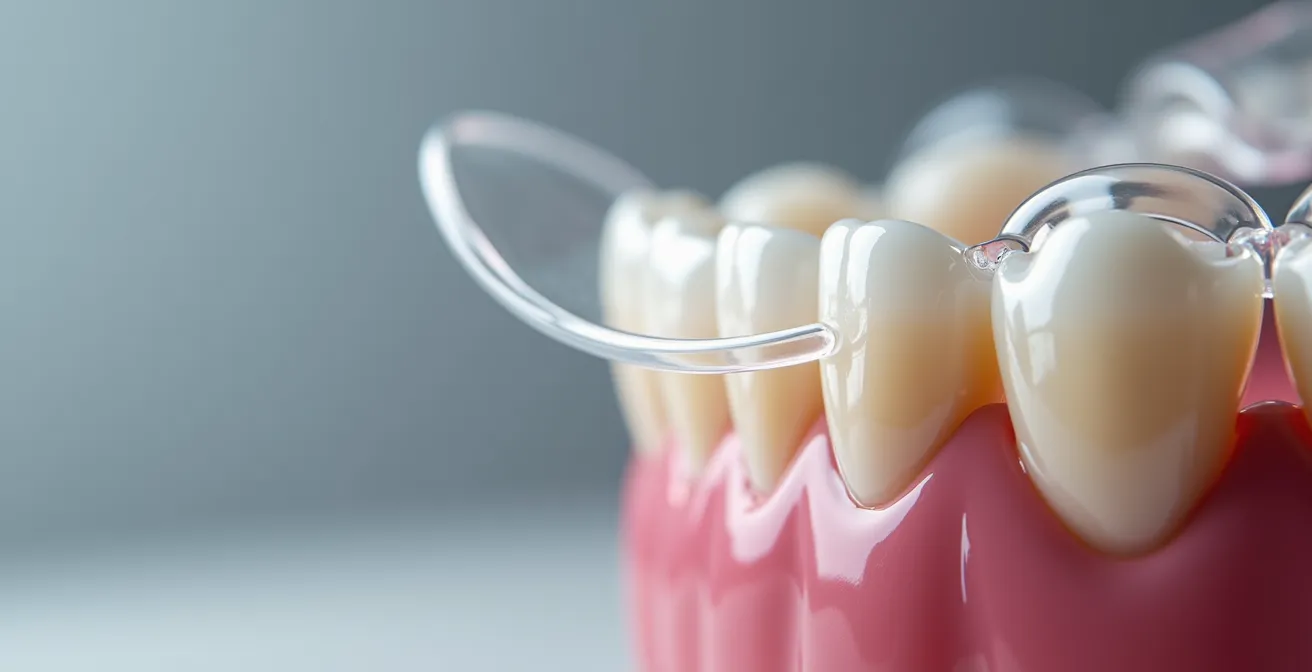
As you can see in this detailed view, the precision fit of the aligner over the attachment is what translates the aligner’s shape into targeted dental movement. It’s a system where every millimeter of the design is intentional. This level of planning is why a comprehensive 3D scan and a detailed treatment plan from your orthodontist are the non-negotiable first steps.
This sophisticated approach ensures that the right amount of pressure is applied at the right time, creating a healthier and more predictable path to your ideal smile than a one-size-fits-all approach.
Invisalign vs. Mail-Order Aligners: Which Is Safe for Complex Cases?
In the age of direct-to-consumer convenience, mail-order aligner companies have emerged, promising a cheaper and faster path to a straight smile without ever visiting a dentist’s office. For a busy professional, this can seem tempting. However, it’s crucial to understand the fundamental difference in the model of care, especially here in Quebec where patient protection is paramount. The core distinction lies in one word: clinical oversight.
Professional treatment with a system like Invisalign, administered by a licensed dentist or orthodontist in Montreal, begins with a comprehensive in-person examination. This includes X-rays to assess the health of your roots and jawbone, a full clinical evaluation of your bite (occlusion), and a precise 3D scan of your teeth. This data allows the professional to diagnose underlying issues that a simple at-home mold cannot detect, such as impacted teeth, bone loss, or TMJ problems. Attempting to move teeth without this information is not just risky; it can be dangerous.
The Ordre des dentistes du Québec (ODQ) has a clear mandate to protect the public, which is built on the foundation of professional supervision. As the ODQ itself states:
In Quebec, all professional orders are governed by the Professional Code, which entrusts them with the mandate of protecting the public
– Ordre des dentistes du Québec, ODQ Official Regulation Guidelines
This protection is absent in a remote model. The following table breaks down the critical differences in the standard of care, which an analysis by orthodontic associations confirms as essential for safe treatment.
| Aspect | Invisalign (Professional) | Mail-Order Aligners |
|---|---|---|
| Initial Examination | In-person clinical exam with X-rays | Self-administered impression kit |
| 3D Imaging | iTero scanner or professional impressions | Home impression or smartphone scan |
| Treatment Monitoring | Regular in-office checkups (6-8 weeks) | Remote photo monitoring |
| Emergency Support | Direct access to treating dentist | Online/phone support only |
| Quebec Compliance | Fully compliant with ODQ regulations | May bypass provincial oversight |
For any case beyond the most minor correction, and certainly for professionals who cannot afford complications or setbacks, the choice is clear. A professional partnership with a local Montreal dentist provides the safety, predictability, and accountability that a remote service simply cannot match.
The Little “Buttons” No One Tells You About Before Aligner Treatment
One of the biggest contributors to the gap between marketing and “treatment reality” is the existence of attachments. Often referred to as “buttons,” these are small, tooth-colored dots of dental composite bonded to specific teeth. While modern aligner marketing often shows flawless imagery of clear plastic on teeth, the truth is that up to 80% of cases require attachments to achieve the desired result. Their purpose is to act as anchors or handles, allowing the aligner to get the necessary grip to perform more complex movements like rotations, extrusions (pulling a tooth down), and providing anchorage.
While they are colored to match your enamel, they are not invisible. When your aligners are out for meals, the buttons are visible and can feel rough to your tongue and lips. This is often a surprise for patients who expected a completely smooth and invisible experience. The first week with attachments is an adjustment period. They can initially irritate the inside of your cheeks, and you may find removing and inserting your aligners more challenging. This is a normal part of the process, and your mouth quickly adapts.
It’s a testament to the technology’s effectiveness that Invisalign has been used to help millions. According to Align Technology, the company has treated over 17 million smiles, the vast majority of which utilized these crucial attachments to achieve a successful outcome. Your orthodontist will strategically place them to be as discreet as possible, but it’s essential to have a realistic expectation. They are a sign that your treatment is sophisticated and designed for a high-quality finish.
Your Action Plan for the First Week with Attachments
- Apply orthodontic wax to any specific attachment that is causing persistent irritation to the inside of your cheek or lip.
- Practice speaking by reading an article or book aloud for 15 minutes each day to help your tongue and lips adjust to the new shape.
- Start with a diet of soft foods (soups, yogurts, smoothies) for the first few days while you get used to the sensation of chewing with them.
- Use a soft-bristled toothbrush to carefully and gently clean around the attachments, where plaque is more likely to accumulate.
- If possible, schedule important client presentations or public speaking engagements for after the first week to ensure you feel fully confident.
Think of attachments not as a flaw in the “invisibility” promise, but as the engine of your treatment. They are the workhorses doing the heavy lifting, and understanding their role is key to embracing the process with confidence.
How High-Frequency Vibration Devices Can Cut Aligner Time by 30%?
For any professional, time is the most valuable commodity. The prospect of a 12 to 18-month orthodontic treatment can be daunting. This has led to the rise of accelerated orthodontics, with high-frequency vibration (HFV) devices being one of the most prominent technologies. These are small, C-shaped mouthpieces that you bite on for 5 to 20 minutes a day. The device generates gentle micro-vibrations that are transmitted through the teeth to the surrounding bone.
The scientific principle is based on increasing cellular activity. The vibrations are thought to stimulate the cells in the jawbone (osteoblasts and osteoclasts) that are responsible for remodeling bone tissue. This increased activity may allow teeth to move more quickly and efficiently through the bone. Some studies and clinical reports suggest this acceleration could potentially reduce overall treatment time. A comparative analysis shows that while modern clear aligner treatment typically takes 6-9 months for simpler cases, incorporating acceleration devices may shorten this timeline.
Beyond speed, a significant reported benefit is comfort. Many patients find that using an HFV device, particularly when switching to a new, tighter aligner tray, can significantly reduce the initial soreness. The vibrations can act as a sort of dental massage, soothing the ligaments around the teeth. These devices are designed for lifestyle integration, easily used while reading emails, watching TV, or during your morning commute in Montreal traffic.
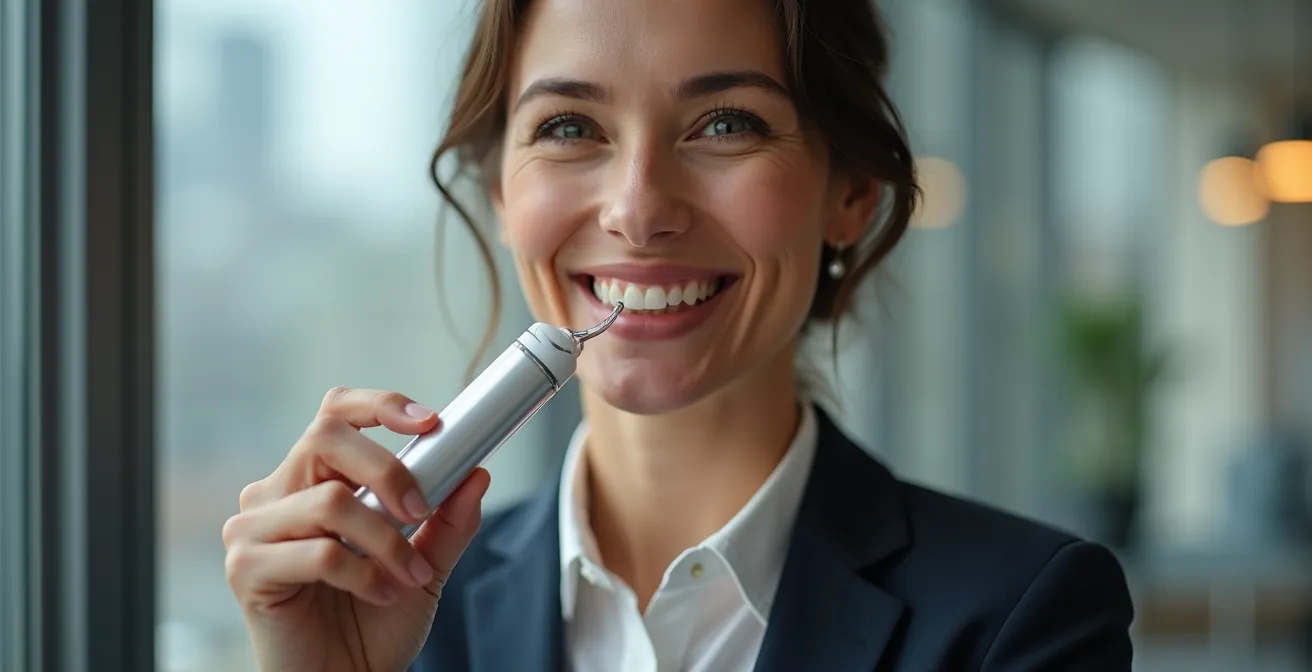
It’s important to approach this technology with realistic expectations. While many orthodontists offer it and patients report positive results, it’s not a magic wand. The effectiveness varies based on individual biology, case complexity, and, most importantly, patient compliance with both aligner wear and device usage. It should be considered an adjunct to treatment, not a replacement for the fundamental principles of biomechanics and consistent aligner wear.
Before investing, have a detailed conversation with your orthodontist about whether your specific case is likely to benefit from an HFV device and what level of acceleration you can realistically expect.
How to Keep Your Transparent Trays Odor-Free During a 12-Hour Workday?
There’s an unglamorous side to clear aligners that is rarely discussed: “aligner funk.” After wearing your trays for several hours, especially during a long workday filled with meetings and deadlines, you might notice an unpleasant odor or taste. This is a common concern, but it’s entirely manageable with the right hygiene protocol. Understanding the cause is the first step to preventing it.
The odor is not caused by trapped food particles, but by bacterial biofilm. Your mouth is a warm, moist environment, and the space between your teeth and the aligner is a perfect incubator for bacteria. As these bacteria multiply, they form a sticky, invisible film and release volatile sulfur compounds, which are responsible for the bad smell. A 12-hour workday without proper cleaning gives this biofilm ample time to develop.
The key to staying fresh is a disciplined routine. The absolute minimum is to rinse your aligners with cool water every single time you remove them. This prevents saliva from drying on the surface, which is a nutrient source for bacteria. Ideally, you should perform a more thorough cleaning at least once during your workday, perhaps during your lunch break. This involves brushing them gently with a soft-bristled toothbrush and a small amount of mild, clear soap. You must avoid abrasive toothpaste, as it will create micro-scratches on the aligner surface, making them dull and even more prone to bacterial buildup.
For a deep clean, most orthodontists recommend soaking the aligners once a day in specialized cleaning crystals or tablets. By integrating these simple habits into your daily professional life—a quick rinse here, a gentle brush there—you can easily keep your aligners truly invisible and odor-free, ensuring your confidence remains high from your first morning meeting to your last evening email.
What Qualifies a Dentist as a “Cosmetic Specialist” in Quebec?
When seeking a discreet orthodontic solution, you will often encounter the term “cosmetic dentist.” It’s important for patients in Quebec to understand that “Cosmetic Dentistry” is not a recognized specialty by the Ordre des dentistes du Québec (ODQ). The official dental specialties in Quebec are fields like Orthodontics, Periodontics, and Oral Surgery. Any general dentist can perform cosmetic procedures, including Invisalign, provided they are competent to do so.
So, how do you identify a truly qualified provider in Montreal? You must look beyond the marketing terms and vet their specific experience and training in clear aligner therapy. The ODQ ensures a baseline of safety for all dentists, noting that it “administers a professional inspection program developed by its Professional Inspection Committee” to ensure standards are met. However, true expertise in Invisalign is built upon that foundation through extensive post-graduate training and case experience.
A provider’s Invisalign Tier status (e.g., Preferred, Premier, or Diamond Provider) is a useful indicator. These tiers are awarded by Align Technology based on the number of cases a doctor completes each year. While a higher tier doesn’t automatically guarantee better results, it does demonstrate a significant level of experience and familiarity with the system. An experienced provider has likely encountered and successfully managed cases similar to yours, including any potential complications that may arise. When choosing your provider, you are choosing their brain and experience, not just the brand name.
To ensure you’re forming a true professional partnership, here are some key questions to ask during your consultation:
- How many Invisalign cases similar to mine in complexity have you completed?
- Can I see before-and-after photos of your actual patients, not the stock images from the company?
- What specific continuing education courses in clear aligner therapy and advanced biomechanics have you completed?
- What is your official Invisalign Provider Tier, and what does that mean in terms of case experience?
- What is your protocol if my treatment is not progressing as planned or needs a mid-course correction?
Ultimately, your best choice is a licensed dentist or orthodontist in Montreal who can demonstrate a substantial portfolio of successful Invisalign cases and who takes the time to answer your questions thoroughly, establishing a relationship built on transparency and trust.
Key takeaways
- Discreet adult orthodontics is less about the hardware and more about integrating a strict hygiene and wear routine into your professional life.
- The “invisibility” of clear aligners is nuanced; most treatments require visible “attachments” to achieve ideal results.
– In Quebec, choosing a provider requires looking past “cosmetic” labels and vetting their specific Invisalign experience and ODQ standing, prioritizing clinical oversight over remote, mail-order options.
Managing Your Coffee Habit with Aligners: A Pro’s Routine
We’ve established that drinking coffee with your aligners in is off-limits due to staining and warping risks. For the Montreal professional, the challenge isn’t *if* you should remove them, but *how* to do it efficiently within a packed schedule. This is where “lifestyle integration” moves from a concept to a practical, daily routine. The goal is to enjoy your coffee without significantly reducing your mandatory 22-hour wear time.
The first step is to shift your mindset from “sipping” to “scheduled consumption.” Instead of nursing a coffee at your desk for an hour, plan a dedicated 15-minute coffee break. During this time, you remove your aligners and store them properly in their case (never in a napkin!). Enjoy your coffee, and once finished, the next step is crucial: rinsing. Before reinserting your aligners, you must rinse your mouth thoroughly with water to wash away residual sugars, acids, and dark pigments.
If possible, a quick brush of your teeth is ideal, but a vigorous water rinse is a practical and effective alternative when you’re between meetings. It’s wise to carry a small “hygiene kit” with you, containing your aligner case, a travel toothbrush, and floss. Having this kit at your office makes the routine seamless. A critical point is to wait a few minutes after finishing your coffee before putting the aligners back in, allowing your mouth’s temperature to neutralize. This small habit provides an extra layer of protection against any potential for thermal distortion, however minor.
By transforming your coffee habit into a structured, mindful event, you can easily meet the demands of your treatment without sacrificing one of life’s simple pleasures. It’s a small adjustment that pays significant dividends for your final smile.
Frequently Asked Questions about Clear Aligner Hygiene
What causes ‘aligner funk’ during long work days?
Odor is primarily caused by bacterial biofilm buildup, not trapped food. Bacteria multiply in the warm, moist environment between aligners and teeth, producing sulfur compounds that create unpleasant odors.
How often should I clean my aligners during a workday?
Rinse aligners with cool water every time you remove them. Perform a thorough cleaning with a soft brush at lunch, and use cleaning crystals or approved solutions once daily.
Can I use regular toothpaste to clean my aligners?
No, avoid abrasive toothpaste which can scratch aligner surfaces, making them more prone to bacterial buildup and staining. Use mild soap or specialized aligner cleaning products instead.