The speed of a one-visit crown isn’t a compromise on quality; it’s the result of a digitally superior process that eliminates common sources of error.
- Monolithic ceramic blocks, milled from a single piece, offer immense strength without the weak points of traditional layered crowns.
- Digital scans are measured in microns, providing a far more precise and comfortable fit than conventional impression trays.
Recommendation: For busy Montrealers, the true value lies in a higher quality, better-fitting restoration achieved in a fraction of the time.
It’s a familiar, sinking feeling for any busy Montrealer: the dentist confirms you need a crown. Immediately, your mind races, calculating the disruption. Two, maybe three appointments. The uncomfortable, gooey impression tray. The fragile temporary crown you have to baby for weeks. And, of course, the multiple days off work, juggling your schedule and navigating downtown traffic or the STM metro system repeatedly.
The traditional solution has always been a multi-step, handcrafted process involving an outside dental lab. But what if the modern, faster alternative wasn’t about cutting corners, but about eliminating them entirely? What if the “quick” option was actually the more precise, durable, and reliable one? The conversation around one-visit dentistry often focuses on convenience, but this misses the fundamental point. The real story isn’t about speed; it’s about a shift from an analog craft to a process of digital integrity.
This isn’t about rushing the job. It’s about leveraging technology to achieve a superior result in a single, efficient session. The speed you experience is simply a by-product of a more controlled, predictable, and robust system. This article will deconstruct how this technology actually works, compare the strength of in-office versus lab-made crowns, and calculate the real, tangible value of getting it all done in one go—all from the perspective of a discerning Montreal patient.
To understand the full scope of this dental revolution, we will explore the key questions and comparisons that matter most to a patient concerned with both time and quality. The following sections break down every aspect of the one-visit crown process.
Summary : The Complete Guide to Single-Visit Crowns in Montreal
- Digital Impression vs. Gooey Tray: Which Fits Your Tooth Better?
- Are Lab-Made Crowns Stronger Than Those Milled in the Office?
- How Chairside Milling Reduces the Carbon Footprint of Your Crown?
- When Should You Still Choose a Hand-Layered Crown Over a Milled One?
- Calculating the Value of Not Taking a Second Day Off Work
- Can You Really Get a Permanent Crown in 2 Hours?
- Prep vs. No-Prep Veneers: Which One Looks More Natural?
- Calculating the Value of Not Taking a Second Day Off Work
Digital Impression vs. Gooey Tray: Which Fits Your Tooth Better?
The first point of failure in traditional crown-making is often the physical impression. For the patient, it’s an uncomfortable process involving a tray full of a gooey, putty-like material. For the dentist, it’s a process with variables: slight movements, saliva contamination, or material shrinkage can introduce inaccuracies. This is where one-visit dentistry introduces its first major quality upgrade: the digital scan. Instead of a physical mold, a small, handheld intraoral camera captures thousands of pictures of your tooth, creating a perfect 3D model on a computer screen.
This isn’t just about avoiding discomfort. It’s about achieving a level of micro-precision that is nearly impossible with physical putty. The accuracy is astounding; for example, CEREC technology achieves remarkable accuracy, often within 50 to 200 microns. For context, a human hair is about 70 microns thick. This digital integrity ensures the data sent to the milling machine is an exact replica of your tooth, leading to a crown that fits perfectly from the start. This eliminates the micro-gaps that can occur with traditional crowns, which are often the entry points for bacteria and future decay.
Many Montreal dental clinics, like Comfort Care Dental in the downtown core, have adopted this technology. They use state-of-the-art scanning that is not only faster and more comfortable but also provides the flawless data needed to design and manufacture a crown with a precise fit, right in the office. The result is a restoration that seals the tooth perfectly, promising better long-term health and stability.
Are Lab-Made Crowns Stronger Than Those Milled in the Office?
A common concern for skeptics is whether a crown made in two hours can possibly be as strong as one crafted over weeks in a lab. The answer lies in the material. A chairside-milled crown is created from a single, solid block of high-performance ceramic, like lithium disilicate. This concept of monolithic strength is key. Because it’s one uniform piece, there are no layers or joints, which are the traditional weak points in porcelain-fused-to-metal crowns. The block is industrially manufactured under ideal conditions, ensuring it has no internal stresses or imperfections.
The milling machine then carves your custom crown from this perfect block, retaining its inherent strength. Afterwards, the crown is fired in a specialized oven at over 900°C, a process which crystallizes the ceramic and gives it its final, formidable durability and natural-looking translucency. This material is exceptionally strong and is ideal for most applications, including front teeth and bicuspids, where aesthetics and strength are both critical.
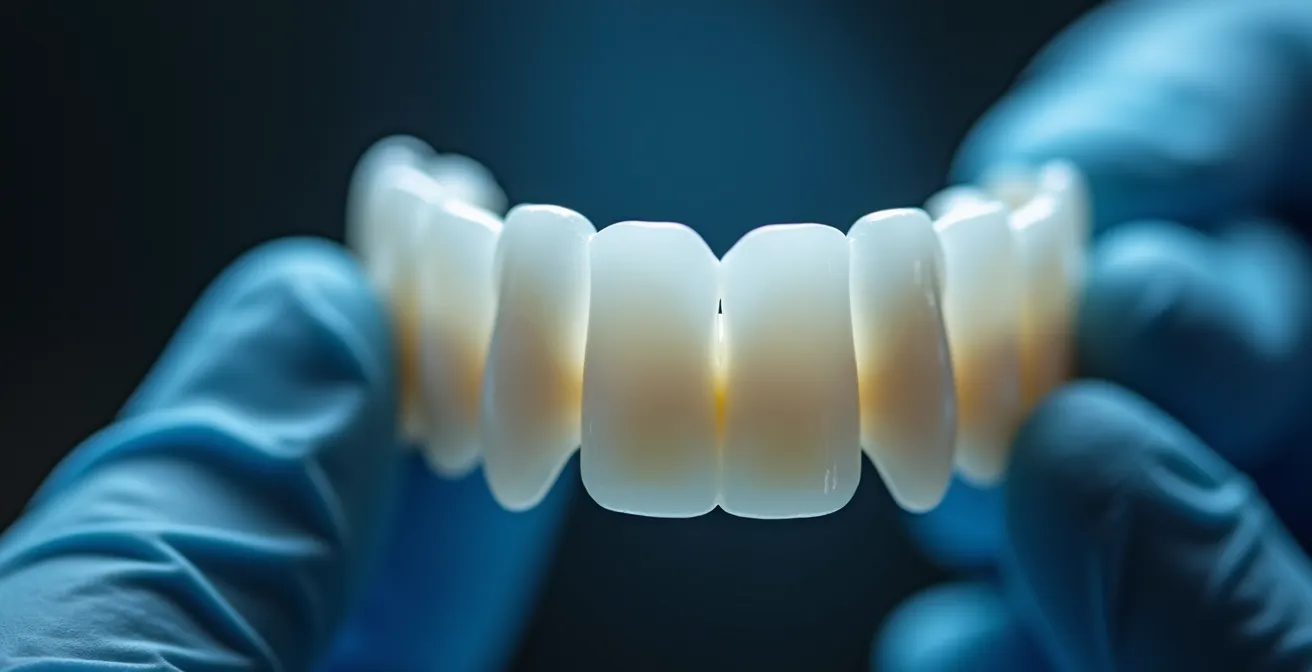
However, it is also true that different materials have different strengths. A dental lab has access to a wider range of materials, including monolithic zirconia, which boasts the highest strength and is often recommended for molars in patients who grind their teeth heavily. A good dentist will be transparent about these options.
| Crown Type | Material | Best Use Case | Durability |
|---|---|---|---|
| Monolithic Zirconia (Lab) | Zirconium Dioxide | Heavy grinders, molars | Highest strength |
| Layered Porcelain (Lab) | Porcelain-fused-to-metal | Balance of aesthetics and strength | Very high |
| Lithium Disilicate (Milled) | Glass ceramic | Front teeth, most daily use | High strength, excellent aesthetics |
The takeaway for the discerning patient is this: an in-office milled crown is incredibly strong and durable for most needs, thanks to its monolithic structure. For extreme cases, a lab-made zirconia crown might be recommended, but for the vast majority of restorations, the in-office option provides more than enough strength, with the added benefit of a perfect fit.
How Chairside Milling Reduces the Carbon Footprint of Your Crown?
In an age where sustainability is increasingly important, one-visit dentistry offers a surprising but significant environmental benefit. The traditional two-visit crown process generates a notable carbon footprint. It involves shipping a physical impression from your Montreal dental clinic to a lab (which could be across town or even out of province), the lab’s manufacturing process, and then shipping the final crown back to the clinic. More importantly, it requires two separate round trips for you, the patient.
This travel component is far from trivial. In fact, a study on the environmental impact of dental services has shown its significance. According to research from England’s NHS, an astonishing 64.5% of dental emissions come from patient and staff travel. By consolidating the entire crown procedure into a single appointment, chairside milling effectively halves the patient’s travel-related emissions for that treatment. No shipping of molds, no return trips for the patient—everything happens in one place.
This is a clear example of process efficiency creating a positive externality. The primary goal of the technology is clinical excellence and patient convenience, but the result is a greener, more sustainable dental restoration. For a patient in Montreal, this means one less car trip downtown or one less journey on the STM, contributing to a smaller personal carbon footprint. It’s a modern solution where superior technology and environmental responsibility go hand-in-hand.
When Should You Still Choose a Hand-Layered Crown Over a Milled One?
Enthusiasm for technology should not overshadow clinical honesty. While in-office milled crowns are a revolutionary solution for the vast majority of cases, there are specific situations where the artistry of a traditional lab-made crown remains the gold standard. A trustworthy dentist will be transparent about these exceptions, building confidence by prioritizing the best possible outcome over a single methodology. The most common scenario involves highly visible front teeth, especially a single central incisor.
A monolithic crown is milled from a block of a single, uniform shade. While it can be stained and glazed externally to mimic natural teeth, it cannot replicate the complex internal layers of color, opacity, and translucency that a natural tooth possesses. As the team at Montreal’s Centre Dentaire de Haute Technologie points out, true artistry is sometimes required.
For a highly visible front tooth, matching the unique translucency and color gradients of adjacent teeth may require the artistic touch of a master technician
– Centre Dentaire de Haute Technologie, Montreal CEREC Technology Center
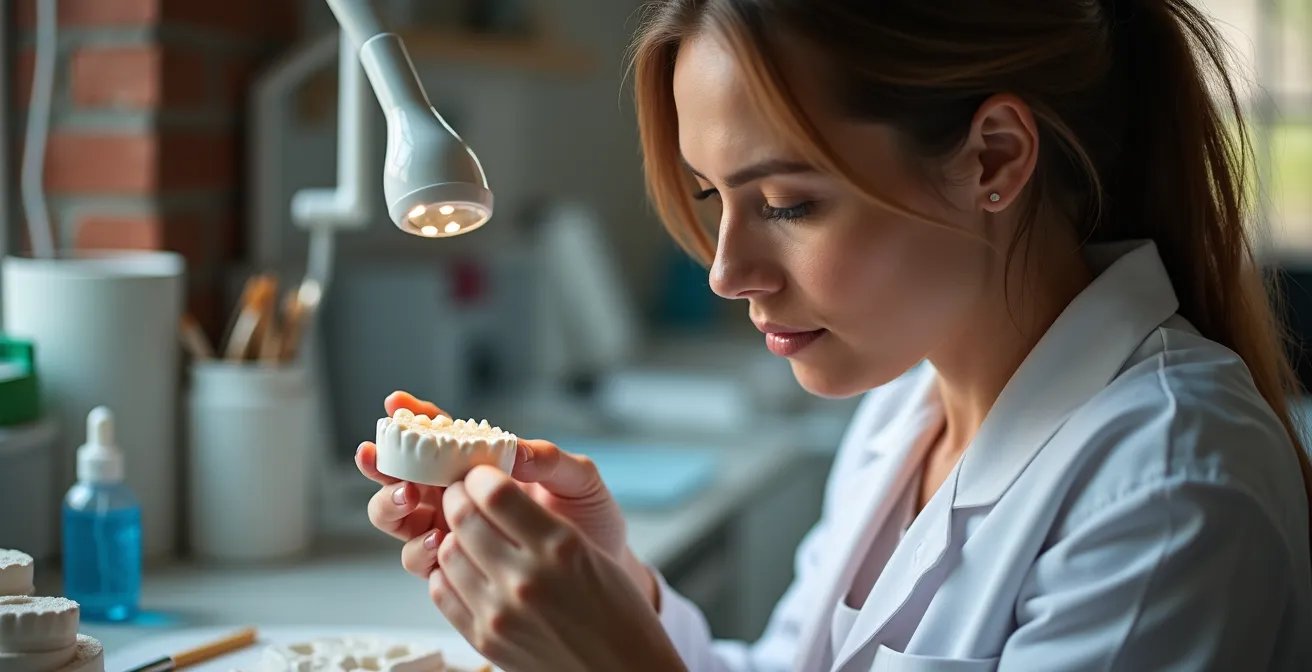
When a single front tooth must perfectly match its neighbours, a master dental technician can build a crown by hand, layer by layer, using different shades and types of porcelain to recreate the natural depth and character. This is a time-consuming artistic process that technology cannot yet fully replicate. Therefore, if the absolute highest level of aesthetic matching is the primary goal for a prominent tooth, a hand-layered crown from a specialized lab is often the superior choice. This honesty is the hallmark of a great clinician who uses technology as a powerful tool, not as the only tool in their kit.
Calculating the Value of Not Taking a Second Day Off Work
For a busy Montreal professional, time is more than just a convenience—it’s a quantifiable asset. The most obvious benefit of a one-visit crown is saving a follow-up appointment, but the true financial impact, or Calculated Value, is often underestimated. It goes far beyond the simple cost of the crown itself. Let’s break down the hidden costs of a traditional two-visit procedure that are completely eliminated by chairside milling technology.
First and foremost are lost wages. Taking two half-days off work isn’t just an inconvenience; it’s a direct financial loss for hourly workers, freelancers, or consultants. For salaried employees, it means using up valuable vacation or personal time. Then there are the logistical costs. Two round trips to a downtown dental clinic mean double the expense on gas and parking, or two separate STM fares. For parents, it could mean arranging and paying for childcare for two separate appointments. These “small” expenses add up quickly.
The following analysis, based on typical Montreal costs, illustrates the savings. While the initial price of a CEREC crown can sometimes be slightly higher than a traditional one, the total cost of ownership is often significantly lower once these external factors are considered.
| Cost Factor | Traditional Crown (2 visits) | CEREC Crown (1 visit) | Savings |
|---|---|---|---|
| Lost wages (Quebec avg hourly) | 16 hours | 3 hours | 13 hours saved |
| STM transit or parking | 2 trips downtown | 1 trip | $7-30 saved |
| Potential childcare | 2 appointments | 1 appointment | $60-120 saved |
| Temporary crown risks | 2-3 weeks exposure | None | Peace of mind |
This calculation doesn’t even include the non-financial “cost” of the mental load of scheduling and managing a second appointment. As confirmed by an overview of the CEREC process, the efficiency is a primary benefit for professionals and students alike, especially those at institutions like Ubisoft or McGill University during critical project deadlines or exam periods.
Can You Really Get a Permanent Crown in 2 Hours?
The claim of a permanent, high-quality crown in about two hours can sound too good to be true. It’s natural for a skeptic to wonder what’s being skipped or rushed. The reality is that nothing is rushed; the workflow is simply radically efficient. The time is saved by eliminating the dead-time and logistical hurdles of the traditional method (shipping, lab scheduling, temporary crowns). The entire clinical and manufacturing process happens in a seamless, digitally-driven sequence while you wait.
As local experts at Clinique dentaire Julien & Marin in Montreal explain, this efficiency is the core advantage. Their team emphasizes that one of the main benefits is the sheer speed of the integrated process.
One of the main advantages of CEREC is the speed of the process. You can have a complete dental restoration in just a few hours
– Clinique dentaire Julien & Marin, Montreal Dental Clinic CEREC Services
The process is methodical and precise, with each step flowing directly into the next. There is no guesswork and no waiting for an external lab. The patient can relax, read a book, or catch up on emails while the machine does the work. This streamlined efficiency is what makes a two-hour turnaround not just possible, but routine for clinics with this technology.
Your Action Plan: Understanding the 2-Hour Timeline
- 0-20 minutes: The dentist prepares the tooth and uses a digital camera to take a 3D scan. No gooey trays are involved.
- 20-25 minutes: The crown is designed on a computer using specialized CAD software, ensuring a perfect fit with adjacent and opposing teeth.
- 25-85 minutes: The design is sent to an in-office milling machine which carves the crown from a solid ceramic block. This is the longest step, during which the patient is free to relax.
- 85-105 minutes: The freshly milled crown is placed in a high-temperature oven for glazing, which gives it a natural luster and final strength. It then cools.
- 105-120 minutes: The dentist does a final fitting, makes any minor adjustments, and permanently bonds the crown to your tooth. You walk out with your final restoration.
Prep vs. No-Prep Veneers: Which One Looks More Natural?
While often discussed in the context of crowns, the precision of digital dentistry has profound implications for cosmetic procedures like veneers. A major concern for patients considering veneers is how much of their natural, healthy tooth structure will need to be removed. The goal is always to be as conservative as possible, and this is where digital precision offers a significant advantage, directly impacting how natural the final result looks.
Traditional “prep” veneers require the dentist to manually remove a layer of enamel to make space for the porcelain. The amount removed can vary. With “no-prep” veneers, the porcelain is bonded directly to the tooth surface, but this can sometimes result in a slightly bulkier or thicker appearance. Digital dentistry offers a powerful middle ground. Because the digital scans and milling process are so precise, the dentist can plan a minimal-prep veneer with incredible accuracy. This means removing the absolute minimum amount of enamel necessary for a perfect fit.
This level of control ensures the veneer sits flush with the gumline and doesn’t look bulky, achieving a highly natural aesthetic. For instance, digital accuracy allows for minimal tooth reduction, with only 0.5mm to 1mm of enamel removal required. This conserves the maximum amount of healthy tooth structure, which is a core principle of modern dentistry. This ethical approach is strongly supported by professional bodies like the ODQ (Ordre des dentistes du Québec), which prioritizes tooth preservation. The robotic grinding ensures an exceptionally precise fit, allowing for these more conservative preparations that look and feel more natural.
Key takeaways
- Digital precision isn’t just faster; it provides a demonstrably better fit than traditional methods, reducing risks of future decay.
- Monolithic strength from a single ceramic block makes in-office crowns incredibly durable for most dental needs without the weak points of layered materials.
- The true value for a busy professional is the calculated saving of not just time, but also lost wages, transit costs, and the risks of a temporary crown.
Calculating the Value of Not Taking a Second Day Off Work
We’ve quantified the direct financial savings of a single-visit crown, but the value proposition for a discerning patient goes deeper. The Calculated Value also includes the elimination of clinical risks and mental burdens associated with the traditional, drawn-out process. The two-to-three-week period spent wearing a temporary crown is not a benign waiting game. It’s a period of vulnerability for the prepared tooth.
Temporary crowns are affixed with weak cement by design, so they can be easily removed. This means they can also come loose or fall out at inconvenient times—during a meal, over a weekend, or before an important meeting. When this happens, the exposed, prepared tooth is sensitive and susceptible to bacterial invasion, potentially compromising the success of the final restoration. Furthermore, an ill-fitting temporary can irritate the gums or affect your bite, causing discomfort for weeks. One-visit dentistry completely eliminates this entire period of risk and uncertainty.
You walk out of the clinic with the permanent, perfectly sealed, and fully functional crown. There’s no “babysitting” a temporary restoration, no dietary restrictions, and no nagging worry that it might pop off. For a busy Montreal professional, this peace of mind is an invaluable part of the equation. It’s the freedom to immediately return to your life without a second thought. This isn’t just about saving time; it’s about buying back certainty and eliminating a source of stress from your life.
For any busy Montrealer skeptical of “fast” solutions, the evidence is clear: one-visit dentistry is not a shortcut. It is a more intelligent, precise, and efficient path to a high-quality dental restoration. To see if your case is a candidate for this superior technology, the next logical step is to schedule a consultation with a local Montreal dentist equipped with a chairside milling system.