
In summary:
- A root canal is a mechanical cleaning; antibiotics only manage pre-op swelling and cannot cure the infection alone.
- Your first 24 hours are critical. Proactively manage inflammation with ice packs and stick to a soft-food diet to prevent pain and speed up healing.
- The treated tooth is brittle. A dental crown is mandatory for back teeth (molars) to prevent fracture and ensure long-term success.
- Modern Montreal clinics offer “one-visit dentistry” using CEREC technology, allowing you to get your root canal and permanent crown in a single appointment.
The phrase “root canal” often brings a wave of anxiety, followed by practical concerns, especially for a busy professional. How much will it hurt? How much time off work will I need? The common advice is to simply rest, take painkillers, and wait. But for someone who needs to be sharp and back in a Montreal office the next day, passive waiting isn’t a strategy. You need a proactive plan to ensure a swift and uncomplicated recovery.
The key to transforming a week of potential discomfort into a 24-hour non-event isn’t a secret—it’s about understanding the process and taking control. It involves actively managing inflammation from the moment you leave the dental chair and protecting the mechanical integrity of your treated tooth. This isn’t just about avoiding pain; it’s about creating the optimal healing micro-environment in your mouth to get you back on your feet faster.
This guide demystifies the entire journey from a practical, post-operative care perspective. We’ll break down what a root canal actually is, why pre-treatment antibiotics aren’t a cure, what to expect during the procedure, and the critical decisions you’ll need to make afterward. By the end, you will have a clear, actionable roadmap for a 24-hour recovery, empowering you to return to your routine with confidence.
This article will walk you through the essential knowledge needed for a smooth recovery. Explore the sections below to understand each step of the process, from initial treatment to long-term care.
Summary: A Practical Guide to Root Canal Recovery
- Why Antibiotics Alone Will Never Cure an Infected Tooth Nerve?
- What Actually Happens During the 90 Minutes of a Root Canal Treatment?
- Crown or Filling: Which One Must Follow a Root Canal to Prevent Fracture?
- Normal Tenderness vs. Failed Treatment: How to Tell the Difference?
- Root Canal vs. Implant: Which Is the Better Long-Term Investment for Your Molar?
- How Does “One-Visit Dentistry” Actually Work in Montreal Clinics?
- Why Can You Only Use Prescription Mouthwash for Two Weeks?
- Crown or Filling: Which One Must Follow a Root Canal to Prevent Fracture?
Why Antibiotics Alone Will Never Cure an Infected Tooth Nerve?
When you have a throbbing toothache, it’s natural to hope a course of antibiotics will solve the problem. However, it’s crucial to understand their role and limitations. Your dentist in Montreal may prescribe antibiotics like Amoxicillin before a root canal, but this is a strategic move to manage symptoms, not a cure. The goal is to reduce acute swelling and inflammation, which serves two purposes: it makes you more comfortable and, more importantly, it allows the local anesthetic to work more effectively during the procedure.
The core of the issue is anatomical. The infection is located inside the pulp chamber—a sealed-off space within your tooth containing the nerve and blood vessels. Once the nerve tissue dies (becomes necrotic), the blood supply is cut off. Antibiotics travel through your bloodstream, so they simply cannot reach the source of the infection inside this sealed chamber. They can only fight the infection that has spread to the surrounding bone and gums, which is what causes the visible swelling and much of the pain.
Think of it like a splinter in your finger. Antibiotics might calm the red, swollen area around it, but the splinter itself—the source of irritation—must be physically removed. The same principle applies here. As demonstrated by the high success rates at specialized Montreal dental clinics, the definitive solution is always the mechanical cleaning of the root canals to physically remove the infected and dead pulp. Taking antibiotics provides a temporary window of relief, but the infection will inevitably return if the source isn’t eliminated through endodontic therapy.
What Actually Happens During the 90 Minutes of a Root Canal Treatment?
One of the biggest sources of anxiety is the unknown. Knowing exactly what will happen in the dental chair can significantly reduce stress and help you feel in control. A modern root canal treatment in a well-equipped Montreal clinic is a precise, and typically painless, procedure. According to local dental clinic data, a straightforward root canal can often be completed in a single appointment, generally lasting about 60-90 minutes.
The environment is designed for precision and comfort. Many clinics now use advanced technology like dental microscopes, which allow the endodontist to see the intricate canal system of your tooth with incredible detail, ensuring a thorough cleaning.

As you can see in the image of a modern operatory, the focus is on technology and a calm environment. The procedure itself is a highly structured process designed to remove the infection and seal the tooth from further invasion. For a patient, understanding the timeline and sensations can be very reassuring.
To demystify the experience, here is a step-by-step breakdown of what you can expect during those 90 minutes. The sensations described are typical and do not involve pain once the anesthetic has taken effect.
| Time Frame | Procedure Step | Patient Experience |
|---|---|---|
| 0-10 minutes | Local anesthesia (Articaine) and rubber dam placement | Slight pinch, then numbness sets in |
| 10-15 minutes | Creating access cavity in tooth | Vibration sensation, no pain |
| 15-60 minutes | Cleaning and shaping canals with rotary files | Quiet whirring sound, mild pressure |
| 60-75 minutes | Irrigation and disinfection of canals | Taste of antiseptic solution |
| 75-90 minutes | Filling canals with gutta-percha and temporary restoration | Warm sensation as material is placed |
Crown or Filling: Which One Must Follow a Root Canal to Prevent Fracture?
After the root canal is complete, the tooth is no longer infected, but it’s also fundamentally changed. A root canal procedure involves removing the pulp, which contains the tooth’s nerves and blood supply. Without this internal hydration and nutrition, the tooth becomes brittle and is at a significantly higher risk of fracture. This is the concept of bio-mechanical compromise. Therefore, the choice of restoration isn’t just cosmetic; it’s a structural necessity to protect your investment.
For anterior (front) teeth, which are used for cutting and experience less force, a large composite filling may sometimes be sufficient. However, for posterior teeth like molars and premolars, which handle immense chewing forces, a dental crown is almost always mandatory. A filling simply plugs the access hole, but a crown covers the entire tooth like a helmet, holding it together and distributing biting forces evenly to prevent it from cracking. A fractured root-canaled tooth often leads to extraction, negating the entire purpose of the initial treatment.
In Quebec, insurance providers like Sun Life, Desjardins, and Manulife typically categorize fillings as ‘basic’ procedures with high coverage, while crowns are considered ‘major restorative’ with lower coverage (often around 50%). While the upfront cost of a crown is higher, it is the only way to ensure the long-term survival of a molar after a root canal. In Canada, a single crown serves as vital support and aims to restore the tooth’s original shape and function, with the cost for a crown typically ranging from $700 to $1,200 or more.
This table breaks down the typical costs you might encounter in Montreal, helping you make an informed financial decision.
| Treatment Option | Montreal Cost Range | Insurance Coverage | Best For |
|---|---|---|---|
| Large Composite Filling | $300-$500 | Basic coverage (80-100%) | Front teeth only |
| Porcelain Crown | $700-$1,200 | Major restorative (50%) | Older option, less aesthetic |
| Zirconia/E-Max Crown | $1,500-$2,500 | Major restorative (50%) | Molars – superior strength |
Normal Tenderness vs. Failed Treatment: How to Tell the Difference?
In the first 24-48 hours after your root canal, it’s normal to experience some mild discomfort. This isn’t a sign of failure but rather the body’s natural response to a dental procedure. The ligaments holding your tooth in place may be slightly inflamed, and the gum tissue around the tooth might be tender from the rubber dam clamp. This is normal post-operative tenderness and should be easily managed with over-the-counter anti-inflammatories like Ibuprofen (Advil) and should steadily decrease over a few days.
However, you must be vigilant and know the warning signs that could indicate a complication or a failed treatment. While rare, issues can arise. The key is to differentiate between expected healing and a red flag that requires a call to your dentist.
- Normal Healing Signs: Mild, dull ache or tenderness around the tooth, especially when chewing. Sensitivity in the gum tissue. This discomfort peaks in the first day or two and then gradually fades.
- Warning Signs of a Problem: Severe, throbbing, or persistent pain that is not relieved by medication or gets worse after three days. Visible swelling in the gums or face that reappears. The formation of a small “pimple” on the gum near the tooth root (a fistula), which indicates a persistent infection. A bad taste or odor from the area.
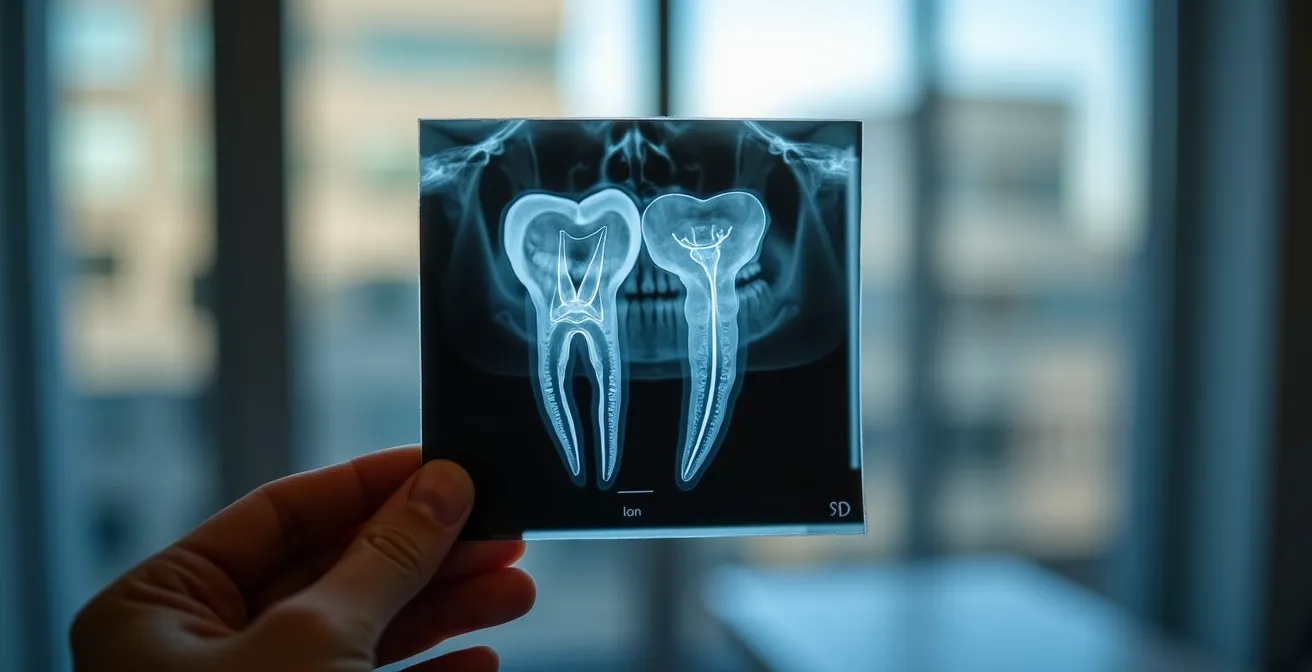
Your dentist will ultimately confirm the success of the treatment with follow-up appointments and dental X-rays. These radiographs allow them to see the bone healing around the root tip, providing definitive proof that the infection has resolved and the procedure was successful.
Root Canal vs. Implant: Which Is the Better Long-Term Investment for Your Molar?
Sometimes, if a tooth is severely damaged, you might be faced with a choice: try to save it with a root canal and crown, or extract it and replace it with a dental implant. From a biological and functional perspective, the priority is almost always to preserve your natural tooth whenever possible. Nothing functions quite like your own tooth, and a root canal is a procedure designed to do just that. However, this decision also has a significant financial component that must be considered as a long-term investment in your oral health.
The cost and process for each path are very different. A root canal is often performed by a general dentist or an endodontist, a specialist in root canal treatments. As Olympia Benefits Canada notes in their analysis:
Cost varies by provider and also on whether the procedure is performed by a specialist (endodontist) or typical dentist. Endodontists are specialists in root canal treatments but typically charge 20-40% more. Your dentist may not have the resources for the procedure and refer you to an endodontist anyway.
– Olympia Benefits Canada, Root Canal Treatment Cost Analysis
The implant route is a multi-stage process involving an oral surgeon for the extraction and implant placement, followed by your general dentist for the final crown. This often results in a higher initial cost and a longer treatment timeline. The following table provides a 10-year cost projection to help illustrate the financial differences in the Montreal context.
| Treatment Path | Initial Cost | 10-Year Maintenance | Total Investment |
|---|---|---|---|
| Root Canal + Crown | $2,000-$3,300 | Possible retreatment: $1,000 | $3,000-$4,300 |
| Extraction + Implant + Crown | $3,500-$5,000 | Crown replacement: $1,500 | $5,000-$6,500 |
| Specialists Involved | General dentist or endodontist | Oral surgeon + general dentist | – |
While an implant is an excellent replacement for a missing tooth, saving your natural tooth root with a root canal is typically the more conservative and cost-effective initial approach, preserving the natural bone and alignment of your jaw.
How Does “One-Visit Dentistry” Actually Work in Montreal Clinics?
For a busy worker, the traditional multi-appointment process for a root canal and crown can be a logistical challenge. The great news is that modern dental technology has created a solution: one-visit dentistry. Several advanced clinics in Montreal are now equipped with in-office CAD/CAM (Computer-Aided Design and Computer-Aided Manufacturing) systems, most notably CEREC technology. This technology allows your dentist to complete the root canal and fabricate and place your final, permanent crown in a single, extended appointment.
The process is remarkably efficient. After your root canal is finished, instead of taking a messy impression and placing a temporary crown, your dentist uses a digital scanner to create a 3D model of your tooth. This model is sent to an in-office milling machine, which carves your custom crown from a solid block of high-strength ceramic or zirconia while you wait. The crown is then bonded into place, and you leave the clinic with a fully restored tooth. As noted by Smile Montreal, a local clinic using this technology, patients can get root canal treatment and a custom dental crown in the same appointment.
This approach saves you multiple trips to the dentist, eliminates the need for a fragile temporary crown, and allows you to get back to your life immediately with a permanent solution. However, not every patient or tooth is a candidate. It’s best for cases without large, active infections. To find out if this is an option for you, it’s essential to ask the right questions.
Your Action Plan: Questions to Ask Your Montreal Dentist About One-Visit Treatment
- Do you have an in-house CAD/CAM milling machine (like CEREC or Planmeca)?
- What material will my one-visit crown be made of (e.g., ceramic, zirconia)?
- Am I a good candidate based on my X-ray (is there no large, active infection)?
- How long will the single appointment take (typically 2-3 hours)?
- What is the success rate of this method compared to traditional multi-visit treatments?
- Is there an additional cost for the convenience of same-day crown fabrication?
Why Can You Only Use Prescription Mouthwash for Two Weeks?
Following a dental procedure, your dentist might prescribe a medicated mouthwash, most commonly one containing Chlorhexidine. This is a powerful antiseptic designed to kill bacteria and help your gums heal. However, the instruction is always firm: use it for no more than two weeks. This strict time limit is in place due to the rinse’s high potency and potential side effects.
Chlorhexidine is effective because it works at a very high concentration. To achieve its antibacterial benefits, it must contain at least 1,200 parts per million of the active ingredient. This potency is a double-edged sword. While it eliminates harmful bacteria that could cause an infection, it is not selective. It also kills the beneficial bacteria that are essential for a healthy oral microbiome, the balanced ecosystem in your mouth. Prolonged use can disrupt this balance, potentially leading to other issues like oral thrush.
The most common and noticeable side effect is extrinsic staining. Chlorhexidine can bind to the surfaces of your teeth, tongue, and existing dental work, causing a brown discoloration. While these are surface stains that can be removed with a professional dental cleaning and certain whitening toothpastes, they can be cosmetically unappealing. The two-week prescription period is carefully calculated to be just long enough for your gums to recover and get a “fresh start” without causing significant long-term disruption or staining. After this period, for long-term maintenance, your dentist or local Montreal pharmacist at Jean Coutu or Pharmaprix can recommend effective, non-staining, alcohol-free alternatives.
Key takeaways
- Antibiotics are a temporary tool to manage pre-operative swelling; only the physical removal of infected tissue during a root canal provides a permanent cure.
- A root-canaled tooth is brittle and requires protection. For molars, a full-coverage dental crown is a structural necessity, not an optional upgrade.
- The key to a 24-hour recovery lies in proactive care: use ice packs to control inflammation, adhere strictly to a soft diet, and maintain meticulous but gentle oral hygiene.
Crown or Filling: Which One Must Follow a Root Canal to Prevent Fracture?
We’ve come full circle, and it’s essential to revisit this critical decision, as it is the single most important factor in the long-term success of your root canal treatment. After navigating the procedure and the immediate recovery, the final restoration is what protects your tooth—and your financial investment—for years to come. Making the wrong choice here can lead to a catastrophic failure: a fractured tooth that requires extraction.
Let’s be unequivocally clear, as your post-op care guide: if the treated tooth is a molar or premolar, a filling is not an adequate long-term solution. These teeth bear the brunt of your chewing forces, and the hollowed-out, brittle structure of a root-canaled tooth simply cannot withstand that pressure without external reinforcement. A filling only plugs the access hole; it does nothing to bind the remaining tooth structure together.
A dental crown, on the other hand, acts as a protective helmet. It encases the tooth, absorbing and distributing the biting forces safely across the entire structure. This prevents the cusps from flexing and eventually cracking under pressure. Choosing a crown is choosing durability. It is the final, non-negotiable step in completing the treatment and ensuring your tooth can function normally for a decade or more. While the upfront cost is higher, the cost of not getting a crown—a potential extraction, implant, and years of further dental work—is exponentially greater.
To ensure the long-term success of your treatment and protect your investment, the next logical step is to have a detailed discussion with your Montreal dentist about the optimal final restoration plan for your specific tooth.