
Restoring worn teeth is not just about fixing what’s broken; it’s about addressing the systemic imbalances—like a misaligned bite or silent acid reflux—that are the root cause of the problem.
- Chronic issues like headaches or digestive problems are often directly linked to the progressive breakdown of your bite.
- Modern conservative treatments like onlays can preserve more of your natural tooth than traditional crowns, preventing future complications.
Recommendation: The first step is a comprehensive diagnosis to identify the underlying cause, allowing for a phased treatment plan that can be strategically aligned with your annual insurance benefits.
For years, you’ve noticed your teeth are not what they used to be. They look shorter, feel sensitive, and chewing certain foods has become a challenge rather than a pleasure. You might even be experiencing new, seemingly unrelated issues like persistent headaches or indigestion. The common advice is to look into veneers or crowns, often presented as a purely cosmetic “smile makeover.” This approach focuses on patching the symptoms but completely misses the bigger picture.
The wear and tear on your teeth is rarely just a simple consequence of aging. More often, it’s a visible sign of a deeper, systemic imbalance. It could be the result of a misaligned bite creating destructive forces every time you close your mouth, or it might be caused by silent acid reflux slowly eroding your enamel while you sleep. These are the silent saboteurs that a simple cosmetic fix will never address, leading to repeated failures and escalating costs down the road.
But what if the true solution wasn’t just to cover up the damage, but to rebuild your dental function from the foundation up? The key is to shift our perspective from simple repair to systemic restoration. It’s about understanding the “why” behind the wear. This approach doesn’t just give you a smile that looks good; it restores occlusal harmony, eliminates associated pain, and gives you back the quality of life you’ve been missing—the simple joy of eating a meal without a second thought.
This guide will walk you through this comprehensive approach. We will explore the hidden causes of tooth wear, compare modern restorative options that preserve your natural teeth, and provide a clear, strategic framework for undertaking a full-mouth reconstruction, all within the context of the Montreal and Canadian healthcare system. You will learn how to turn an overwhelming problem into a manageable, phased plan that restores not just your teeth, but your overall well-being.
Summary: A Strategic Guide to Rebuilding Your Bite and Function
- Why Acid Reflux Is Destroying Your Back Teeth Without You Noticing?
- How Fixing Your Bite Alignment Can Stop Your Chronic Headaches?
- Onlay or Crown: Which Preserves More of Your Natural Tooth Structure?
- The Domino Effect: How One Broken Tooth Shifts Your Entire Jaw Balance
- When to Start Major Restoration Work to Maximize Your Annual Benefits?
- Why Ignoring a Misaligned Bite Can Cause Migraines in Your 40s?
- Where to Start When You Need to Fix Every Single Tooth?
- The Domino Effect: How One Broken Tooth Shifts Your Entire Jaw Balance
Why Acid Reflux Is Destroying Your Back Teeth Without You Noticing?
One of the most insidious causes of tooth wear, especially on the back molars, is something that often goes completely unnoticed: silent acid reflux. Unlike classic heartburn, Gastroesophageal Reflux Disease (GERD) can occur without obvious symptoms, particularly at night. While you sleep, small amounts of stomach acid can travel up the esophagus and into your mouth, creating a highly acidic environment. This acid is far more corrosive than anything you eat or drink, and it systematically dissolves the hard enamel of your teeth.
Your back teeth are particularly vulnerable because of their position and anatomy. The chewing surfaces of molars have natural grooves and pits, which trap the acid, allowing it to demineralize the tooth structure for extended periods. Over months and years, this leads to a characteristic pattern of erosion known as “cupping,” where the inner dentin layer becomes exposed and wears away faster than the surrounding enamel. You may only notice increased sensitivity or that your fillings seem to be “rising” out of your teeth, when in fact the tooth around them is dissolving.
A skilled restorative dentist is often the first line of defense in identifying this silent condition. The specific pattern of erosion is a tell-tale sign that points towards a medical issue, not just a dental one. In Montreal, this diagnostic partnership is critical; an astute dentist can be instrumental in getting you the right medical care. A case in point involves the established protocol where dentists in Quebec, upon identifying these specific acid erosion patterns, refer patients for a medical consultation, which is covered by the Régie de l’assurance maladie du Québec (RAMQ). This allows for a proper GERD diagnosis and medical treatment to stop the source of the acid, which is the essential first step before any dental restoration can be successful and long-lasting.
How Fixing Your Bite Alignment Can Stop Your Chronic Headaches?
If you suffer from chronic headaches, jaw pain, or even migraines, you may have sought numerous medical opinions without finding a definitive cause. The answer, surprisingly, could be hiding in your mouth. A misaligned bite, or “malocclusion,” creates a state of systemic imbalance. When your teeth don’t meet correctly, your jaw muscles are forced into a constant state of strain to find a comfortable resting position. This hyperactivity puts immense pressure on the temporomandibular joint (TMJ), the complex hinge connecting your jaw to your skull.
This constant muscle tension doesn’t stay confined to your jaw. It radiates outwards, leading to tension headaches that often wrap around your head, neck pain, and even pain behind the eyes. For many patients, what they assume are stress or sinus headaches are actually the direct result of their occlusal disharmony. Your body is trying to compensate for an imbalanced foundation, and the muscles are paying the price. This is especially true for patients over 50, as decades of minor tooth wear can accumulate to create a significant, function-altering misalignment.
The good news is that modern dentistry offers precise diagnostic tools to resolve this. Technologies like the T-SCAN digitally map out the force and timing of your bite with an accuracy that was previously impossible. This allows a specialist to see exactly where the destructive interferences are. Many patients who have suffered for years from TMJ disorders and migraines find lasting relief through targeted treatments. This can range from a simple procedure called equilibration, where the bite is minutely adjusted, to the creation of a custom oral appliance that helps the jaw rest in a relaxed, harmonious position. By restoring occlusal harmony, we are not just fixing teeth; we are turning off the source of chronic pain and giving you back your comfort and quality of life.
Onlay or Crown: Which Preserves More of Your Natural Tooth Structure?
When a tooth is significantly worn down or damaged, the conversation often turns to placing a dental crown. A crown is a reliable restoration that covers the entire tooth like a cap, protecting it from further fracture. However, preparing a tooth for a crown requires significant removal of its natural structure, even the healthy parts. In an era where the guiding principle of restorative dentistry is to be as conservative as possible, there is often a better alternative: the porcelain onlay.
Think of an onlay as a partial crown. Instead of covering the whole tooth, it is custom-fabricated in a lab to precisely fit over only the damaged or worn-away portion, much like a puzzle piece. This approach allows the dentist to preserve the maximum amount of healthy, natural tooth structure. By bonding the ceramic onlay to the tooth, we not only restore its shape and function but also strengthen the remaining structure. This conservative philosophy is critical for long-term oral health, as every millimeter of preserved tooth is valuable capital for the future.
The image below provides a clear visual comparison: on the left, a tooth prepared for an onlay with minimal alteration, and on the right, the more aggressive preparation required for a traditional crown.
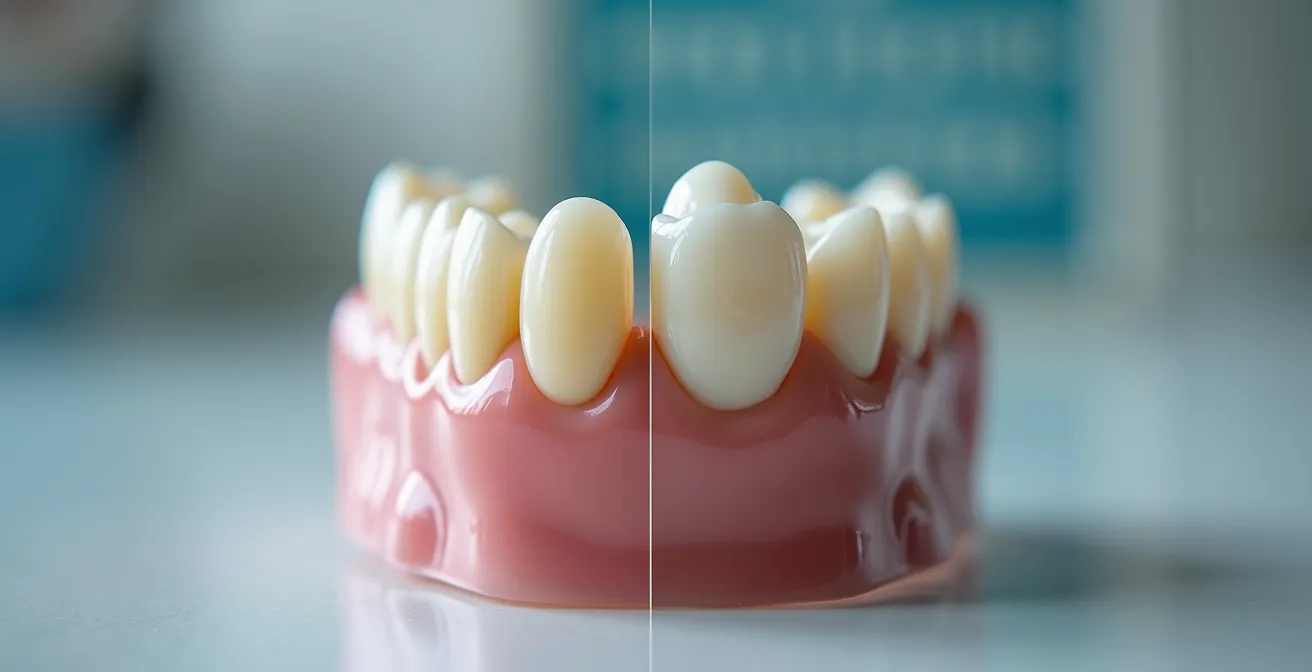
From a financial and longevity perspective, the choice becomes even more compelling. Both options offer excellent durability, but the onlay’s conservative nature can reduce the risk of future complications that might lead to root canals or even tooth loss. The following table, based on Canadian dental fee guides, outlines the key differences.
This data highlights that for a similar investment, the onlay offers a significantly more conservative approach, as detailed in a recent cost analysis based on the Ontario Dental Association (ODA) fee guide.
| Treatment | Cost Range (CAD) | Tooth Structure Preserved | Longevity |
|---|---|---|---|
| Porcelain Onlay | $1,349 | Maximum preservation | 10-15 years |
| Dental Crown | $1,349-$1,449 | Requires more removal | 10-15 years |
| Future Implant Risk | $5,000+ if tooth fails | N/A | Lifetime with care |
The Domino Effect: How One Broken Tooth Shifts Your Entire Jaw Balance
Ignoring a single broken or severely worn tooth might seem like a manageable issue, but in the complex ecosystem of your mouth, it’s like removing a keystone from an arch. This one missing piece triggers a cascade of negative consequences known as the “domino effect,” which can shift your entire jaw balance and lead to far more complex and expensive problems down the road. The process begins subtly but accelerates over time, turning a single-tooth problem into a full-mouth crisis.
First, the teeth adjacent to the gap will begin to drift and tilt into the empty space, disrupting the alignment of your entire arch. This creates new food traps and makes cleaning more difficult, increasing your risk of decay and gum disease in those teeth. More significantly, the opposing tooth—the one that used to bite against the damaged one—loses its counterpart. With nothing to stop it, this tooth will begin to “super-erupt,” or slowly emerge further from the gum line. This elongation throws your entire bite out of alignment, creating destructive interferences and placing excessive force on other teeth.
This chain reaction is precisely why early intervention is so critical. A comprehensive analysis of treatment costs shows that what starts as a single-tooth issue can quickly escalate. The investment for a single crown to protect a vulnerable tooth is manageable, but failing to act can lead to a cascade of failures requiring multiple crowns, orthodontic correction, or even implants. In Quebec, financial data clearly illustrates this risk: restoring one tooth might cost between $1,500 and $2,500, whereas letting the domino effect play out can result in a comprehensive restoration case costing upwards of $10,000 due to the cascade failure. Dental crowns serve to protect teeth from this very scenario, preventing the shift of adjacent teeth and the super-eruption of opposing ones, thereby averting the need for a much larger reconstruction.
When to Start Major Restoration Work to Maximize Your Annual Benefits?
One of the biggest hurdles for patients considering a major dental restoration is the perceived cost. The thought of a large, upfront expense can be paralyzing, causing many to delay necessary treatment. However, with strategic planning, you can leverage your Canadian dental insurance benefits to make the process significantly more manageable. The key is to think in terms of “financial phasing,” aligning your treatment timeline with your insurance policy’s annual maximums.
Most Canadian dental plans operate on a calendar year, with your benefits resetting every January 1st. This creates a powerful strategic opportunity at the end of the year. By starting the process in November or December, you can use your current year’s benefits for all the diagnostic and preparatory work. This includes consultations, X-rays, models, and even the placement of temporary restorations. Then, once January arrives, your annual maximum is renewed, and you can immediately proceed with the major restorative work, like the placement of permanent crowns or onlays, using your fresh benefits.
This approach effectively allows you to double your available coverage for a single course of treatment by splitting it across two benefit years. Furthermore, many insurance plans in Canada, such as those from providers like Canada Life, cover 50-80% of major restorative procedures deemed medically necessary. Understanding these details is crucial, as the average cost of a single crown can vary. Current pricing data indicates an average of $900-$1,500 across Canada, depending on the province and materials used. A well-planned timeline, coordinated with your dental office, can transform an overwhelming expense into a predictable and affordable investment in your health.
Your Action Plan: Maximizing Annual Dental Benefits in Canada
- Phase 1 (November-December): Submit pre-treatment estimates to your insurer to verify coverage eligibility and remaining benefits for major dental work.
- Phase 2 (December): Complete all diagnostic and preparatory work, such as exams, X-rays, and impressions, using your current year’s benefit maximum.
- Phase 3 (January): Begin the main restorative procedures (e.g., crown placement) as soon as your new annual maximum becomes available. Note that many plans have a 5-year replacement clause for crowns.
- Phase 4 (Throughout Treatment): Ensure all procedures are correctly coded as medically necessary to leverage the typical 50-80% insurance coverage for major dental services.

Why Ignoring a Misaligned Bite Can Cause Migraines in Your 40s?
For many people in their 20s and 30s, a slightly misaligned bite or a habit of grinding their teeth (bruxism) might not cause any significant symptoms. The body’s adaptive capacity is high, and the muscles and joints can often compensate for minor imbalances without causing overt pain. However, as you enter your 40s and 50s, this delicate balance can break down. This is the stage of life where “bite decompensation” often occurs, and previously silent issues can suddenly manifest as debilitating migraines and chronic facial pain.
The reason for this shift is cumulative. Decades of subtle, uneven forces from a misaligned bite have slowly worn down specific teeth, strained ligaments, and forced the jaw muscles into a state of chronic fatigue. The cartilage disc within the temporomandibular joint (TMJ), which once cushioned the joint’s movement, may have become displaced or damaged. At this point, your body’s ability to compensate is exhausted. The constant strain on the jaw muscles begins to trigger referral pain, which the brain interprets as a migraine, a tension headache, or even sinus pain.
Many patients are frustrated because they’ve never had these problems before and don’t connect them to their dental health. They seek treatment for the migraines themselves, without addressing the underlying structural cause. The solution lies in a thorough occlusal analysis to identify and correct the bite imbalances that are at the root of the problem. Re-establishing a stable, harmonious bite allows the overworked muscles to finally relax, which can dramatically reduce or even eliminate the frequency and intensity of migraines. It’s not about masking the pain; it’s about removing the trigger, restoring balance, and addressing a problem that has been decades in the making.
Where to Start When You Need to Fix Every Single Tooth?
The thought of needing to fix every tooth can be incredibly overwhelming. It feels like a monumental task, both clinically and financially. The key to making it manageable is to have a clear, prioritized framework. A full-mouth reconstruction is not a single event; it’s a carefully staged journey. The starting point is always a comprehensive diagnosis, which forms the blueprint for everything that follows. This initial phase goes far beyond a standard check-up and includes a detailed examination, digital X-rays, a professional cleaning, and precise models and photographs of your teeth.
Once this complete picture is established, the next stage is to create a “trial smile.” Using the models of your teeth, your dentist will build a wax-up, showing you the proposed final outcome. This isn’t just for aesthetic approval; it’s a functional prototype. From this wax-up, temporary crowns or restorations are made and placed in your mouth. This is a critical evaluation period where you get to “test drive” your new bite. You can assess the comfort, function, and appearance, and any necessary adjustments can be made before the final restorations are created. This ensures there are no surprises and that the final result meets your functional needs perfectly.
With the blueprint finalized, the treatment is sequenced. The priority is to establish a stable foundation. This often means addressing any missing teeth first, typically with dental implants or bridges. A basic implant procedure, including the surgical placement and crown, can be a significant investment, with data from Ontario’s fee guide suggesting a starting cost of around $4,165. After the foundation is secure, the remaining teeth are restored in a series of appointments. A full smile makeover can often be completed in as few as two main appointments, though the entire process can take around six months if implants are involved to allow for proper healing. This phased approach turns an overwhelming project into a logical, step-by-step process toward renewed health and function.
Key Takeaways
- Restoring worn teeth is a health intervention, not just a cosmetic fix, addressing root causes like bite misalignment and acid reflux.
- Delaying treatment for a single damaged tooth can trigger a “domino effect,” leading to more complex and costly full-mouth problems.
- Strategic financial phasing, aligned with Canadian annual insurance benefit cycles, can make comprehensive restorative work much more affordable.
The Domino Effect: How One Broken Tooth Shifts Your Entire Jaw Balance
We’ve discussed the physical “domino effect”—how one failing tooth can cause others to shift, tilt, and over-erupt, destabilizing your entire bite. But the consequences of this chain reaction extend far beyond the mechanics of your jaw. The most significant impact is on your quality of life. As chewing function diminishes, your dietary choices become restricted. You start avoiding crunchy vegetables, hearty breads, and nutritious nuts, not by choice, but by necessity. This can lead to nutritional deficiencies and digestive issues, as food is not being properly broken down.
The social and emotional toll is just as profound. You may feel self-conscious when dining out with friends or family, carefully selecting the softest items on the menu or cutting food into tiny pieces. The simple pleasure of sharing a meal can become a source of anxiety. Chronic pain from an imbalanced bite, such as headaches or jaw soreness, can drain your energy and affect your mood, creating a constant, low-grade source of stress in your life. This is the true domino effect: a dental problem that cascades into a nutritional, social, and emotional crisis.
Viewing restoration through this lens changes everything. Investing in rebuilding your bite is not an expense; it’s a direct investment in your overall health, well-being, and daily happiness. It’s about regaining the freedom to eat what you love, the confidence to smile without hesitation, and the comfort of a life free from chronic dental-related pain. Breaking the chain reaction means restoring not just your teeth, but your ability to fully engage with and enjoy your life.
To begin the journey of reclaiming your comfort, function, and quality of life, the next logical step is to schedule a comprehensive diagnostic consultation to understand the root cause of your dental wear and create a personalized, phased treatment plan.