
Choosing an implant dentist in Montreal for a high-stakes procedure isn’t about finding the best price; it’s about verifying true specialist credentials and technological capacity.
- Verify specialist designations like “Periodontist” or “Prosthodontist” directly on the Ordre des dentistes du Québec (ODQ) website.
- Demand an on-site CBCT scanner for precise surgical planning, as it’s a key indicator of a modern, safety-focused practice.
Recommendation: Treat a clinic’s warranty details and their ‘Smile Gallery’ not as marketing, but as the first pieces of evidence in your investigation.
Committing to a dental implant procedure, often a five-figure investment in your health and confidence, is a significant decision. The anxiety is real, and the stakes in a city like Montreal, with hundreds of dental clinics, are high. Standard advice often feels flimsy: “read reviews,” “check their website,” “ask for a consultation.” While not wrong, this approach is dangerously superficial for a complex surgical procedure. It treats a life-altering decision like choosing a new restaurant, leaving patients vulnerable to slick marketing over proven substance.
Many patients don’t realize that while any general dentist can legally place an implant, not all have the specialized surgical training to manage complex cases or, more importantly, to handle complications when they arise. The common advice overlooks the critical nuances of a true forensic vetting process. It fails to teach you how to discern an authentic patient photo from a generic stock image, how to decode a warranty document, or how to use Quebec’s own professional order as your most powerful verification tool.
But what if the key wasn’t just to ask questions, but to become an empowered investigator of your own care? This guide shifts the power dynamic. It provides a forensic framework to move beyond surface-level impressions and scrutinize the three pillars of a top-tier implant practice: verified credentials, advanced technology, and transparent policies. We will dissect the difference between a generalist and a specialist, analyze visual “proof” with a critical eye, and understand the real protections available to you as a patient in Quebec.
This article will guide you through a systematic vetting process. You will learn to identify the specific qualifications to look for, the technological non-negotiables to demand, and the red flags to watch out for. By the end, you will have a clear, actionable checklist to make your decision with the confidence of a well-informed advocate for your own health.
Summary: A Forensic Guide to Choosing Your Montreal Implant Dentist
- Periodontist vs. General Dentist: Who Should Place Your Implant?
- Red Flags to Look for in a Clinic’s “Smile Gallery” Photos?
- Does Your Montreal Clinic Offer a Warranty on Implant Failures?
- Why You Should Ask if the Clinic Has an On-Site CT Scanner?
- How to Spot Fake Reviews for Montreal Dental Clinics?
- Are Dental Implants a Safe Option for Seniors Over 70 in Montreal?
- How Does the Order of Dentists Protect You If a Treatment Goes Wrong?
- Periodontist vs. General Dentist: Who Should Place Your Implant?
Periodontist vs. General Dentist: Who Should Place Your Implant?
The most crucial question in your investigation is not “Can this dentist place implants?” but “Who is the most qualified person to place my implants?” In Quebec, any licensed dentist can perform implant surgery. However, this does not mean all dentists possess the same level of training or experience, especially when it comes to complex cases or managing complications. The gold standard for implant surgery lies with dental specialists who have completed years of additional, university-based education in surgical procedures.
The two main specialists for implant placement are Periodontists (experts in gums and the bone supporting the teeth) and Prosthodontists (experts in tooth replacement and restoration). These professionals have dedicated their advanced training to the art and science of surgery and rehabilitation. As Dr. Barry Dolman, President of the Ordre des dentistes du Québec, highlights, specialists have the most comprehensive background. He states that just as endodontists are specialists in root canals, “periodontists and maxillofacial surgeons are specialists with the most comprehensive background in implant surgery and related complications.” This distinction is not just academic; it translates to a deeper understanding of tissue healing, bone grafting, and managing unforeseen challenges during surgery.
A general dentist may be perfectly capable of placing a straightforward, single implant. However, for full-arch restorations, cases requiring bone grafts, or patients with underlying health conditions, a specialist’s expertise is a critical form of risk management. Your first step as an investigator is to verify these credentials directly. Do not rely solely on the clinic’s website; use the official channels provided by Quebec’s regulatory body.
Your Action Plan: Verifying Specialist Credentials in Quebec
- Identify Points of Contact: Navigate directly to the Ordre des dentistes du Québec (ODQ) public member directory at odq.qc.ca. This is your primary, unbiased source of truth.
- Collect Data: Use the “Find a dentist” tool to search for the practitioner’s full name. Collect the official profile information provided.
- Ensure Coherence: Cross-reference the clinic’s marketing claims with the ODQ profile. Look specifically for the official designation “Specialist in Periodontics” or “Specialist in Prosthodontics.” A general dentist will not have this.
- Verify Good Standing: Scrutinize the profile for any mentions of current limitations, disciplinary actions, or suspensions on their right to practice. An unblemished record is a key indicator of professionalism.
- Finalize Your Integration Plan: Check for any additional listed credentials, such as specific advanced implant training programs or fellowships. This completes your initial vetting of the practitioner’s qualifications.
Red Flags to Look for in a Clinic’s “Smile Gallery” Photos?
A clinic’s “Smile Gallery” is presented as a portfolio of success, but for an investigator, it’s a crucial piece of evidence to be analyzed with skepticism. Authentic before-and-after photos are valuable, but many galleries are filled with generic stock photography or overly edited images that misrepresent a dentist’s actual work. Learning to spot the difference is key to assessing a surgeon’s aesthetic and technical skill.
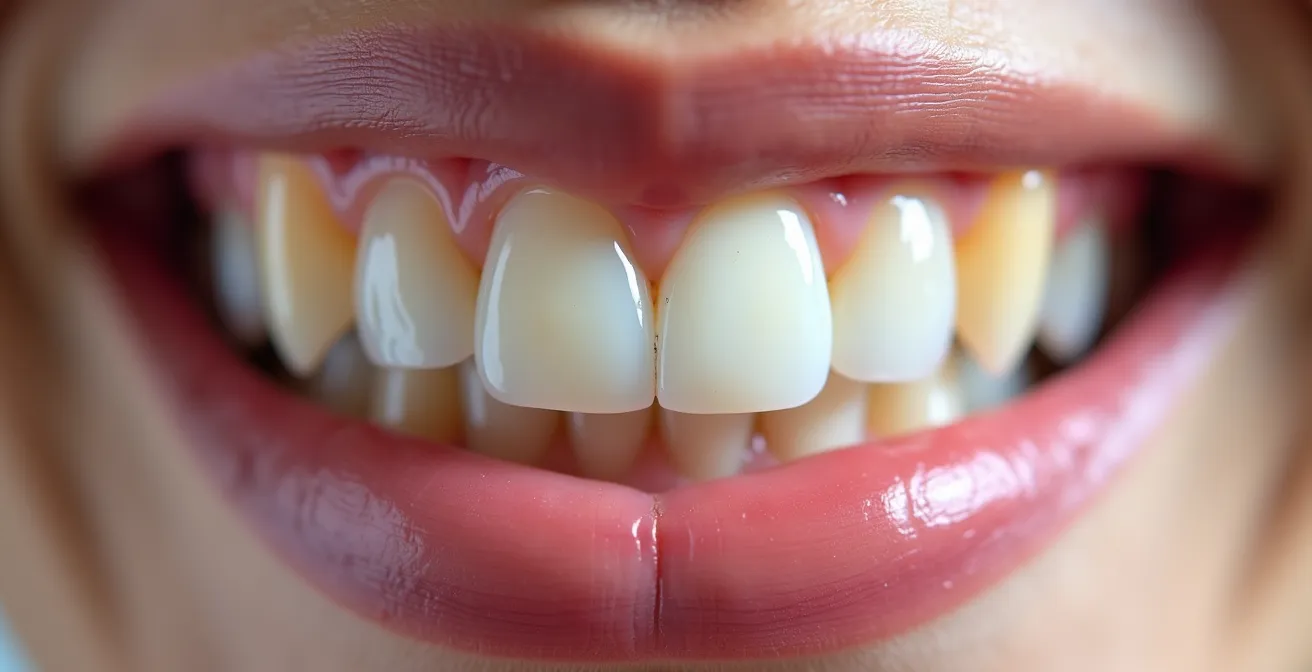
The first red flag is perfection and uniformity. A gallery where every “after” smile is identically bright white, with perfectly symmetrical teeth and no sign of natural gum tissue variation, is suspicious. Real human mouths have subtle imperfections. Authentic results show healthy but natural-looking gums, with the gentle scalloped architecture of the gingiva around each tooth. Look for consistency in lighting and angle between the before and after shots of the same patient; major changes suggest manipulation. Conversely, a gallery that shows a variety of cases—different ages, different challenges, different lighting—screams authenticity.
As the split view above illustrates, genuine transformations preserve the natural gum contours and individual character of a smile. This is the mark of true craftsmanship. Top-tier clinics in Montreal demonstrate this transparently. For instance, an analysis of highly-rated Montreal dentists shows that practitioners like Dr. Mohamad Mawlawi, who trained at the renowned Misch International Implant Institute, maintain comprehensive galleries. Their cases feature consistent documentation standards, varied patient scenarios, and sometimes even long-term follow-ups, showcasing the stability of their work over time. This level of detail provides far more assurance than a gallery of flawless, anonymous smiles.
Does Your Montreal Clinic Offer a Warranty on Implant Failures?
A warranty on a dental implant is more than a simple guarantee; it’s a litmus test for a clinic’s confidence in their materials, their technique, and their long-term commitment to your health. However, the term “warranty” can be misleading. As a patient investigator, you must dissect the policy to understand what is truly covered, for how long, and under what conditions. In Quebec, the rules are specific: according to the Ordre des dentistes du Québec (ODQ), dentists cannot legally offer an absolute guarantee on dental care, as treatment success hinges on many biological factors unique to each patient.
Therefore, you must differentiate between two types of warranties. First is the manufacturer’s warranty, which typically comes from implant companies like Straumann or Nobel Biocare. This often provides lifetime coverage on the implant screw itself if it breaks or has a defect. The second, and more critical, is the clinic’s warranty. This covers the dentist’s labour and the prosthetic components, like the crown or bridge placed on top of the implant. This coverage is usually for a limited period, often 5 to 10 years, and is contingent upon you following a strict maintenance protocol, such as attending mandatory annual check-ups.
Be wary of vague promises. A trustworthy clinic will provide a written document clearly outlining the terms, conditions, and voiding factors (e.g., smoking, poor hygiene). The cost structure can also be revealing. A clinic that bundles costs may be harder to evaluate than one that itemizes the implant, abutment, and crown separately, as shown in the comparative data for Montreal clinics.
The following table provides a glimpse into the typical costs and warranty structures you might encounter in Montreal, helping you benchmark the offers you receive. Notice the variability, which underscores the need to get specifics in writing from any clinic you consider. A transparent clinic will have no issue providing this detail.
| Clinic Type | Implant Cost (CAD) | Crown Cost (CAD) | Total Package | Typical Warranty |
|---|---|---|---|---|
| Signature Dentaire Montreal | $2,603 | $2,421 | $5,024 | Manufacturer warranty on implant |
| General Montreal Range | $1,000-$5,000 | Varies | Varies | 5-10 years on crown |
| Aoude Dental Center | $1,600 average | Not specified | From $3,300 | Clinic-specific terms |
Why You Should Ask if the Clinic Has an On-Site CT Scanner?
In modern implant dentistry, precise planning is the bedrock of a successful outcome. While traditional 2D X-rays were once the standard, they provide a limited, flat view of your jaw. This is akin to planning a major construction project with a simple sketch instead of a detailed 3D blueprint. The modern gold standard for implant planning is Cone Beam Computed Tomography, or a CBCT scanner. The presence of an on-site CBCT scanner is one of the single most important technological arbitrators you can use to vet a clinic.
A CBCT scan generates a high-resolution, 3D image of your jawbone, nerves, and sinus cavities. This allows the surgeon to measure bone density, width, and height with sub-millimeter accuracy. They can virtually place the implant on a computer screen, selecting the perfect size, angle, and position to avoid critical structures like nerves and to ensure maximum stability. This meticulous planning dramatically reduces the risk of surgical complications and implant failure. The difference is not trivial; an important 2024 study on dental implant planning found that 7% of surgeries using traditional X-rays alone were unexpectedly aborted mid-procedure due to unforeseen anatomical issues that a CBCT scan would have revealed.

A clinic that has invested in an on-site CBCT scanner is making a clear statement about its commitment to patient safety and surgical precision. It means they are not taking shortcuts by referring you out to an imaging center, a process that can delay treatment and lead to a disconnect in planning. Asking “Do you have an on-site CBCT scanner for implant planning?” is a simple but powerful question. A “yes” indicates a modern, technologically advanced practice. A “no” should be considered a significant red flag in your investigation, especially for a complex or high-cost procedure.
How to Spot Fake Reviews for Montreal Dental Clinics?
Online reviews are the modern-day word-of-mouth, but the digital landscape is rife with fabricated testimonials designed to mislead prospective patients. As an investigator, you cannot take Google or RateMDs reviews at face value. You must learn to perform a digital footprint analysis to separate genuine patient feedback from coordinated marketing campaigns. Authentic reviews have a distinct texture that fakes can rarely replicate.
Your first step is to look for suspicious patterns. A sudden burst of dozens of 5-star reviews in a single week is a major red flag. Real reviews trickle in over time. Secondly, analyze the reviewer’s profile. Click on their name. A genuine Montreal patient will likely have reviewed other local businesses—a restaurant in the Plateau, a shop on Saint-Catherine Street, a park in Westmount. A profile with only one review (for that dental clinic) is highly suspect. Also, pay attention to the language. Genuine reviews from Quebecers often contain unique linguistic markers, such as French phrases or references to local landmarks, that paid reviewers from overseas wouldn’t know. The tone is another giveaway; authentic reviews often mention small, specific details—the friendliness of the receptionist, the punctuality of the appointment, or a brief, conversational comment. As one authentic review for a Montreal clinic states:
I went there for the first time to do an Implant and felt like i was a client for so many years!
– Verified Patient, Aoude Dental Center
This brief, slightly imperfect, and emotionally resonant feedback feels far more real than a polished, generic paragraph praising “professionalism and great service.” To conduct a thorough check, use a multi-platform approach. Cross-reference Google reviews with a dedicated medical review site like RateMDs.ca. Do the review counts and ratings align? Significant discrepancies are cause for concern. Finally, check if the clinic is a verified member of professional associations like the Ordre des dentistes du Québec (ODQ) and the Association des chirurgiens dentistes du Québec (ACDQ), as clinics committed to professional standards are less likely to engage in deceptive practices.
Are Dental Implants a Safe Option for Seniors Over 70 in Montreal?
Age itself is not a barrier to receiving dental implants. A healthy person in their 80s can be a better candidate than a younger person with significant health issues. For seniors in Montreal considering this life-changing treatment, the vetting process simply requires an added layer of scrutiny focused on overall health, bone quality, and the dentist’s experience with geriatric patients. The key is not the patient’s chronological age, but their physiological health.
A trustworthy dentist will conduct a thorough medical history review before proceeding. Certain conditions must be well-managed. For example, Montreal’s Clinique MFML, which has extensive experience with senior implant cases, emphasizes that contraindications include uncontrolled diabetes and excessive smoking, as these severely impair healing. The clinic’s protocol for seniors involves close collaboration with the patient’s family doctor (*médecin de famille*) to ensure the patient is healthy enough for surgery. It is also important to note that while Quebec’s public health insurance (RAMQ) does not cover the implant surgery itself, some associated consultations or examinations may be covered for eligible seniors.
Bone density, which can decrease with age, is another critical factor. This is where a CBCT scan becomes indispensable for senior patients. According to the Canadian Dental Care Standards from 123Dentist, a leading network, “A trustworthy dentist will use a CBCT scan to objectively measure bone quality and will discuss specific protocols for older patients, such as longer healing times or using implants with specially treated surfaces” to promote better integration with the bone. A dentist who dismisses age-related concerns or skips a detailed 3D scan is not a safe choice. Look for a practitioner who demonstrates a clear, tailored protocol for older adults, ensuring a safe and predictable outcome for patients over 70.
Key Takeaways
- True expertise lies with specialists; verify “Periodontist” or “Prosthodontist” credentials on the ODQ website.
- An on-site CBCT scanner is a non-negotiable sign of a modern clinic committed to surgical precision and safety.
- Authentic “Smile Galleries” show variety and natural imperfections, unlike uniform stock photos. Scrutinize all visual claims.
How Does the Order of Dentists Protect You If a Treatment Goes Wrong?
Even with the most thorough vetting, complications can occur. In Quebec, patients have a powerful safety net: the Ordre des dentistes du Québec (ODQ). The ODQ is not just a licensing body; it is a public protection organization with a mandate to ensure dentists adhere to high ethical and professional standards. Understanding its role is the final piece of your investigation, providing peace of mind that a system of accountability is in place.
The ODQ regulates the practice of the more than 5,430 dentists in Quebec, giving it significant oversight. If you believe your treatment was substandard or that a dentist acted unethically, your recourse is through the Office of the Syndic (inquiry office) at the ODQ. It’s crucial to understand the Syndic’s role: their primary mission is to investigate potential breaches of professional conduct and to protect the public. They do not award financial compensation for damages. For monetary claims, you would typically need to pursue civil litigation or contact the Fonds d’assurance responsabilité professionnelle de l’ODQ (the professional liability insurance fund).

The process begins with trying to resolve the issue directly with your dentist. If that fails, you can submit a formal inquiry to the Syndic. You will need to provide all evidence, including treatment records and correspondence. The Syndic will then conduct an investigation. If a fault is found, the consequences for the dentist can range from a recommendation for further training to a formal disciplinary hearing. Knowing this process exists provides a powerful backstop. It ensures that the professionals you entrust with your care are held to an enforceable standard, which is the ultimate form of patient protection.
Periodontist vs. General Dentist: Who Should Place Your Implant?
We’ve established the difference in qualifications, but it’s crucial to revisit this topic from a risk management perspective. Choosing between a generalist and a specialist for a high-stakes implant procedure is fundamentally a decision about managing complexity and potential complications. A general dentist may have taken weekend courses on implant placement, but a periodontist or prosthodontist has completed an additional 2-3 years of full-time, university-based surgical and restorative training. This is not just more education; it’s a deep immersion into the very fabric of what makes implant surgery successful or fail.
This advanced training focuses heavily on complication management. What happens if a nerve is closer than anticipated? What if the bone quality is poorer than expected? What is the protocol if an infection develops post-surgery? A specialist’s training is designed around answering these difficult questions. They spend years studying the biology of bone healing, advanced grafting techniques, and managing the soft tissue (gums) for optimal long-term health and aesthetics. A generalist’s experience may be limited to straightforward cases, leaving them less equipped to handle the unexpected turns a complex surgical procedure can take.
Think of it like this: a general family doctor can set a simple fracture, but for complex reconstructive surgery on a joint, you would unequivocally seek out an orthopedic surgeon. The same logic applies with profound force to dental implants. The financial investment and the impact on your quality of life are too significant to settle for anything less than the highest level of specialized training. The choice to go with a specialist is the most important proactive step you can take to minimize risk and ensure your procedure is not just completed, but masterfully executed with a long-term vision for health and stability.
Start your vetting process today. Use this guide not as a simple list of questions, but as an investigator’s framework to ensure your health and significant investment are placed in the hands of a true, verifiable Montreal implant specialist.
Frequently Asked Questions about How to Verify a Montreal Dentist’s Implant Credentials Before Booking?
Can dentists in Quebec legally guarantee their implant work?
According to the ODQ, dentists cannot offer absolute guarantees on dental care as treatment success depends on many factors beyond their control. Each person responds differently to treatments.
What’s the difference between manufacturer and clinic warranties?
Manufacturer warranties (like Straumann or Nobel) typically cover the implant screw itself for lifetime, while clinic warranties cover the crown and labor, usually for 5-10 years.
What typically voids an implant warranty?
Common warranty voidance factors include smoking, poor oral hygiene, missing mandatory annual check-ups, or not following post-operative care instructions.