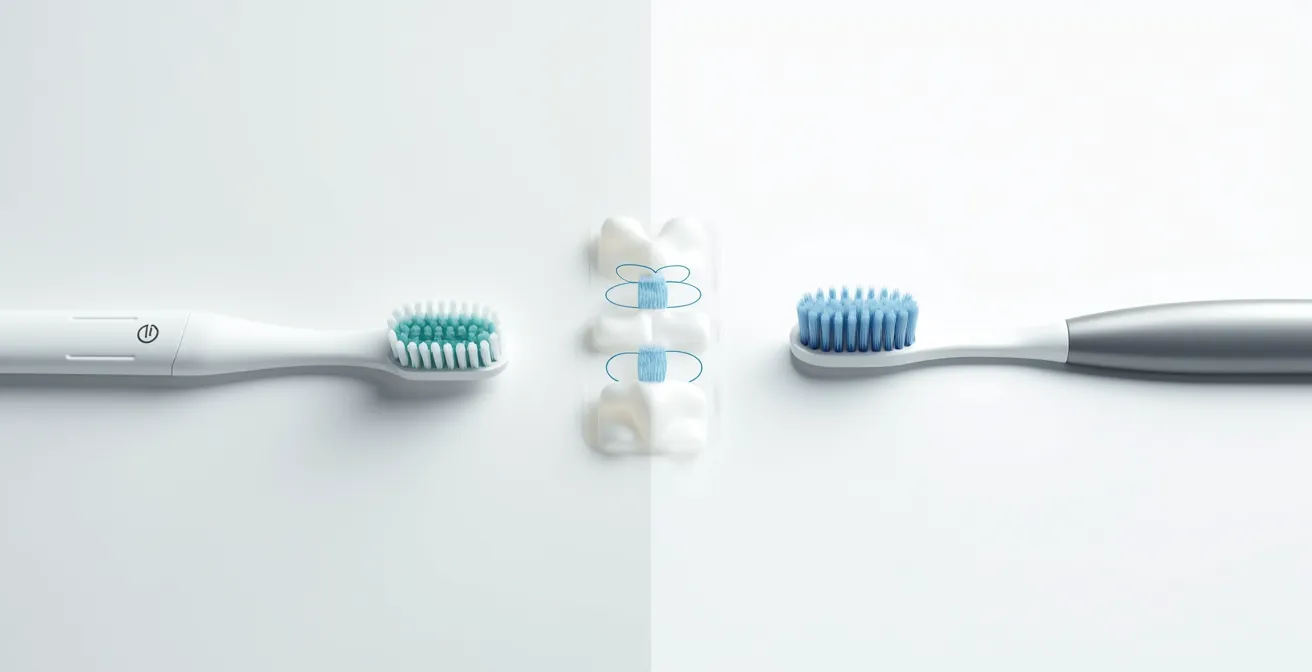
A $200 sonic toothbrush isn’t a luxury gadget; it’s a preventative tool with a measurable return on investment against expensive dental procedures common in Montreal.
- Its core technology cleans areas bristles can’t physically touch, reducing plaque that leads to cavities.
- The integrated pressure sensor actively prevents gum damage, a condition that can cost over $1,000 per tooth to repair with grafts.
Recommendation: Evaluate the high upfront cost not as an expense, but as an insurance policy against the far greater long-term financial and health risks of inadequate brushing.
You’re standing in the aisle of a Pharmaprix or Jean Coutu, a $5 manual toothbrush in one hand and a sleek, $200 box promising tens of thousands of vibrations per minute in the other. The price gap is enormous. The question isn’t just about which cleans better; it’s about value. Is the expensive gadget a gimmick, or is it a genuinely superior tool that justifies its price tag? Many articles will tell you electric is better, often focusing on the obvious two-minute timer or quoting generic studies. They rarely break down the specific mechanisms that create a return on that initial investment.
This analysis takes a different approach. We will treat the sonic toothbrush like any other piece of high-performance technology. We’ll dissect its key features not as marketing points, but as functional components designed to mitigate specific, high-cost dental risks. From the physics of its cleaning action to the long-term cost of ownership, we will determine if this device is a worthwhile financial instrument for preserving your oral health in a city like Montreal, where advanced dental work comes with a significant price tag. We will ignore the brand wars of Sonicare vs. Oral-B and focus on the core sonic technology itself.
This guide provides a value-focused breakdown of the technology, the safety features, the running costs, and the actual health outcomes. It’s designed to give you, the skeptical consumer, a clear framework for deciding if the $195 difference is a justifiable expense or an unnecessary luxury.
Summary: The True Value of a High-End Toothbrush
- How Sonic Vibrations Clean Places the Bristles Don’t Even Touch?
- Why the Red Warning Light Is the Most Important Feature for Gum Safety?
- Why Using a Frayed Electric Head Is Worse Than a Manual Brush?
- Does the Cleaning Power Drop as the Battery Fades?
- At What Age Can a Child Safely Use a Sonic Toothbrush?
- Can You Heal a Cavity at Home Before It Needs a Filling?
- Water Flosser vs. String Floss: Which One Is the Truth?
- Revisiting Sonic Power: Is It The Right Investment For You?
How Sonic Vibrations Clean Places the Bristles Don’t Even Touch?
The fundamental difference between a manual brush and a sonic one isn’t just speed; it’s physics. A manual brush relies on mechanical scrubbing—bristles physically scraping plaque off the tooth surface. A sonic toothbrush adds a second, more powerful cleaning mechanism: Dynamic Fluid Action. The head vibrates at an extremely high frequency (often over 30,000 strokes per minute), agitating the saliva and toothpaste in your mouth into a turbulent, oxygenated foam. This fluid is forcefully propelled into areas where bristles cannot go: between teeth and just below the gumline.
This micro-stream of fluid effectively power-washes plaque and bacteria from interdental spaces and gingival sulci. It’s a non-contact form of cleaning that complements the physical scrubbing of the bristles. This is the “magic” that explains how sonic technology can achieve a superior clean, particularly for hard-to-reach areas where cavities and gum disease often begin.
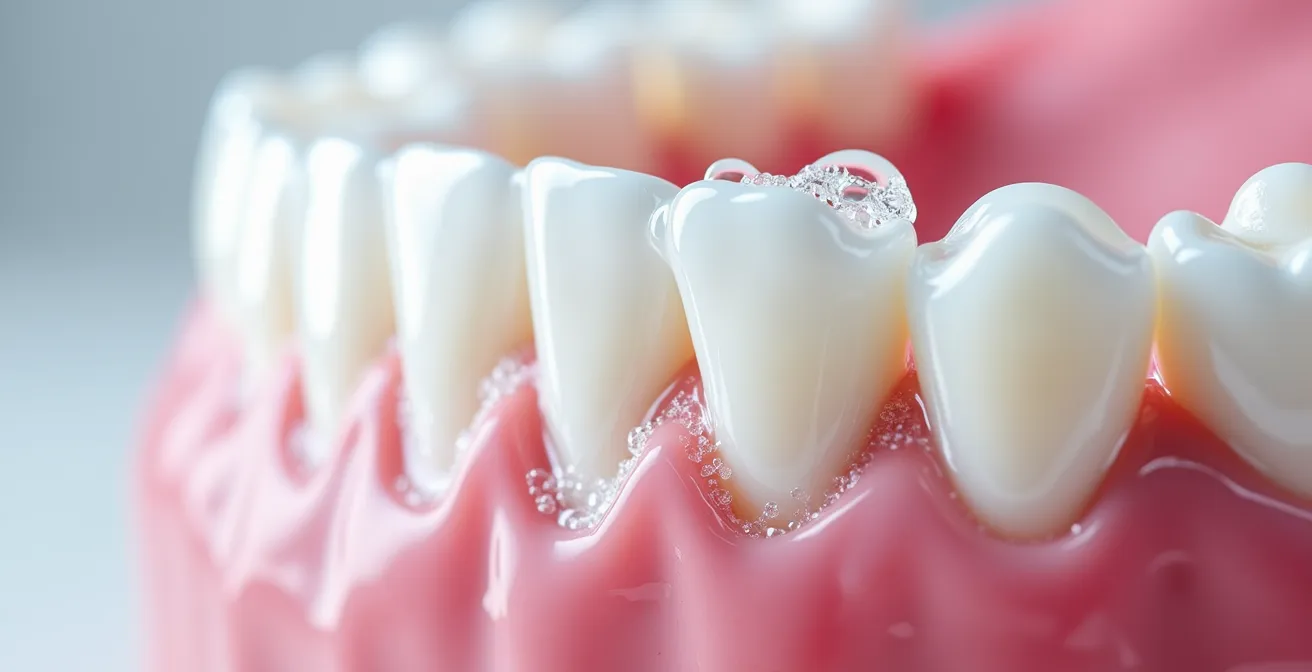
This isn’t just a theoretical benefit. Observations from dental professionals confirm the real-world impact. According to a blog post from a Montreal-based clinic referencing a major study, electric toothbrushes perform better at eliminating plaque and reducing gingivitis. Dentists in the city particularly note the superior results for patients with orthodontic hardware or fixed bridges, where Dynamic Fluid Action can flush out debris trapped around brackets and under appliances more effectively than manual brushing alone.
Why the Red Warning Light Is the Most Important Feature for Gum Safety?
If Dynamic Fluid Action is the primary offensive feature of a sonic toothbrush, the pressure sensor is its most critical defensive one. One of the most common and irreversible forms of dental damage is gingival recession, where the gum tissue wears away, exposing the sensitive root of the tooth. A primary cause is simply brushing too hard over a long period—a habit many people have without realizing it. With a manual brush, the only feedback you get is when your dentist points out the damage during a check-up, by which point it’s too late.
A high-end sonic toothbrush provides real-time feedback. When you press too hard, an indicator light (usually red) flashes, and the motor may pulse or even shut off. This feature acts as a personal coach during every single brushing session, training you to use the correct, gentle pressure. It transforms a subconscious, damaging habit into a conscious, correct one. This isn’t a gimmick; it’s an active system for preventing permanent damage to your gums.
The financial implications of ignoring this are significant in Montreal. Correcting severe gum recession often requires a gum graft, a surgical procedure where tissue is taken from the roof of your mouth to cover the exposed root. It’s a procedure not typically covered by Quebec’s public health insurance (RAMQ). According to local data, a gum graft procedure at a Montreal dental clinic costs between $870 to $1,200 CAD per tooth. The $200 for a toothbrush with a pressure sensor suddenly looks like a very sound investment when compared to a potential four-figure surgical bill for a single tooth.
The following table breaks down the difference in risk between a manual brush and a sonic brush equipped with this crucial safety feature.
| Feature | Manual Toothbrush | Sonic Toothbrush with Sensor |
|---|---|---|
| Pressure Feedback | None – Silent damage until dental checkup | Real-time warning light/vibration |
| Gum Protection | Depends entirely on user awareness | Automatic protection against excessive force |
| Long-term Cost Risk | High – potential gum grafts not covered by RAMQ | Low – prevents irreversible damage |
| Professional Detection | Only at semi-annual checkups | Daily prevention at home |
Why Using a Frayed Electric Head Is Worse Than a Manual Brush?
The single biggest factor that degrades the performance of a sonic toothbrush is a worn-out head. After approximately three months of use, the bristles lose their precise shape and stiffness. They splay outwards, becoming less effective at sweeping away plaque and, more importantly, unable to properly transmit the high-frequency vibrations that power the Dynamic Fluid Action. A frayed sonic head becomes little more than a clumsy, vibrating manual brush. In fact, its stiff, bent bristles can be more abrasive and less effective than a fresh, soft-bristled manual brush.
This brings us to the most significant ongoing expense: the Total Cost of Ownership (TCO). The initial $200 purchase is just the beginning. Replacement heads are the “ink cartridges” of the dental world, and failing to replace them on schedule negates the entire benefit of the expensive device. In Canada, a pack of three official replacement heads typically costs around $30. For optimal performance, you need four heads per year.
Let’s run a five-year TCO analysis for a typical Montreal consumer:
- Year 1 (Sonic): $200 (brush) + 3 heads ($30) = $230 CAD
- Years 2-5 (Sonic): 4 heads/year x 4 years @ ~$40/pack = ~$160 CAD
- 5-Year Sonic Total: ~$390 CAD (averaging $78/year)
- 5-Year Manual Total: $5 brush x 20 replacements (one every 3 months) = $100 CAD
The sonic toothbrush costs approximately $290 more over five years. This is the real price of admission. The decision is whether the superior cleaning and preventative safety features are worth an extra ~$58 per year. It’s also worth noting that while the plastic heads are waste, many modern sonic toothbrush bodies contain lithium-ion batteries and can be recycled through Montreal’s municipal e-waste programs, reducing their environmental footprint.
Does the Cleaning Power Drop as the Battery Fades?
A common concern with any rechargeable device is performance degradation as the battery drains. Does a sonic toothbrush clean less effectively on its last day of charge compared to its first? The answer depends entirely on the quality of its internal electronics. From a tech reviewer’s perspective, this is where high-end models justify their price over cheaper electric alternatives. Premium sonic toothbrushes incorporate voltage-regulated circuits. This technology ensures the motor receives a consistent voltage, and therefore maintains a stable vibration frequency and amplitude, right until the battery is almost completely depleted. Your last brushing session of the week is just as powerful as your first.
Cheaper electric or sonic models often lack this sophisticated circuitry. They experience a noticeable, gradual decline in power as the battery drains. The hum of the motor might drop in pitch, and the intensity of the vibrations will feel weaker. This means your cleaning performance becomes inconsistent, diminishing significantly by the end of the charge cycle. With a top-tier device, the performance is a flat line that drops off a cliff at the very end; with a cheaper one, it’s a slow, steady slope downwards.
Without lab equipment, how can you tell if your brush’s performance is degrading? You can perform a simple sensory audit at home to check for signs of power loss, either from a draining battery on a cheaper model or an aging battery on an older high-end one.
Your 5-Point Audit: Is Your Sonic Toothbrush Losing Power?
- Listen: Pay attention to the pitch of the motor’s hum. A lower, “lazier” sound compared to when it’s fully charged indicates a drop in motor speed and cleaning power.
- Feel: Notice the intensity of the tingling sensation on your gums and lips. A significantly weaker sensation suggests reduced vibration amplitude.
- Touch: Place the tip of the vibrating brush head against your fingernail. A new or fully powered brush will create a very strong, sharp buzzing sensation. A weak brush will feel duller.
- Observe: Watch the brush head in a cup of water. A powerful brush will create vigorous, visible waves and agitation. A weak brush will produce much less fluid movement.
- Monitor: Check if the brush ever struggles to start, or if the two-minute timer cycle seems to end with the brush feeling noticeably weaker than when it started.
At What Age Can a Child Safely Use a Sonic Toothbrush?
The power and intensity of a sonic toothbrush raise valid questions for parents. While excellent for adults, is this technology safe and appropriate for a child’s developing mouth? The consensus among dental professionals and manufacturers is yes, but with important age and supervision guidelines. The fine motor skills required for perfect manual brushing are often not fully developed in young children, making a sonic brush a potentially more effective tool for them.
However, it is not suitable for toddlers or very young children. The intensity can be overwhelming, and their gum tissue is more delicate. Specific recommendations from reputable brands available in Canada provide a clear and safe timeline. For instance, a leading manufacturer provides the following guidance:
We recommend our Hydrosonic sonic toothbrushes for children older than 6 years of age. They should start with a compact sensitive brush head and with level 1, then gradually increase the intensity.
– Curaprox Canada, Canadian Dental Product Guidelines
This expert advice highlights two key principles: starting at an appropriate age (generally age 6 and up) and using the right equipment (a smaller, softer “sensitive” head) on the lowest power setting. Introducing the technology gradually allows the child to acclimate to the unique vibrating sensation. Most importantly, the use of a sonic toothbrush does not replace parental supervision. According to guidelines, parents should brush their child’s teeth or check results until age 10, and continue supervision until around age 12 to ensure proper technique and coverage.
Can You Heal a Cavity at Home Before It Needs a Filling?
This is a critical question that directly ties into the value of superior cleaning. The answer is a nuanced “yes, but only at the very earliest stage.” A dental cavity does not appear overnight. It begins as a process of demineralization, where acids from plaque bacteria leach minerals from the tooth enamel. This initial stage, called an incipient lesion or a “white spot,” is often invisible to the untrained eye but is reversible. At this point, the tooth’s surface structure is still intact. Your body, with the right help, can repair this damage through a process called remineralization, where minerals like fluoride and calcium from your saliva and toothpaste are redeposited into the enamel.
However, once the demineralization progresses and a physical hole or “cavitation” forms in the tooth, the process is irreversible. No amount of brushing or special toothpaste can make the tooth structure grow back. At that stage, the only solution is a professional filling from a dentist.
This is where the sonic toothbrush demonstrates its preventative value. By providing a demonstrably cleaner tooth surface, it removes the plaque biofilm that causes demineralization in the first place. As noted by dental research in Montreal, this creates the perfect conditions for healing to occur:
Optimal cleaning with a sonic toothbrush creates the ideal surface environment for remineralizing agents to work effectively.
– Montreal Dental Research, Preventive Dentistry Guidelines
Essentially, the sonic toothbrush isn’t healing the cavity itself. It’s creating a pristine surface that allows high-fluoride products, available in Canadian pharmacies like Pharmaprix or Shoppers Drug Mart (often requiring a dentist’s prescription in Quebec), to do their job effectively and reverse the damage before it becomes permanent and requires a costly filling.
Water Flosser vs. String Floss: Which One Is the Truth?
The debate between water flossing and traditional string flossing mirrors the manual vs. sonic toothbrush argument. One is a time-tested manual tool, the other a pricier electronic device. The “truth” is that they are not rivals, but partners that perform different functions. According to Quebec dental hygienists, the ideal approach is often to use both, as they excel at different tasks. String floss is a mechanical scraper. Its primary strength is removing sticky, tenacious plaque from the contact points where two teeth touch directly. A water flosser, which uses a pressurized stream of pulsating water, is less effective at scraping off this tough biofilm.
However, the water flosser excels at flushing out loose debris from around and between teeth, and is particularly superior for cleaning periodontal pockets (the space between the tooth and gum) and for navigating complex dental work like braces, implants, and bridges where string floss is difficult or impossible to use. It functions as an irrigator, dislodging food particles and bacteria from areas the floss can’t reach. Just as with toothbrushes, there is a Total Cost of Ownership to consider.
Here’s a 5-year cost analysis for the two methods in Canadian dollars:
| Item | Water Flosser | String Floss |
|---|---|---|
| Initial Purchase | $80-150 CAD | $0 |
| Replacement Tips (5 years) | $100 CAD | $0 |
| Floss Supply (5 years) | $0 | $75 CAD |
| Electricity Cost | $10 CAD | $0 |
| Total 5-Year Cost | $190-260 CAD | $75 CAD |
| Insurance Coverage Potential | May be covered if prescribed for periodontitis | Not covered |
The tandem approach recommended by many hygienists involves using string floss first to break up the plaque on contact points, followed by the water flosser to flush everything out. For added benefit, some users add a small amount of antimicrobial mouthwash to the water reservoir, though it’s crucial to check the manufacturer’s warranty first.
Key takeaways
- A sonic toothbrush cleans via Dynamic Fluid Action, reaching areas bristles can’t touch.
- The pressure sensor is a critical safety feature that prevents irreversible gum recession, saving thousands in potential surgical costs in Montreal.
- The true cost includes regular head replacements; failing to do so makes the device ineffective and a waste of the initial investment.
Revisiting Sonic Power: Is It The Right Investment For You?
We’ve broken down the technology, the safety features, the long-term costs, and the specific health outcomes. The evidence shows that a high-quality, $200 sonic toothbrush is not an overpriced gimmick. From a purely functional standpoint, it is a superior cleaning device. Its ability to disrupt plaque in hard-to-reach areas and its built-in safeguards against user error provide tangible benefits that a $5 manual brush simply cannot replicate. The key is to stop viewing it as a toothbrush and start seeing it as a piece of preventative medical equipment.
The decision to invest comes down to a personal cost-benefit analysis. Are you willing to pay an extra ~$58 per year (the amortized cost difference over five years) for a technology that significantly lowers your risk of gum grafts (costing ~$1,000+ per tooth) and creates the optimal environment to reverse early cavities before they require fillings? For many Montrealers facing high costs for restorative dental care, the answer is a clear yes. The initial sticker shock is mitigated by the potential for substantial long-term savings and better health outcomes.
However, the investment is only sound if you commit to it fully. This means replacing the heads on schedule, every three months, without fail. Using a frayed head on a sonic toothbrush is, in many ways, worse than using a fresh manual one. The device is only as good as its maintenance.
For those convinced by the long-term value, the next logical step is to discuss with your dentist which model and features are best suited to your specific oral health needs.
Frequently Asked Questions About a $200 Sonic Toothbrush Really Better Than a $5 Manual One?
Can white spot lesions (incipient caries) be reversed?
Yes, white spot lesions can be remineralized with proper treatment including high-fluoride toothpaste and optimal oral hygiene, a condition that a sonic toothbrush helps create.
Can a cavity (cavitated lesion) heal itself?
No, once a physical hole forms in the tooth, it cannot heal itself and requires professional dental treatment such as a filling.
What products are available in Canadian pharmacies for remineralization?
High-fluoride toothpastes like PreviDent 5000 and CPP-ACP products like MI Paste are available at Pharmaprix/Shoppers Drug Mart, often requiring a Quebec dentist prescription to purchase.