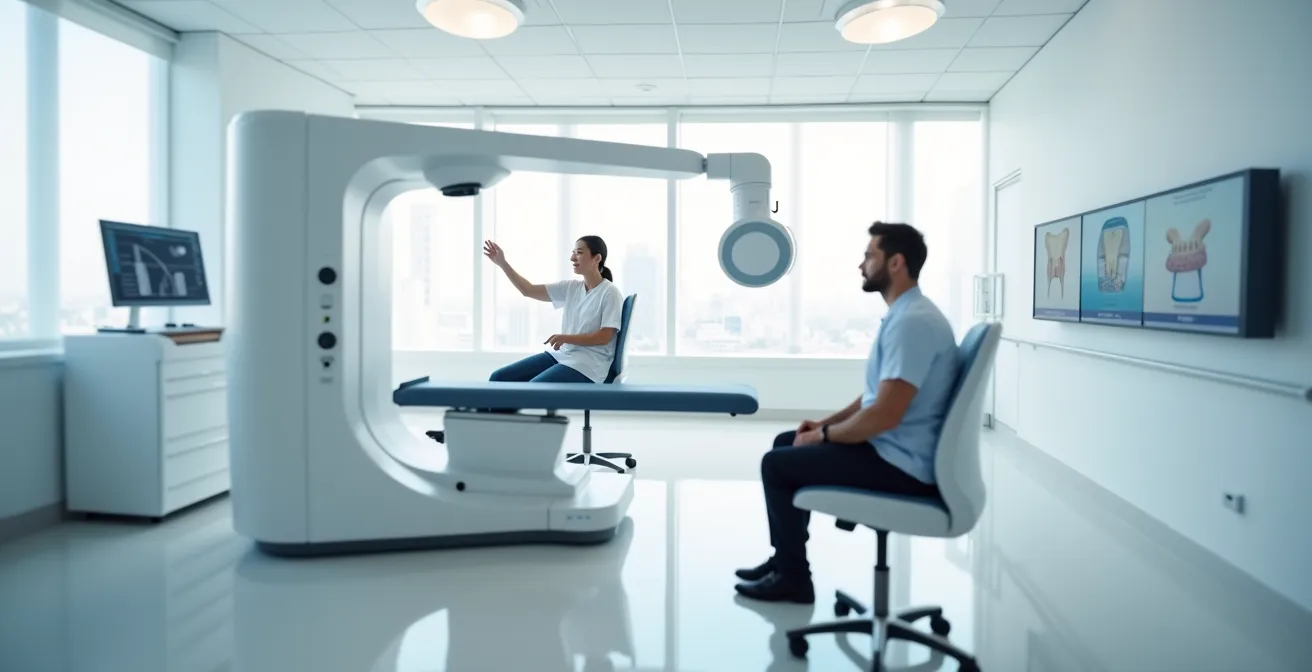
A 3D CBCT scan is not an optional expense for a dental implant; it is the single most important risk mitigation tool to ensure a successful, one-time procedure.
- It reveals “anatomical blind spots” like critical nerve paths and poor-quality bone that 2D X-rays miss, preventing irreversible surgical errors.
- The small radiation dose is a fraction of a medical CT, while the upfront cost in Montreal prevents catastrophic failure costs that can easily exceed $6,000.
Recommendation: For any implant procedure in Montreal, the CBCT scan must be considered a non-negotiable part of your surgical plan for safety and long-term success.
When considering a dental implant, you are likely focused on the final result: a permanent, natural-looking tooth. However, the conversation often shifts to the preparatory steps, specifically the recommendation for a 3D Cone Beam Computed Tomography (CBCT) scan. For many patients in Montreal, this raises two immediate and valid concerns: the additional cost and the exposure to radiation. It’s tempting to view it as an optional “upgrade,” especially if the procedure seems routine.
This perspective, while understandable, is fundamentally flawed. From a surgical standpoint, proceeding with an implant based only on a traditional 2D X-ray is like navigating a complex landscape with a flat, incomplete map. It shows the general layout but hides critical details in what we call anatomical blind spots. These hidden variables—the exact path of a nerve, the true thickness of your jawbone, or a silent, underlying infection—are precisely what turn a “routine” surgery into a complicated, costly failure.
The purpose of this article is to reframe the discussion. We will move beyond the surface-level debate of cost versus benefit and instead analyze the scan through the lens of risk mitigation. This is not about upselling a technology; it is about adopting a mandatory safety protocol that transforms a potential gamble into a predictable, precision-engineered medical procedure. We will explore how this technology prevents surgical errors, contextualize the radiation dose, and demonstrate why the upfront investment is a crucial form of financial and biological triage.
This guide provides a surgeon’s analysis of why a 3D scan is an indispensable tool in modern implantology, especially within the context of care available in Montreal. By understanding the full picture, you can make a truly informed decision about your health and financial well-being.
Summary: Why a 3D Scan is Non-Negotiable for Dental Implants
- How 3D Scans Prevent Nerve Damage During Wisdom Tooth Removal?
- Banana Equivalent Dose: How Much Radiation Is in a Dental CBCT?
- Finding the “Silent” Abscess That 2D X-Rays Missed
- Why Paying $200 for a Scan Can Save You $2,000 in Failed Surgery?
- From Scan to Surgery: How 3D Data Creates Surgical Guides?
- When Should You Insist on Seeing an Endodontist Instead of a General Dentist?
- Are Dental Implants a Safe Option for Seniors Over 70 in Montreal?
- Why Paying $200 for a Scan Can Save You $2,000 in Failed Surgery?
How 3D Scans Prevent Nerve Damage During Wisdom Tooth Removal?
While the title mentions wisdom teeth, the underlying principle is critically important for dental implants in the lower jaw. The primary concern in this area is the inferior alveolar nerve, a major nerve that provides sensation to your lower lip, chin, and teeth. A 2D X-ray can show its general location, but it cannot reveal its exact three-dimensional path or its proximity to the proposed implant site. This is a significant anatomical blind spot.
A 3D CBCT scan provides a precise, cross-sectional view, allowing the surgeon to map the nerve’s entire canal with sub-millimeter accuracy. We can see if it curves unexpectedly, measure the exact distance between the nerve and the drill path, and select an implant of the appropriate length and diameter to maintain a safe buffer zone. This level of detail is simply impossible to obtain from a flat image. According to local experts at Montreal’s Clinique MFML, 3D radiology is an indispensable tool for these exact anatomical assessments, providing superior quality of care.
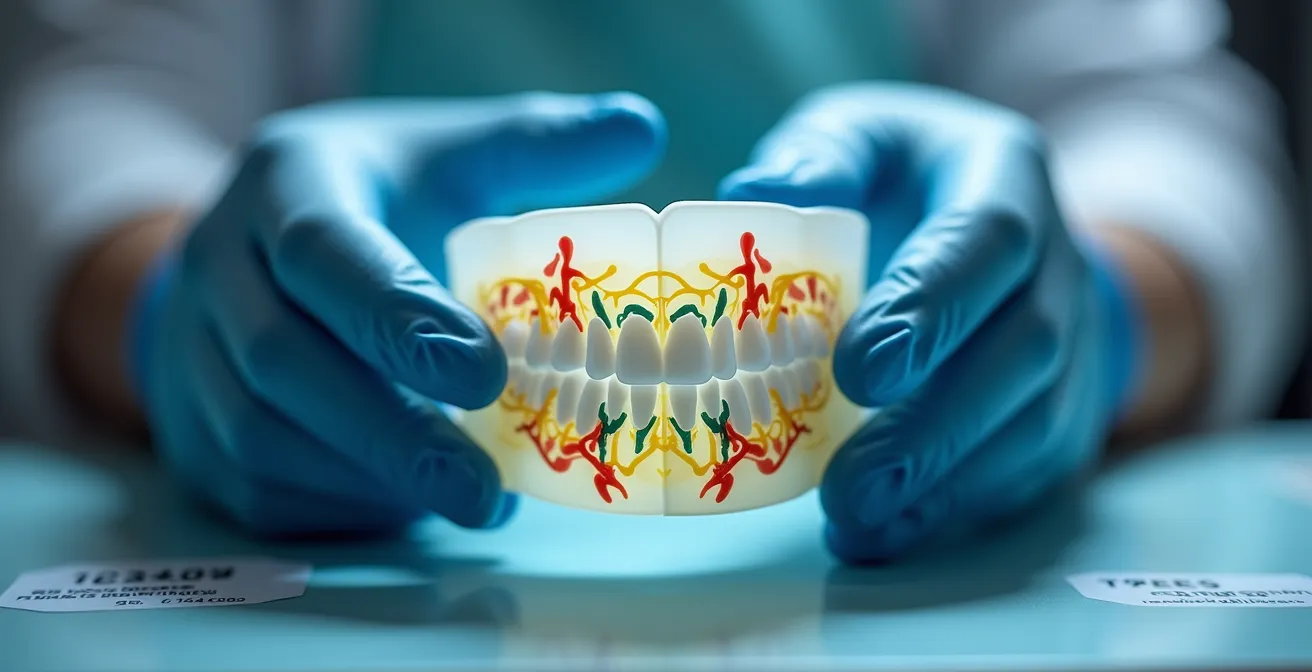
This visualization effectively eliminates the guesswork. Damaging this nerve can lead to temporary or even permanent numbness (paresthesia) of the lip and chin—a life-altering complication. By creating a detailed predictive blueprint of your unique anatomy, the CBCT scan transforms the procedure from an approximation into a meticulously planned event, making nerve damage a preventable, rather than a possible, outcome. This is the first and most critical pillar of surgical risk mitigation.
Banana Equivalent Dose: How Much Radiation Is in a Dental CBCT?
The concern about radiation is entirely valid and should always be addressed. The guiding principle in radiology is ALARA: “As Low As Reasonably Achievable.” The key is to contextualize the dose. The radiation from a dental CBCT scan is significantly lower than many people assume, especially when compared to other medical imaging or even environmental exposure.
A useful way to understand this is by comparing effective radiation doses. As a Montrealer, you are exposed to a certain amount of natural background radiation every year. A single cross-country flight also exposes you to cosmic radiation. A dental CBCT scan fits into this spectrum at a very low level. In fact, recent 2024 research confirms CBCT delivers approximately 100 microsieverts (μSv), whereas a conventional medical head CT can deliver over 500 μSv. The technology is designed specifically for the head and neck, using a targeted, rapid scan to minimize exposure.
The following table puts the dose into perspective against common benchmarks, including data sourced from the Health Physics Society.
| Imaging Type | Radiation Dose | Equivalent Background Days |
|---|---|---|
| CBCT Scan (average for implants) | 130 μSv | 16 days |
| Panoramic X-ray | 14 μSv | 1.7 days |
| Medical Head CT | 860 μSv | 105 days |
| Montreal-Vancouver Flight | ~30 μSv | 3.6 days |
| Annual Background (Montreal) | ~2400 μSv | 365 days |
As the data from a comparative analysis by health physicists shows, the dose from a targeted CBCT scan is a small, calculated exposure. When weighed against its ability to prevent catastrophic surgical failure, nerve damage, or the need for more invasive, higher-radiation procedures later on, the dose is not only reasonable but essential for responsible treatment planning.
Finding the “Silent” Abscess That 2D X-Rays Missed
A successful implant requires more than just avoiding nerves; it demands a foundation of healthy, robust bone. This is where 2D X-rays present another critical blind spot. A standard X-ray can’t accurately depict bone density or reveal early-stage infections and cysts (silent abscesses) that may be lurking at the root of a failing tooth or in the jawbone.
A CBCT scan provides a detailed view of the bone’s internal structure and quality. It allows the surgeon to identify areas of low density or hidden pathology that would compromise an implant’s ability to integrate with the jaw (a process called osseointegration). Placing an implant into an area with an undetected chronic infection or insufficient bone is a leading cause of early implant failure. The scan enables us to find and treat these issues *before* surgery, not discover them when the implant fails months later.
Furthermore, bone is not uniform. It is categorized into four types, from dense Type I to very soft Type IV. This is a critical factor for success. According to foundational clinical literature, implants placed in Type IV bone have significantly higher failure rates due to its low density and poor strength. A 2D X-ray cannot reliably distinguish between these bone types. A CBCT scan, however, gives a clear indication of bone quality, allowing the surgeon to choose the right implant design or determine if a bone graft is necessary to build a solid foundation first. This proactive assessment of the biological cost is a cornerstone of predictable implantology.
Why Paying $200 for a Scan Can Save You $2,000 in Failed Surgery?
The title frames the financial choice in simple terms, but the reality for a patient in Montreal is even more stark. The upfront cost of a CBCT scan is not an expense; it is a form of financial triage that prevents a cascade of much larger costs associated with implant failure. A failed implant is not a simple reversal; it is a complex, expensive, and time-consuming problem to fix.
Let’s break down the real “biological and financial cost” of a preventable failure. If an implant is placed without a complete 3D picture and fails due to nerve proximity, poor bone, or a hidden infection, the recovery process is arduous. It involves surgically removing the failed implant, often requiring a bone graft to repair the damaged site, a lengthy healing period of 4-6 months, and then starting the entire implant process over again. Each of these steps carries a significant cost.

The following cost analysis, based on typical fees in Montreal, illustrates the dramatic financial difference between proactive planning and reactive recovery. The initial investment in a scan is dwarfed by the potential cost of failure.
| Procedure/Issue | Cost (CAD) | Time Impact |
|---|---|---|
| CBCT Scan in Montreal | $350-$500 | 20 minutes |
| Failed Implant Removal | $800-$1,200 | 1-2 hours surgery |
| Bone Graft After Failure | $1,000-$1,500 | 4-6 months healing |
| New Implant Procedure | $2,500-$4,000 | 3-4 months osseointegration |
| Total Failure Cost | $4,300-$6,700+ | 8-12 months total |
As this data from a Montreal-based oral surgery clinic demonstrates, paying for a scan is not spending money—it’s saving it. It’s an insurance policy against a multi-thousand-dollar problem and a year of lost time. When you see the numbers, the choice becomes clear: a small, one-time, controlled cost is vastly preferable to an unpredictable and catastrophic financial burden.
From Scan to Surgery: How 3D Data Creates Surgical Guides?
The CBCT scan’s value extends beyond diagnosis; it is the foundation of modern guided surgery. The digital data from the scan creates a “predictive blueprint” that is used to design and 3D-print a custom surgical guide. This guide is a template that fits precisely over your existing teeth, with a channel that directs the surgical drill to the exact pre-planned position, angle, and depth.
This process removes any margin for human error during the drilling phase. As described by Montreal’s digital dentistry leaders, virtual planning of the surgical procedure is possible thanks to 3D digitization… the procedure is better planned and the surgical procedure better executed. This means the implant is placed in the optimal location for both bony support and the final prosthetic crown, ensuring a result that is not only safe but also aesthetically and functionally superior.
Guided surgery is often less invasive. Because the surgeon knows the exact location of all underlying structures, they can often perform “flapless” surgery, avoiding the need to cut and peel back the gums. This results in less post-operative pain, reduced swelling, and faster healing times for the patient. The entire workflow, from data acquisition to final placement, is a testament to precision engineering in medicine.
Your Action Plan: The Guided Surgery Workflow
- Data Capture: The process begins with a CBCT scan, where you must remain perfectly still to avoid motion artifacts in the 3D model.
- Digital Merging: The 3D anatomical data (DICOM files) from the scan is imported into planning software and aligned with a digital impression of your teeth (STL file).
- Virtual Planning: Your surgeon plans the ideal implant position on the 3D model, considering both the final tooth position and your unique anatomy (bone, nerves, sinuses).
- Guide Design & Fabrication: A custom surgical guide is designed in the software and then 3D printed using a biocompatible, medical-grade resin.
- Precision Surgery: The guide is fitted in your mouth, and the surgeon uses it to perform a minimally invasive and highly accurate implant placement, executing the pre-approved digital plan.
When Should You Insist on Seeing an Endodontist Instead of a General Dentist?
The decision to see a specialist—such as an oral surgeon, a periodontist, or a prosthodontist—is not a reflection on your general dentist’s ability. Rather, it is about ensuring the right expert is managing the specific complexities of your case. The CBCT scan is often the objective tool that makes this decision clear and necessary.
Many complex issues that require specialist intervention are invisible on a 2D X-ray. For instance, a CBCT scan might reveal severe bone loss requiring advanced grafting by a periodontist, or a nerve path so close to the implant site that an oral surgeon’s expertise is mandatory. It might also identify a complex root canal issue in an adjacent tooth that needs an endodontist’s attention before an implant can even be considered. The scan serves as a shared, evidence-based blueprint for interdisciplinary collaboration between your dental team in Montreal.
Furthermore, access to this technology is not universal. Studies indicate that less than 5% of dentists in North America have 3D CBCT imaging available in-office. If your dentist does not have this capability, insisting on a referral to a specialist or a radiology center that does is a critical step in taking ownership of your treatment’s safety and success. The scan empowers you and your dentist to make a data-driven decision about whether a specialist’s hands are required, moving beyond opinion and into the realm of objective fact.
Are Dental Implants a Safe Option for Seniors Over 70 in Montreal?
For seniors, dental implants can be a life-changing solution, improving nutrition, confidence, and overall quality of life. However, safety is paramount, as older adults may present with more complex medical histories and changes in bone physiology. In this context, the CBCT scan transitions from being highly recommended to being an essential safety protocol.
One of the primary concerns for seniors is bone density, which can be affected by age-related osteoporosis. As previously discussed, implant success is highly dependent on bone quality. A CBCT scan is the only way to accurately assess the bone’s density and structure, ensuring the jaw can support an implant. It allows the surgeon to avoid placing an implant in weak, porous Type IV bone, which is more common in the posterior maxilla of older patients and has a higher risk of failure. This assessment is critical for ensuring a stable, long-lasting result.
Additionally, seniors are more likely to be on medications, such as bisphosphonates for osteoporosis, which can affect bone healing and carry a risk of complications. The detailed planning afforded by a CBCT allows for a minimally invasive surgical approach, like flapless surgery. This reduces surgical trauma, minimizes bleeding, and promotes faster healing, which is a significant benefit for any patient, but especially for older adults. By providing a complete picture of the patient’s anatomy and bone health, the scan empowers the Montreal-based surgical team to create the safest, most predictable, and least invasive treatment plan possible.
Key Takeaways
- A 3D scan is a risk mitigation tool, not an optional luxury; it reveals critical anatomical blind spots like nerve paths and bone defects that 2D X-rays miss.
- The radiation dose from a dental CBCT is minimal and represents a tiny fraction of a medical CT scan or even annual background radiation in Montreal.
- The upfront cost of a scan is a form of financial triage that prevents catastrophic failure costs, which can exceed $6,000 and require a year of corrective procedures.
Why Paying $200 for a Scan Can Save You $2,000 in Failed Surgery?
We have established the clear financial argument for a 3D scan, demonstrating how a small upfront cost prevents a cascade of expensive corrective procedures. However, the true cost of a preventable implant failure cannot be measured in dollars alone. The biological cost—the irreversible damage to your body—is a far more significant, and often permanent, consequence.
Imagine undergoing an implant procedure, only to have it fail due to an undetected issue. The process of removing it often involves the loss of more of your natural jawbone. The subsequent bone graft is another surgery, with its own risks and long healing period. In the worst-case scenario, an implant placed without a clear 3D map can damage a nerve, leading to permanent numbness in your lip and chin. These are not just financial setbacks; they are significant, and sometimes irreversible, biological events.
The 3D scan is the objective diagnostic tool that helps a general dentist and their patient decide if a specialist’s expertise is required. It facilitates a transparent and evidence-based referral process within the Montreal dental community.
– Montreal Dental Specialists, Clinical Practice Guidelines Montreal
This is why the surgeon community in Montreal and worldwide increasingly views the CBCT scan as the standard of care. It is the definitive tool for risk assessment. By investing in a complete 3D picture of your anatomy, you are not just making a wise financial decision; you are protecting your body from unnecessary trauma, preserving your natural bone, and ensuring the long-term health of your mouth. The question is not whether you can afford the scan, but whether you can afford the consequences of proceeding without it.
For your own safety and long-term success, the next step is to have an open discussion with your clinician about incorporating a 3D scan into your specific treatment plan. It is your right as a patient to demand the highest standard of care, one that prioritizes precision, predictability, and above all, your well-being.
Frequently Asked Questions about 3D Scans for Dental Implants
When should a CBCT scan trigger a specialist referral?
When the scan reveals severe bone loss, proximity to vital nerves (less than 2mm), need for a sinus lift, or complex anatomical variations that require advanced surgical techniques not typically performed by a general dentist.
Which specialists handle complex implant cases in Montreal?
In Montreal, complex cases are typically handled by a team. Prosthodontists manage complex restorations, Periodontists are experts in bone and soft tissue grafting procedures, and Oral & Maxillofacial Surgeons perform cases involving nerve repositioning or extensive jaw reconstruction.
How does interdisciplinary planning work with CBCT?
The CBCT scan acts as a universal digital blueprint shared among specialists. For example, an endodontist can treat a hidden lesion identified on the scan, a periodontist can perform a precise bone graft based on the 3D model, and a prosthodontist can plan the final crown, all while working from the same, unified dataset for a seamless treatment sequence.