
The “Teeth in a Day” procedure is a single surgical event, but true success is a four-month journey of disciplined healing, meticulous adaptation, and critical long-term decisions.
- Your diet is restricted to liquids and soft foods for months, requiring careful planning to maintain nutrition for proper healing.
- Daily cleaning is a non-negotiable, technical process involving specific tools like water flossers and superfloss to prevent failure.
- The initial acrylic teeth are temporary; the choice to upgrade to a permanent Zirconia bridge is a major financial and functional decision.
Recommendation: Prioritize a consultation with a Montreal clinic that transparently discusses the full recovery timeline and long-term costs, not just the surgery day itself.
For anyone in Montreal who has grown weary of the daily frustrations of dentures—the slipping, the messy adhesives, the restricted diet—the promise of “Teeth in a Day” sounds like a definitive solution. The marketing presents a powerful image: walk into a clinic with failing teeth or a loose denture and walk out the same day with a brand new, fixed smile. This immediate transformation is a compelling vision, and for many, it represents the end of a long and difficult chapter.
However, the clinical reality is far more nuanced than the one-day marketing slogan suggests. While the surgery itself is a remarkable feat of modern dentistry, it’s merely the starting point of a comprehensive healing and adaptation process. The true success of a full-arch solution like All-on-4 doesn’t happen in a single day. It unfolds over several months of careful recovery, learning new hygiene protocols, and making informed decisions about the long-term materials that will become your permanent teeth. The promise is real, but it’s conditional.
This article moves beyond the hype to provide a factual, clinical-realist perspective for Montreal patients. We will not focus on the single day of surgery, but on the crucial months that follow. By understanding the realities of the healing diet, the specifics of maintenance, the reasons for temporary speech changes, and the true cost-benefit of material upgrades, you can set realistic expectations and become an active partner in the long-term success of your investment. This is the journey that truly matters.
To navigate this complex topic, we have broken down the most pressing and practical questions that patients have. This guide will walk you through the day-to-day realities of living with a new fixed bridge, from your first meal to long-term care and financial planning, all contextualized for a patient in Montreal.
Summary: Unpacking the Reality of the ‘Teeth in a Day’ Journey
- What Can You Actually Eat During the 4-Month Healing Phase?
- How Do You Floss Under a Bridge That Doesn’t Come Out?
- Why Upgrade to Zirconia Teeth Instead of the Standard Acrylic Hybrid?
- Why You Might Lisp for Two Weeks After All-on-4 Surgery?
- What Does Implant Failure Feel Like in a Full Arch Case?
- Are Dental Implants a Safe Option for Seniors Over 70 in Montreal?
- Where to Start When You Need to Fix Every Single Tooth?
- What Does Implant Failure Feel Like in a Full Arch Case?
What Can You Actually Eat During the 4-Month Healing Phase?
The first question after surgery is almost always about food. While you leave with teeth, your jaw and gums have undergone significant trauma, and the implants need undisturbed time to integrate with the bone—a process called osseointegration. Forcing a normal diet too soon is a primary cause of implant failure. The diet is not a suggestion; it’s a strict medical protocol. For the first week, you will be on a full liquid diet. This means protein shakes from stores like Jean Coutu, smooth, blended soups from IGA, and yogurts. It is critical to avoid using straws, as the suction pressure can dislodge blood clots and impede healing.
As you progress, the texture of your food will gradually change. Weeks two through four typically allow for “mushy” foods like scrambled eggs, pureed stews, and mashed potatoes. The key is that the food requires no real chewing. This is the time to steer clear of Montreal staples like St-Viateur bagels or any hard, crusty bread. For the complete osseointegration process typically takes 3 to 6 months, your diet will slowly evolve. In months two and three, you can introduce soft-chew items like tender fish, ground meat, and well-cooked pasta. However, even seemingly soft foods like poutine with its squeaky cheese curds must be avoided until your surgeon gives you the all-clear.
During this entire period, maintaining adequate protein intake is crucial for tissue repair and healing. Protein supplements from a local pharmacy like Pharmaprix can be essential to support your body’s recovery. Only after about four months, and once your final, stronger bridge is placed, can you begin to reintroduce tougher foods like a classic Montreal smoked meat sandwich. Patience during this phase is not just a virtue; it is a clinical necessity for long-term success.
How Do You Floss Under a Bridge That Doesn’t Come Out?
Once you are past the initial healing, the next reality is a new, permanent hygiene routine. A full-arch bridge is a single, solid unit; you cannot floss between the teeth in the traditional way. Instead, the focus shifts to cleaning the area where the bridge meets the gum line and around the implant posts themselves. Failure to do so leads to inflammation (peri-mucositis) and eventually bone loss around the implant (peri-implantitis), which can cause the entire restoration to fail. This is not optional maintenance; it is a daily, non-negotiable requirement.
Your primary tool will be a water flosser, like a Waterpik. Used on a low-pressure setting, it flushes out food particles and plaque from underneath the bridge and along the gum line. This should be done every morning. Another essential tool is called “superfloss,” which has a stiff end that allows you to thread it under the bridge. You can find this and floss threaders at stores like Canadian Tire. Once threaded, you gently sweep the spongy part of the floss back and forth along the gum-facing surface of the bridge and around each implant post. This is best done every evening.
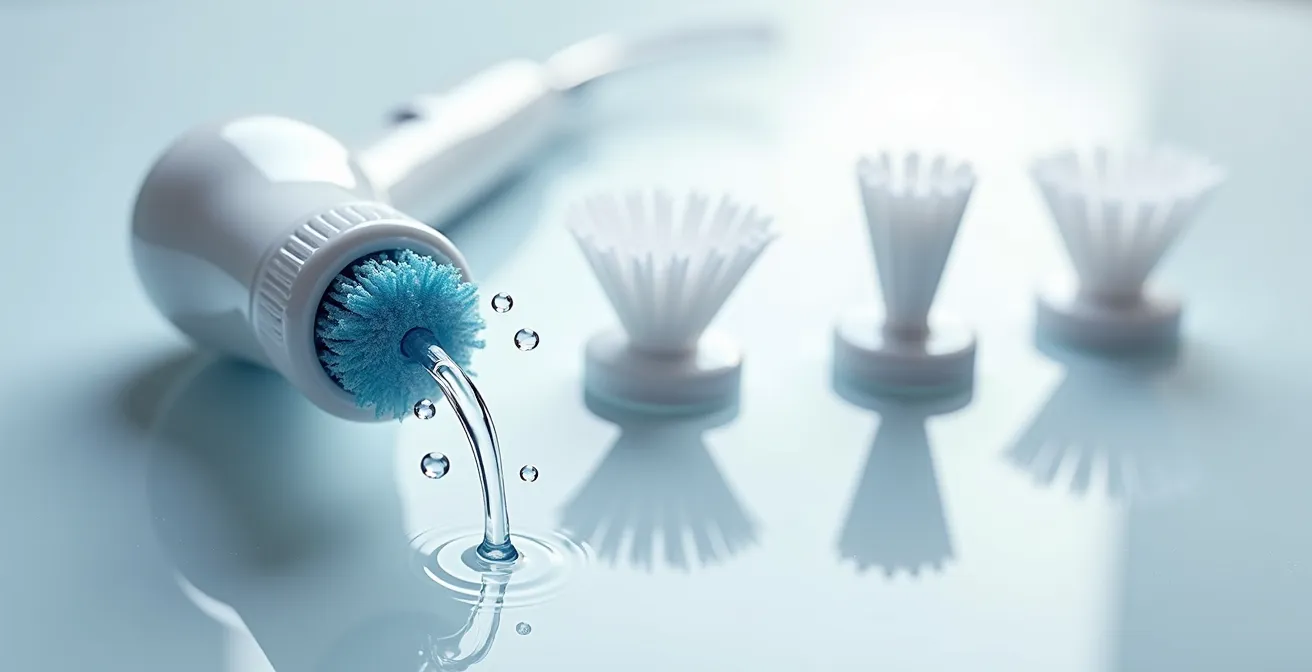
As seen in the arrangement of specialized tools, your bathroom counter will look more like a technician’s station. In addition to water flossing and superfloss, small “proxy brushes” are used at a 45-degree angle to clean the sides of the implant posts where they emerge from the gums. During the first six months of healing, it’s also wise to avoid commercial mouthwashes containing alcohol, as they can dry out oral tissues. A simple salt-water rinse after meals is often more effective and gentler on healing gums. This meticulous routine is the price of admission for a permanent, fixed smile.
Why Upgrade to Zirconia Teeth Instead of the Standard Acrylic Hybrid?
A common point of confusion for patients is the discussion of materials. The teeth you receive on the day of surgery are almost always a temporary “hybrid” bridge made of acrylic (a type of plastic) supported by a metal frame. While functional and aesthetic, this initial bridge is not intended to be a permanent solution. It is designed to be a cost-effective, easily adjustable prosthetic for the healing phase. The real long-term decision you will face is whether to replace it with another acrylic bridge or upgrade to a full Zirconia bridge.
From a purely financial standpoint, Zirconia seems more expensive upfront. However, a 10-year cost-benefit analysis for Montreal residents reveals a different story. Acrylic is prone to staining from coffee (a Tim Hortons regular will notice this quickly), chipping, and wear. The teeth can break off and the material itself wears down, often requiring replacement every 5-7 years or significant repairs every few years. Zirconia, a type of high-strength ceramic, is vastly superior. It is incredibly dense, highly resistant to staining and chipping, and has a lifespan of 15-20 years or more. As Montreal prosthodontists from Smile Montreal Dental Practice state:
Zirconia is more biocompatible, leading to healthier gum tissue response, a crucial point for long-term success.
– Montreal prosthodontists, Smile Montreal Dental Practice
This table breaks down the long-term financial and functional implications, demonstrating how the initial investment in Zirconia can be more economical over a decade.
| Feature | Acrylic Hybrid | Zirconia Bridge |
|---|---|---|
| Initial Cost | $15,000-$20,000 | $23,000-$30,000 |
| Lifespan | 5-7 years | 15-20+ years |
| Stain Resistance | Poor (yellows with coffee/wine) | Excellent (resists Tim Hortons stains) |
| Repair Frequency | Every 2-3 years | Minimal maintenance |
| 10-Year Total Cost | $25,000-$35,000 (with replacements) | $23,000-$30,000 (one-time) |
| Bite Force Tolerance | Moderate | Superior (handles Montreal bagels) |
The superior bite force tolerance of Zirconia is not a trivial feature; it’s the difference between eating with caution and confidently biting into the foods you love, including those famous Montreal bagels. The choice is a classic case of “pay now or pay later,” both financially and functionally.
Why You Might Lisp for Two Weeks After All-on-4 Surgery?
One of the most surprising and temporarily distressing side effects for many patients is a change in their speech. It’s common to develop a slight lisp or have difficulty pronouncing certain sounds, particularly “S” and “Th,” immediately after the new bridge is placed. This is not a sign of a flawed prosthetic; it is a normal and temporary phase of neuro-muscular adaptation. Your tongue has spent years, or even decades, accustomed to the specific shape and volume of your natural teeth or denture. Suddenly, it has a new, slightly bulkier “palatal” surface to contend with.
The tongue needs time to re-learn its positioning to form sounds against this new structure. This adaptation period can vary from a few days to a few weeks. The key is active practice. Simply waiting for it to go away is less effective than consciously working on it. Clinics recommend simple speech exercises to speed up the process. For bilingual Montreal patients, this can mean practicing both English and French sounds.
Patient Speech Adaptation Timeline at Msmiline in Pierrefonds
Patients at Msmiline Cosmetic Dentistry in Pierrefonds report temporary speech adjustment periods lasting a few days to weeks. Minor changes like a lisp occur initially as the tongue adapts to the new prosthetic palatal bulk. Dr. Mirmooji notes that practicing common words and reading Montreal Gazette articles aloud speeds adaptation. According to an overview of their All-on-4 implant process, most patients achieve normal speech within 2-3 weeks, with fine-tuning of the prosthetic fit available if issues persist beyond this period.
To accelerate your own adaptation, you can try reading headlines from La Presse aloud to work on sibilant “S” sounds, repeating English phrases with “the” and “this,” and practicing the nasal sounds common in Quebec French like ‘un,’ ‘on,’ and ‘en.’ Recording yourself daily can help you track your progress and build confidence. If a significant lisp or a gag reflex persists beyond three weeks, it’s important to contact your Montreal clinic, as a minor adjustment to the prosthetic’s bulk may be necessary.
What Does Implant Failure Feel Like in a Full Arch Case?
With such a significant investment of time and money, the fear of implant failure is a major source of anxiety for patients. It’s crucial to distinguish between normal post-operative symptoms and genuine red flags. In the first one to two weeks, you will experience a dull ache, swelling, and possibly a low-grade temperature. This is your body’s natural response to surgery and is manageable with prescribed medication. The key indicator of normal healing is that these symptoms peak around day 3 and then steadily decrease.
Implant failure, on the other hand, presents a different set of symptoms. The pain is often described as a sharp, shooting pain when you bite down, or a persistent, throbbing ache that does not subside with medication. If you notice swelling that increases after day 5, or if you develop a fever above 38.5°C, these are warning signs that require an immediate call to your surgeon. The most definitive sign of a problem is any sensation of movement. A healing implant should feel completely firm and integrated with your jaw. If you feel a “spinning” sensation or any mobility when touching an implant area (through the bridge), it could indicate that osseointegration has failed.
This table from data provided by oral surgery specialists helps differentiate between what is normal and what is a cause for concern. Being able to self-monitor effectively can provide peace of mind and ensure you seek help at the earliest sign of trouble.
| Symptom | Normal Post-Op (Days 1-14) | Failure Red Flags (Seek Help) |
|---|---|---|
| Pain Level | Dull ache manageable with medication | Sharp pain when biting, persistent throb |
| Swelling | Peaks at 48-72 hours, then decreases | Increased swelling after day 5 |
| Temperature | Slight elevation (<38°C) | Fever above 38.5°C |
| Implant Sensation | Firm, no movement | ‘Spinning’ sensation or mobility |
| Gum Appearance | Pink, healing normally | Red, inflamed around specific implant |
Knowing these differences empowers you to be a vigilant participant in your own recovery. Do not hesitate to contact your clinic if you experience any of the red flag symptoms; early intervention is key.
Are Dental Implants a Safe Option for Seniors Over 70 in Montreal?
A common misconception is that there is an age limit for dental implants. For seniors in Montreal over 70, the primary determining factor for candidacy is not chronological age, but overall health and bone density. A healthy 80-year-old can be a better candidate than an unhealthy 50-year-old. Conditions like uncontrolled diabetes, a history of radiation therapy to the jaw, or heavy smoking can complicate healing and compromise implant success. However, many chronic conditions, when well-managed, do not prevent treatment.
As experts from a leading Montreal clinic explain, a collaborative approach is key. This is a point emphasized by the team at Maxillo 3 Lacs, who note that candidacy is determined by overall health, not chronological age. Top Montreal specialists regularly coordinate with a patient’s family doctor or specialists at major hospitals like the MUHC or the CHUM to ensure that conditions such as heart disease or osteoporosis are properly managed before, during, and after surgery. This integrated approach ensures patient safety is the top priority.
Candidacy is determined by overall health, not chronological age. Montreal specialists coordinate with a patient’s family doctor or specialists at major hospitals like the MUHC or CHUM to manage conditions.
– Dr. El-Hakim, Dr. Makhoul and Dr. Gigliotti, Maxillo 3 Lacs Montreal
Furthermore, the success rates for this procedure in the senior population are exceptionally high. In fact, for many seniors struggling with ill-fitting dentures that cause poor nutrition and social withdrawal, dental implants can dramatically improve their quality of life. Studies consistently show that Montreal maxillofacial surgeons report that All-on-4 treatment achieves an over 95% success rate, and this holds true for older, healthy patients. Age itself is not a barrier; a thorough health evaluation is the only true determinant.
Where to Start When You Need to Fix Every Single Tooth?
Facing the need for a full-mouth reconstruction can feel overwhelming. The clinical complexity and financial scope are significant, and many patients simply don’t know where to begin. The most critical first step is to move from a state of general worry to a concrete, actionable plan. This begins with a specialized consultation. You should not start with a general dentist, but with a clinic in Montreal that specializes in complex restorative cases and has a prosthodontist on staff. They have the advanced training and technology required for these procedures.
During this comprehensive evaluation, the clinic will perform a 3D CBCT scan. This advanced X-ray provides a detailed map of your jawbone, nerve locations, and sinus cavities, which is essential for planning implant placement. A prosthodontist will then assess your bite, aesthetic requirements, and functional needs to develop a detailed treatment plan. A crucial part of this plan for Montreal residents is the inclusion of specific Quebec dental codes for each procedure. These codes are necessary for submitting pre-determinations to your private insurance provider, such as Sun Life or Manulife, to understand what portion of the treatment may be covered.
Once you have an estimate of your out-of-pocket costs, you can explore financing options. Many Montreal clinics have partnerships with financial institutions like Desjardins to offer Accord D financing, which can break down the significant cost into manageable monthly payments. With the average price of a single dental implant in Quebec being approximately $4,000 CAD, a full-arch solution represents a major investment. A structured approach is the only way to navigate it successfully.
Your Full-Mouth Rehabilitation Roadmap in Montreal
- Initial Consultation: Book an appointment with a Montreal clinic that has a prosthodontist specializing in complex restorative cases.
- Comprehensive Evaluation: Undergo a full assessment including a CBCT scan to map bone structure and determine implant viability.
- Treatment Plan & Codes: Receive a detailed, phased treatment plan that includes the official Quebec dental codes for each procedure.
- Financial Planning: Submit the plan to your private insurer (e.g., Sun Life, Manulife) for a pre-determination and explore financing options like Desjardins Accord D for the remainder.
- Phased Approach: Discuss the possibility of a phased treatment with your clinician to align the procedure schedule with your budget and personal tolerance.
Key Takeaways
- The “Teeth in a Day” surgery is just the start; a strict 4-month soft diet is mandatory for the implants to heal and integrate successfully.
- Permanent hygiene for a fixed bridge is technical and non-negotiable, requiring tools like water flossers and superfloss to prevent failure.
- The long-term choice between a standard acrylic bridge and a premium Zirconia upgrade is a critical financial and functional decision that impacts durability and lifetime cost.
What Does Implant Failure Feel Like in a Full Arch Case?
After understanding the potential warning signs of implant failure, it’s equally important to contextualize the risk. While failure is a serious concern, it is not the most likely outcome. In fact, the opposite is true. The All-on-4 procedure and similar full-arch restorations are among the most predictable and successful treatments in modern dentistry. The key is a combination of proper surgical planning, skilled execution, and, most importantly, patient compliance with post-operative instructions.
The vast majority of failures that do occur happen within the first few months and are often linked to patient-controlled factors, such as smoking or introducing hard foods too early, which disrupts the delicate osseointegration process. A successfully integrated implant is one where the jawbone has grown directly onto the titanium surface, creating a solid, stable foundation that is biologically fused to your body. This successful integration is the silent, invisible process that makes the entire restoration possible.
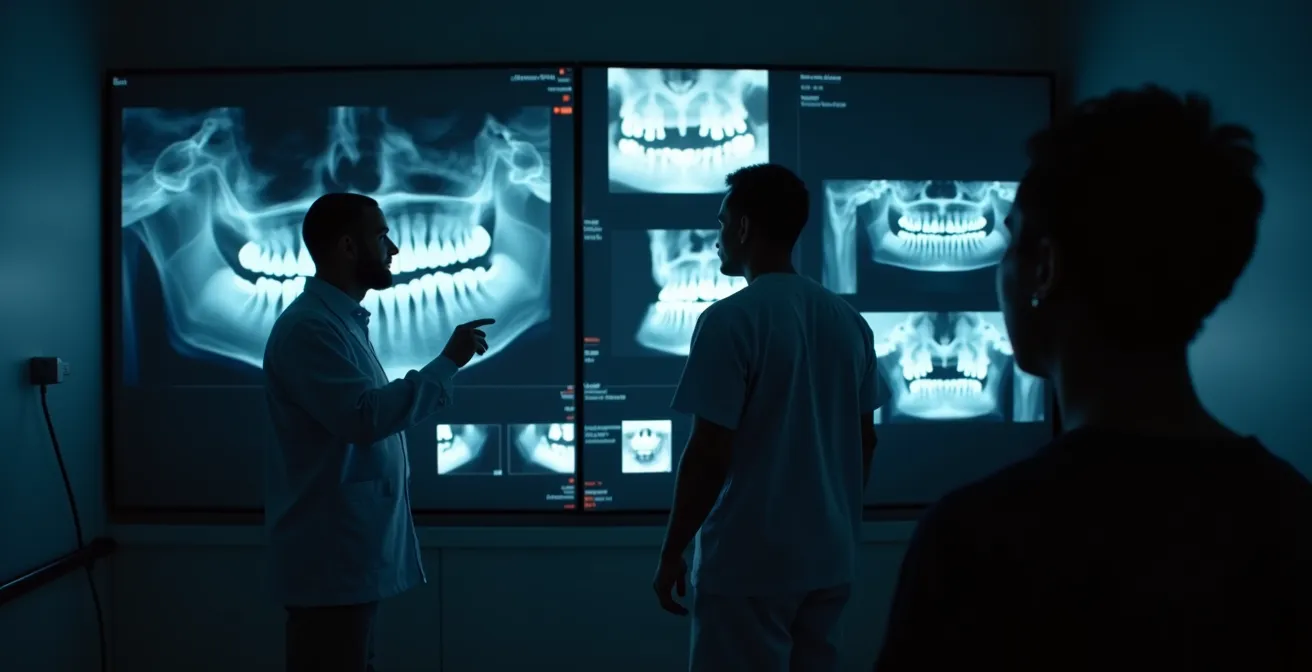
As this clinical visualization shows, the goal is a seamless bond between implant and bone. When this is achieved, the long-term prognosis is excellent. Studies from multiple reputable sources, including those from Montreal-based clinics, consistently report high success rates. For example, comprehensive reviews show that studies from Montreal clinics show All-on-4 procedures have a 94.8% to 98.0% success rate after a 10-year follow-up period. This statistic should be reassuring. While it is vital to be vigilant for warning signs, it is also important to proceed with confidence, knowing that you are undergoing a procedure with a proven track record of success when protocols are followed.
Ultimately, navigating the path to a fixed smile is about being an informed and realistic patient. By looking past the marketing and focusing on the practical steps of healing, hygiene, and long-term planning, you transform from a passive recipient into an active partner in your own success. To begin this journey with clarity, the next logical step is to seek a consultation that prioritizes this transparent, long-term approach.