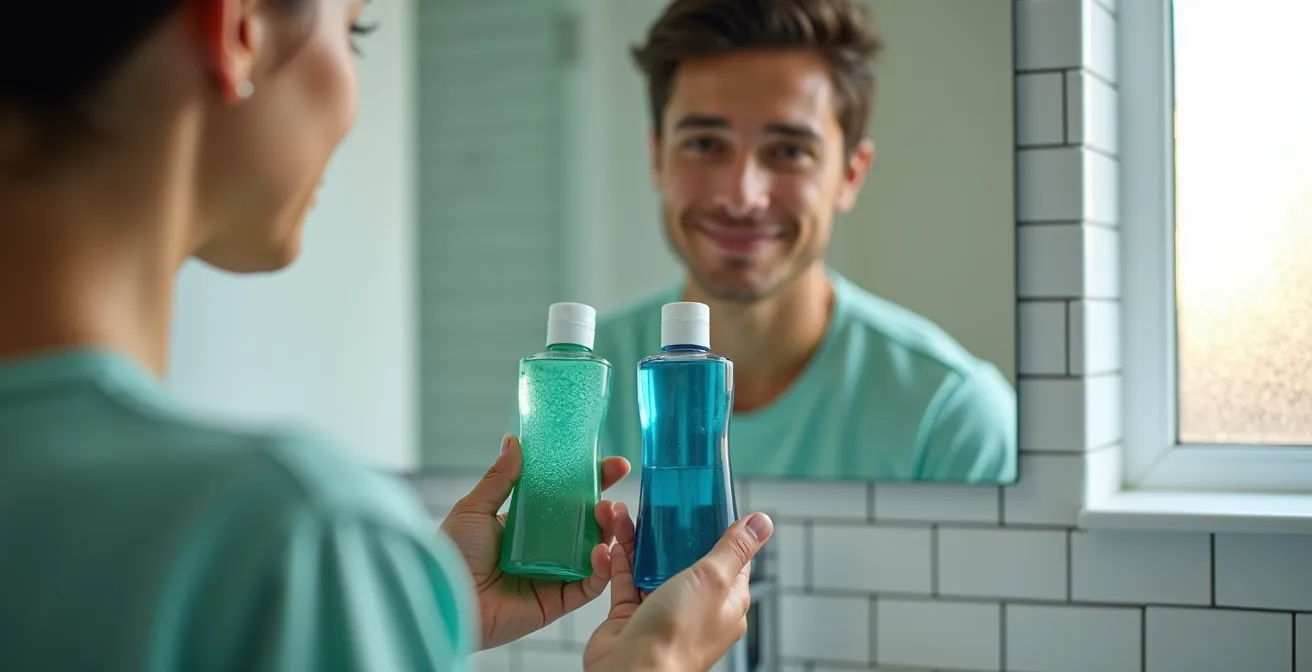
In summary:
- Stop choosing mouthwash based on the problem on the label; select it based on the active ingredient’s mechanism.
- Alcohol-based rinses can worsen bad breath by drying your mouth and disrupting your oral microbiome.
- For gum health (gingivitis), look for ingredients like stannous fluoride or CPC. For sensitivity, look for potassium nitrate.
- Never rinse immediately after brushing. Wait at least 30 minutes to let the fluoride from your toothpaste work.
- Persistent bad breath can be a sign of systemic health issues; consult a doctor if a targeted oral care routine doesn’t help.
Standing in the mouthwash aisle of a Montreal Pharmaprix or Jean Coutu can be overwhelming. Dozens of bottles promise to cure bad breath, fight gingivitis, whiten teeth, or soothe sensitivity. The labels blur together, and you’re left wondering: is there really a difference, or is it all just mint-flavoured marketing? Many of us grab a bottle for bad breath, hoping it will solve our gum issues, or vice-versa. We often hear that the answer is to just “pick one with the CDA seal,” but that doesn’t help narrow down 30 approved options.
The common approach is to treat mouthwash as a cosmetic rinse—a quick fix for morning breath or before a meeting. This leads to choosing a product that masks a symptom rather than addressing its root cause. But what if the true key isn’t found on the front of the bottle, but in the fine print of the active ingredients list? The secret to navigating the shelf isn’t to find one “best” mouthwash; it’s to understand that these bottles are a toolkit of specific therapeutic agents.
This guide will shift your perspective. Instead of focusing on the problem advertised, we will focus on the job of the active ingredient inside. You will learn to perform “diagnostic rinsing”—using a specific formula to understand what your mouth truly needs. By understanding the mechanism behind the key ingredients, you can move from randomly guessing to making an informed, effective choice for your specific oral health condition, whether it’s chronic bad breath, tender gums, or something else entirely.
This article provides a clear framework for decoding mouthwash labels. We will explore the active ingredients designed for each major oral health concern, helping you finally select the right therapeutic tool for the job.
Summary: Your Guide to Choosing the Right Mouthwash
- Why Alcohol-Based Rinses Might Be Making Your Bad Breath Worse?
- Should You Rinse Before or After Brushing for Cavity Prevention?
- How Does Potassium Nitrate in Mouthwash Calm Nerve Pain?
- Do Whitening Mouthwashes Actually Change Tooth Color?
- Is Your Natural Mouthwash Actually Eroding Your Enamel?
- Why Can You Only Use Prescription Mouthwash for Two Weeks?
- Why Is Your Breath Bad Even Though You Brush Twice a Day?
- Why Alcohol-Based Rinses Might Be Making Your Bad Breath Worse?
Why Alcohol-Based Rinses Might Be Making Your Bad Breath Worse?
The intense, burning sensation of an alcohol-based mouthwash feels like it must be working. For decades, we’ve associated that sting with a powerful clean. However, the very ingredient that creates this feeling—alcohol—can paradoxically contribute to the problem it’s supposed to solve: bad breath. The primary issue is that alcohol is a desiccant, meaning it causes dryness. A dry mouth is a prime breeding ground for the very bacteria that produce foul-smelling volatile sulfur compounds (VSCs).
While the initial blast of mint and alcohol may mask odour, the subsequent dryness can lead to a rebound effect, where bad breath returns even stronger. This creates a cycle where you feel the need to rinse more often, further drying out your oral tissues. It’s a classic case of a cosmetic mask hiding a brewing problem. If you experience persistent dry mouth or find your breath is only fresh for a short period after rinsing, your alcohol-based mouthwash is a likely culprit.
Furthermore, the aggressive nature of alcohol doesn’t just kill “bad” bacteria; it can disrupt your entire oral ecosystem. According to dental research, mouthwashes that contain alcohol can create an imbalanced oral microbiome, eliminating the beneficial bacteria that help maintain a healthy mouth. A healthy mouth relies on a balanced community of microorganisms, and indiscriminately wiping them out can lead to long-term issues beyond just bad breath. For chronic halitosis, choosing an alcohol-free formula that targets specific bacteria without causing dryness is a far more effective therapeutic strategy.
Should You Rinse Before or After Brushing for Cavity Prevention?
This is one of the most common and critical mistakes in oral hygiene: using mouthwash immediately after brushing your teeth. It feels like the logical final step to “rinse everything clean,” but it actively undermines the most important part of your routine. The fluoride in your toothpaste is highly concentrated to remineralize and strengthen your enamel against acid attacks. When you brush, you leave a residual layer of this protective fluoride on your teeth. Rinsing right away simply washes it all down the drain.
Think of the time right after brushing as the “Fluoride Window.” This is a crucial 30-minute period where the fluoride from your toothpaste is at its peak effectiveness, actively working to repair your enamel. Introducing any liquid, even a fluoride mouthwash, will dilute this concentration and reduce its preventative power. The fluoride in mouthwash is much less concentrated than what’s in your toothpaste and is not meant to replace it.
The correct approach is to separate your brushing and rinsing times. After brushing, spit out the excess toothpaste but do not rinse with water or mouthwash. Reserve your mouthwash for a completely different time of day, such as after lunch. This gives you an extra dose of fluoride and freshness midday without interfering with your morning and evening brushing sessions. This simple change in timing can significantly boost your defense against cavities.

As the image suggests, timing is everything. By treating brushing and rinsing as separate events with distinct purposes, you maximize the benefits of both. This small adjustment ensures your toothpaste’s cavity-fighting ingredients have the time they need to work effectively.
Your Action Plan: The Fluoride Window Protocol
- After brushing, spit out any excess toothpaste but do not rinse your mouth with water or mouthwash immediately.
- Do not use mouthwash (even a fluoride one) straight after brushing, as it will wash away the concentrated toothpaste fluoride.
- Choose a different time to use mouthwash, such as after lunch, to freshen up and get an extra fluoride boost.
- Wait at least 30 minutes after using a fluoride mouthwash before eating or drinking to allow it to work.
- View mouthwash as a supplement to your routine, not the final step of your brushing process.
How Does Potassium Nitrate in Mouthwash Calm Nerve Pain?
If a sip of cold water or a bite of ice cream sends a sharp, shooting pain through your teeth, you’re experiencing dentin hypersensitivity. This occurs when the protective enamel wears down or gums recede, exposing the underlying dentin layer. This layer contains thousands of microscopic tubules that lead directly to the tooth’s nerve pulp. When exposed, external stimuli can travel through these tubules and trigger the nerve, causing that characteristic jolt of pain. The active ingredient designed specifically for this job is potassium nitrate.
Potassium nitrate works by acting as a nerve-calming agent. It doesn’t block the tubules physically, but rather, it penetrates them to reach the nerve. Once there, it depolarizes the nerve, making it less responsive and unable to send pain signals to the brain. Think of it as a “numbing” agent that, with consistent use, builds up a shield of calmness around the nerve. This is why sensitivity-focused products, whether toothpaste or mouthwash, often require several weeks of regular use to become fully effective. The effect is cumulative.
It’s crucial to differentiate this mechanism from treatments for gingivitis. While a brand like Crest Pro-Health, widely available in Canada, might offer formulas that tackle both plaque and sensitivity, the active ingredients are doing different jobs. An antiseptic agent like Cetylpyridinium Chloride (CPC) kills bacteria to fight gingivitis, while potassium nitrate is focused solely on soothing the nerve. The table below clarifies the distinct roles of common therapeutic ingredients.
As this comparative analysis from a leading dental practice shows, choosing the right mouthwash depends on correctly identifying the cause of your discomfort—is it bacterial inflammation or nerve exposure?
| Active Ingredient | Primary Function | Secondary Benefits |
|---|---|---|
| Potassium Nitrate | Reduces tooth sensitivity | May provide temporary relief from nerve pain |
| Stannous Fluoride | Reduces gingivitis | Strengthens enamel, prevents cavities |
| CPC (Cetylpyridinium Chloride) | Kills bacteria | Reduces bad breath, controls plaque |
Do Whitening Mouthwashes Actually Change Tooth Color?
The promise of a brighter, whiter smile from a simple 30-second rinse is highly appealing. Whitening mouthwashes have become a popular category, but it’s important to manage expectations. These products primarily work by helping to remove and prevent extrinsic (surface) stains, rather than changing the intrinsic shade of your teeth. Their main whitening agent is typically hydrogen peroxide, the same ingredient used in professional whitening treatments, but at a much lower concentration.
Most over-the-counter whitening mouthwashes contain a 1.5 to 2 percent hydrogen peroxide concentration. For comparison, professional whitening gels used by dentists can range from 25 to 40 percent. This significant difference in strength is why mouthwash results are far more subtle and take much longer to appear. The low concentration and short contact time (30-60 seconds) are sufficient to help lift daily surface stains from coffee, tea, or wine, but not to deeply bleach the tooth’s dentin layer, which determines its core colour.
Therefore, a whitening mouthwash is best viewed as a maintenance tool. It can help keep your teeth bright after a professional cleaning or whitening procedure and slow down the accumulation of new stains. However, it will not produce the dramatic, multi-shade changes that cosmetic dental procedures can achieve. As a leading dental benefits provider explains, the effect is real but limited.
Some mouthwashes are formulated with active ingredients like hydrogen peroxide to reduce staining and whiten teeth. These typically require extended use before any results are noticeable and will not have the same effect as cosmetic whitening procedures performed by your dentist.
– Delta Dental, Delta Dental Oral Health Guidelines
Is Your Natural Mouthwash Actually Eroding Your Enamel?
The “natural” and “DIY” wellness trend has extended to oral care, with many people turning to homemade or boutique mouthwashes containing ingredients like apple cider vinegar, lemon juice, or various herbs. While the intention to avoid synthetic chemicals is understandable, some of these natural ingredients can pose a significant risk to your dental health, specifically through enamel erosion.
Your tooth enamel is the hardest substance in your body, but it is vulnerable to acid. Enamel begins to demineralize, or dissolve, at a pH of 5.5 or lower. Many popular “natural” ingredients are highly acidic. For example, apple cider vinegar and lemon juice have a pH between 2 and 3. Rinsing your mouth with these substances is akin to giving your teeth an acid bath, which can soften and strip away the protective enamel layer over time, leading to increased sensitivity and cavity risk.

Not all natural ingredients are harmful, however. The key is scientific validation. For instance, certain essential oils—specifically eucalyptol, menthol, thymol, and methyl salicylate—have proven antimicrobial properties and are the active ingredients in many mouthwashes that have earned the Canadian Dental Association (CDA) seal of approval. These ingredients effectively kill bacteria without the damaging acidity. When choosing a natural mouthwash, it’s crucial to look for formulas with a neutral pH and ingredients backed by dental research, rather than assuming anything “natural” is inherently safe for your teeth.
Why Can You Only Use Prescription Mouthwash for Two Weeks?
When you have a severe gum infection (periodontitis) or are recovering from dental surgery, your dentist may prescribe a special medicated mouthwash. The gold standard for this is chlorhexidine gluconate. This powerful antiseptic is incredibly effective at killing a broad spectrum of bacteria and preventing plaque from forming, making it a crucial tool for short-term, intensive oral care. However, its very strength is why its use is strictly limited.
Dental guidelines specify a 2 weeks maximum recommended duration for chlorhexidine prescription mouthwash use. This is not an arbitrary number; it’s based on the significant side effects that can occur with prolonged use. The most common and noticeable side effect is extrinsic staining. Chlorhexidine can bind to the pellicle (the protein layer on your teeth), causing a brown or yellow discoloration on teeth, fillings, and even your tongue. While this staining is on the surface and can be polished off by a hygienist, it is cosmetically undesirable.
Beyond staining, long-term use can also lead to an increase in supragingival calculus (tartar) formation and, for some, a temporary alteration in taste perception. Because of these effects, chlorhexidine is considered a short-term therapeutic intervention, not a daily maintenance rinse. Its purpose is to get a severe bacterial problem under control quickly, after which you should transition back to a gentler, over-the-counter mouthwash for long-term gum health maintenance, such as one containing stannous fluoride or CPC.
Why Is Your Breath Bad Even Though You Brush Twice a Day?
It’s a frustrating scenario: you brush diligently twice a day, you floss, yet you still suffer from persistent bad breath (halitosis). If your oral hygiene is meticulous, it’s a sign that the problem may lie deeper than surface cleaning. Most cases of bad breath are caused by bacteria living on the tongue and below the gumline, which produce odorous volatile sulfur compounds (VSCs). Brushing alone may not be enough to control this bacterial population.
However, if a high-quality antibacterial mouthwash doesn’t resolve the issue, it’s time to consider that the cause may not be in your mouth at all. Halitosis can be a symptom of an underlying systemic health condition. This is where it becomes crucial to differentiate between oral and non-oral causes to seek the right professional help. Your mouth can be a window into your overall health.
Conditions like acid reflux (GERD), post-nasal drip from sinus issues, tonsil stones, or even metabolic disorders like diabetes and kidney issues can all manifest as persistent bad breath that no amount of brushing or rinsing will cure. The odour’s character can sometimes offer a clue (e.g., a “fruity” or acetone smell can be linked to diabetes). This is why if your halitosis persists despite a rigorous and targeted oral care routine, your next step should be a visit to your family doctor (GP) or a specialist.
The following table, based on information from multiple dental health resources, helps clarify when to see your dentist versus another medical professional.
| Oral Causes | Systemic Causes | When to See |
|---|---|---|
| Plaque below gumline | GERD | Dentist |
| Tongue coating | Post-nasal drip | GP/ENT |
| Dental abscess | Diabetes | Emergency dentist |
| Gingivitis | Kidney issues | Medical specialist |
Key Takeaways
- Your mouthwash is a therapeutic tool. Choose it based on the active ingredient that solves your specific problem (e.g., potassium nitrate for sensitivity, stannous fluoride for gingivitis).
- Avoid alcohol-based rinses for chronic bad breath, as they can cause dryness and disrupt your oral microbiome, ultimately making the problem worse.
- Proper timing is crucial. Never rinse right after brushing; save your mouthwash for another time of day, like after lunch, to protect the concentrated fluoride from your toothpaste.
Why Alcohol-Based Rinses Might Be Making Your Bad Breath Worse?
We’ve established that the traditional, alcohol-heavy mouthwash can be a double-edged sword, providing a temporary feeling of clean while potentially exacerbating the underlying causes of bad breath. So, what is the effective alternative? The solution is to shift your focus from the harshness of alcohol to the targeted action of modern, alcohol-free antiseptic ingredients. This is the final step in moving from a cosmetic approach to a truly therapeutic one.
The most effective alcohol-free antibacterial mouthwashes utilize ingredients like Cetylpyridinium Chloride (CPC) or Stannous Fluoride. CPC is a well-researched compound that effectively kills plaque and gingivitis-causing bacteria and neutralizes VSCs without the drying effect of alcohol. Stannous fluoride is a multi-tasking powerhouse; it not only fights bacteria to reduce gingivitis but also strengthens enamel and can help with sensitivity, making it an excellent all-around choice for gum health.
When you’re back in that pharmacy aisle, your new mission is to ignore the “Kills 99.9% of Germs” claims that often rely on alcohol, and instead, turn the bottle over. Look for “Alcohol-Free” on the front and “Cetylpyridinium Chloride” or “Stannous Fluoride” in the active ingredients list on the back. This simple check ensures you are selecting a modern, therapeutic tool designed for long-term health, not a dated, cosmetic mask.
Your next step is to audit your current mouthwash. Check the label for alcohol and the active ingredients, and determine if it’s truly serving your oral health goals or simply masking a symptom. Make your next purchase an informed, therapeutic one.