
Navigating Quebec’s dental care system on a limited budget means understanding that “covered” almost always comes with conditions.
- The Régie de l’assurance maladie du Québec (RAMQ) is generous for children under 10 but extremely limited for most adults, covering almost no routine care.
- Accessing benefits for social assistance recipients or specific hospital procedures requires precise documentation and proven medical necessity.
Recommendation: Your most powerful tools are a valid RAMQ card at all times, understanding tax credits for out-of-pocket expenses, and exploring university clinics for major work.
For many residents in Montreal and across Quebec, understanding what dental care is covered by the public system feels like trying to solve a puzzle with missing pieces. You hear that some services are free, especially for children, but the reality for adults, students, or those on a low income can be confusing and often discouraging. It’s easy to assume that if you’re an adult, you’re simply on your own, facing the full cost of every check-up, filling, and procedure.
This assumption, while partly true, overlooks the critical details. The public system, governed by the Régie de l’assurance maladie du Québec (RAMQ), is not a simple “yes” or “no”. It’s a complex framework of specific conditions, age limits, and procedural requirements. Simply having a health card is not enough; accessing the benefits you are entitled to requires knowing the rules of the system. This is especially true when navigating the intersection between RAMQ, social assistance programs, and the new Canadian Dental Care Plan (CDCP).
But what if the key wasn’t just knowing what’s covered, but understanding *how* to navigate the system to your advantage? This guide is designed from the perspective of an administrator, cutting through the jargon to give you factually strict, empathetic advice. We will move beyond the generalities and focus on the specific pathways and documentation you need to maximize every available benefit. This is about system navigation—treating your dental health with a clear, strategic plan.
This article will break down the essential information you need, from pediatric care and surgical extractions to the specific benefits for social assistance recipients. We will explore the practical steps for managing high costs and claiming expenses, providing you with the clarity needed to make informed decisions for your dental health in Quebec.
Summary: Your Guide to RAMQ Dental Coverage and Costs in Quebec
- Free Dental for Kids in Quebec: What Is Included and What Isn’t?
- When Does RAMQ Pay for Wisdom Teeth Extraction in a Hospital?
- Dental Benefits for Social Assistance Recipients: Understanding the Limits
- Why Must You Present a Valid Health Card for Every Dental Visit?
- How to Claim Dental Expenses on Your Quebec Tax Return?
- Does RAMQ Cover Dental Work for Seniors Over 65?
- How to Pay for $10,000 of Dental Work Without Going Broke?
- Free Dental for Kids in Quebec: What Is Included and What Isn’t?
Free Dental for Kids in Quebec: What Is Included and What Isn’t?
Quebec’s public health insurance plan provides a significant advantage for families by offering a range of free dental services for children under 10 years old. This coverage is a cornerstone of preventative health in the province, but it’s crucial for parents in Montreal to understand its scope and, more importantly, its limitations. To access these services, a child must have a valid RAMQ health insurance card, which must be presented at every visit.
The covered services are quite comprehensive for basic needs. They include one annual examination, any necessary emergency examinations, and X-rays. For restorative work, RAMQ covers amalgam (silver) fillings for posterior teeth and aesthetic (white) fillings for anterior teeth. Furthermore, more complex procedures like prefabricated crowns and endodontic treatments, including root canal therapy, are also included under this program. This ensures that major dental health issues in young children can be addressed without a direct financial burden on the family.
However, the most common misconception is that all pediatric dental care is free. Several key services are notably excluded. Routine teeth cleaning and fluoride applications are not covered by RAMQ. These are considered preventative maintenance and are the financial responsibility of the parents. Additionally, as one Montreal parent’s experience highlights, Quebec’s coverage does not extend to orthodontic treatments. This means that services like braces, which are often a significant expense during childhood or adolescence, require private dental insurance or out-of-pocket payment.
When Does RAMQ Pay for Wisdom Teeth Extraction in a Hospital?
For most adults in Quebec, dental extractions, including wisdom teeth, are not covered by RAMQ when performed in a private dental clinic. This is a common point of confusion and financial stress. However, there is a critical exception: RAMQ will cover the cost of a tooth or root extraction, including wisdom teeth, if it is performed in a hospital setting due to medical necessity. This is the core condition that unlocks public coverage.
What constitutes “medical necessity”? This is determined by a physician or a dental specialist and typically involves situations where a patient has a concurrent illness, such as a heart condition or a bleeding disorder, that makes a standard in-office procedure unsafe. It can also apply in cases of severe infection (like an abscess) or trauma that requires the resources of a hospital. A referral from a dentist to an oral and maxillofacial surgeon practicing in a hospital like the MUHC is required. In these specific, medically-justified cases, RAMQ covers the surgeon’s fee and associated hospital costs.
The financial difference is substantial. In a private clinic, wisdom tooth extraction costs in Montreal typically range from $294 to $826 per tooth, depending on complexity. If the procedure is deemed medically necessary and performed in a hospital, the cost to the patient with a valid RAMQ card is $0. This distinction highlights the system’s focus: it is a health insurance plan, not a comprehensive dental plan. It intervenes when a dental problem becomes a medical one requiring hospital-level care.
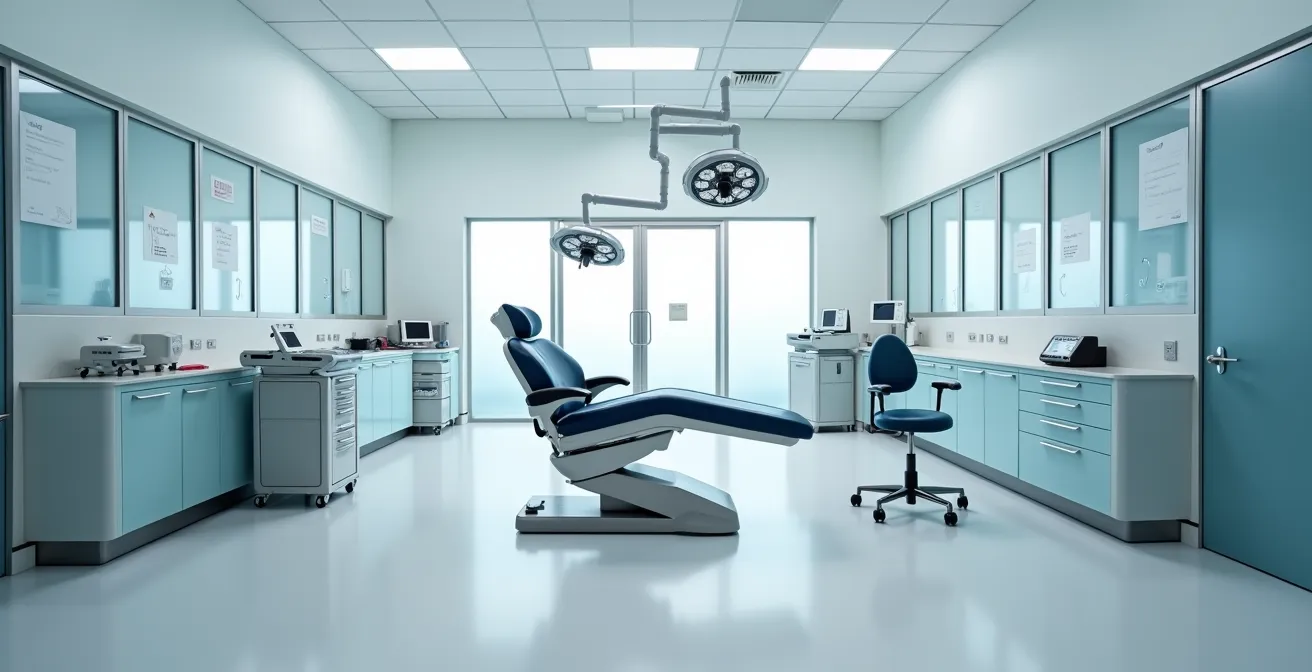
As the image of a professional surgical suite suggests, these hospital-based procedures are reserved for complex cases that go beyond routine dental care. It is not an option for elective or non-complicated extractions. Therefore, unless you have a specific medical condition, you should expect to pay for wisdom tooth removal through private insurance or out-of-pocket.
Dental Benefits for Social Assistance Recipients: Understanding the Limits
For individuals and families receiving social assistance in Quebec, there are specific dental benefits available, but they are subject to strict eligibility rules and service limitations. Access is not automatic upon receiving benefits; it is conditional. The primary requirement is that you must have been a recipient of a social assistance program (such as Social Assistance or Social Solidarity) for at least 12 consecutive months. This waiting period is a critical first hurdle.
Once this condition is met, your eligibility is indicated directly on your claim slip (often called the `carnet de réclamation`). You must check to see if the word “YES” appears in the “Dental Care” box. If it does, you are entitled to certain services covered by RAMQ. When visiting the dentist, you must present both your valid Health Insurance Card and this valid claim slip. Both documents are non-negotiable for the dentist to be able to bill RAMQ directly.
The covered services for eligible recipients are limited to basic, immediate needs. These generally include examinations, X-rays, simple fillings, and extractions. It’s important to note that more extensive procedures like root canals or crowns are typically not covered. After 24 months of continuous assistance, recipients become eligible for coverage for dentures, but this requires a pre-authorization form obtained from a Services Québec office *before* visiting a denturist.
With the introduction of the Canadian Dental Care Plan (CDCP), it’s vital to avoid confusion. Federal guidelines are clear: services covered by Quebec RAMQ will NOT be reimbursed by the CDCP. The programs are designed to be distinct, not to provide duplicate payments. This means you cannot use the federal plan to pay for a service that is already an insured benefit for social assistance recipients under RAMQ.
Why Must You Present a Valid Health Card for Every Dental Visit?
The insistence on presenting a valid Quebec Health Insurance Card (RAMQ card) at every single dental appointment can sometimes feel like a bureaucratic formality, but it is the absolute linchpin of the public coverage system. For a dentist or hospital to bill RAMQ directly for any insured service—whether for a child’s exam or a medically necessary hospital extraction—they must have proof of the patient’s current, valid coverage at the time the service is rendered. The card is the sole instrument for this verification.
Without a valid card, the provider has no way of confirming your eligibility. From their perspective, you are an uninsured patient responsible for the full cost of the services. This isn’t a policy of a specific clinic; it’s a fundamental rule of the RAMQ system. An expired or invalid card breaks the chain of billing, and the financial responsibility defaults to you, the patient. This underscores the “Documentation is Key” principle of system navigation; your card is your passport to any and all public benefits.
The policy at major institutions like the McGill University Health Centre (MUHC) provides a clear case study. If you arrive for a covered service without a valid RAMQ card, you will be required to go to the Patient Accounts office and pay for the services upfront. However, the system has a recourse: the MUHC will reimburse you in full as soon as you renew your card and present it to update your file. This demonstrates that the issue isn’t to penalize you, but to ensure the administrative and financial records are accurate for RAMQ billing.
Forgetting or losing your card can have immediate financial consequences. While you can get reimbursed, you first have to pay out of pocket. If you lose your card and need proof of eligibility urgently, you can request an attestation of eligibility from RAMQ. However, this is not a free service; RAMQ charges a fee of $20 for this letter, adding an avoidable cost. The simplest and most effective strategy is to treat your RAMQ card with the same care as your driver’s license or bank card.
How to Claim Dental Expenses on Your Quebec Tax Return?
For the vast majority of adult dental care that RAMQ does not cover, the Quebec tax system offers a form of relief through the medical expense tax credit. This is a crucial tool for financial triage, allowing you to recover a portion of your out-of-pocket costs. However, it’s not a simple 1-for-1 deduction. The key is understanding the eligibility threshold. In Quebec, your total eligible medical expenses (including dental) must exceed a certain amount before you can claim the credit.
This threshold is calculated as 3% of your net income, which is found on line 275 of your Quebec (TP-1) income tax return. For example, if your net income is $30,000, your medical expense threshold is $900. You can only claim the amount of expenses that is *above* this $900 threshold. If your total dental and medical costs for the year were $1,200, you would be able to claim $300 on your tax return. It’s also critical to subtract any amount that was reimbursed to you by a private insurance plan.

To successfully claim these expenses, meticulous record-keeping is non-negotiable. You must keep all your dental receipts and any statements from your private insurer. While you don’t submit these with your return, as confirmed by Revenu Québec, you must be able to provide them if requested for verification. The eligible amount is claimed on Line 381 of the TP-1 return. A strategic tip is that you can claim expenses for any 12-month period ending in the tax year, which can help you group larger expenses to exceed the 3% threshold.
Your Action Plan: Claiming Dental Expenses on Line 381
- Gather all dental receipts from any 12-month period ending in the current tax year.
- Calculate 3% of your net income (line 275 of your TP-1 return) to determine your personal threshold.
- Subtract any insurance reimbursements you received from your total dental expenses to find your net cost.
- Enter the eligible expenses that exceed your 3% threshold on Line 381 of your tax return.
- Keep all original receipts and insurance statements in a safe place, as Revenu Québec may request them for verification.
Does RAMQ Cover Dental Work for Seniors Over 65?
There is a persistent and unfortunate misconception that upon reaching the age of 65, Quebec seniors gain access to expanded public dental coverage through RAMQ. The reality is starkly different: there is no specific, universal dental care program for seniors under RAMQ. Seniors are subject to the same rules as any other adult in Quebec. This means that routine dental care—including examinations, cleanings, fillings, and extractions in a dental office—is not covered.
The only coverage available to seniors is the same as for any adult: oral surgery services performed in a hospital for a recognized medical reason. This does little to address the day-to-day dental health needs that are crucial for overall well-being in one’s later years. This gap in public coverage leaves many seniors facing significant out-of-pocket expenses, particularly those on a fixed income who may no longer have access to private insurance from a former employer.
The federal government’s introduction of the Canadian Dental Care Plan (CDCP) is intended to help fill this gap for low-income seniors. However, the coordination between the provincial and federal plans must be clearly understood. The Government of Canada has explicitly stated its policy for Quebec:
At this time, services covered by Quebec dental programs including under the Régie de l’assurance-maladie du Québec (RAMQ) will not be reimbursed by the CDCP.
– Government of Canada, CDCP and Quebec Provincial Dental Programs Coordination
This means if a service is theoretically insured by RAMQ (like a hospital-based surgery), the CDCP will not cover it. For the vast majority of services that RAMQ *doesn’t* cover, the CDCP may offer assistance, provided the senior meets the income and eligibility criteria. For those with higher incomes or who want more predictable coverage, private dental insurance remains a primary option. Plans exist specifically for seniors, with some providers offering guaranteed issue plans for Quebec residents. For instance, a basic plan can start at around $110 per month, providing coverage for preventive and basic restorative care.
Key Takeaways
- RAMQ is primarily for children under 10 and specific, medically necessary hospital surgeries for adults; most routine adult care is not covered.
- Access to any public benefit is conditional on documentation; a valid RAMQ card and, where applicable, a social assistance claim slip are non-negotiable.
- Managing high costs involves a strategic mix of payment plans, using university clinics, and diligently claiming all eligible expenses on your tax return.
How to Pay for $10,000 of Dental Work Without Going Broke?
Facing a quote for $10,000 or more in dental work can be overwhelming, especially in a system with limited public coverage for adults. This level of cost typically involves major restorative procedures like multiple root canals, crowns, bridges, or implants. In these situations, a single solution is rarely enough. The key is a multi-pronged strategy of “financial triage”—systematically exploring every available avenue to reduce and manage the cost.
First, if you have private insurance, you must use it strategically. Many plans have annual maximums. If possible, work with your dentist to phase your treatment across two calendar years. This allows you to use the maximum benefit from two separate years, potentially doubling the amount your insurance contributes. Second, speak directly and honestly with your dental clinic’s administrator. Many clinics in Montreal offer in-house payment plans that allow you to spread the cost over several months or a year, making the immediate financial hit more manageable.
One of the most effective but often overlooked options in Montreal is to seek treatment at a university dental faculty. Both McGill University and the Université de Montréal have student clinics where treatment is performed by dental students under the close supervision of experienced, licensed dentists. The quality of care is high, but the costs can be 30-50% lower than in a private practice. This can translate into thousands of dollars in savings on a major treatment plan. The tradeoff is typically longer appointment times and less scheduling flexibility, but the financial benefit is significant.
The table below outlines a comparison of these financing avenues. Finally, remember to use the tax system as a final safety net by claiming all eligible out-of-pocket expenses for the medical expense tax credit.
| Financing Option | Monthly Cost | Coverage Details | Best For |
|---|---|---|---|
| Private Insurance (Basic) | From $110.90 | Preventive care focus | Regular maintenance |
| Private Insurance (Enhanced) | From $116+ | Includes major restorative | Complex procedures |
| Payment Plans | Varies | Direct with dental clinic | Large treatments |
| University Clinics | 30-50% less | McGill, UdeM faculties | Cost-conscious patients |
Free Dental for Kids in Quebec: What Is Included and What Isn’t?
While knowing the list of RAMQ-covered services for children under 10 is the first step, a parent’s role extends into the practical navigation of the system. Simply being eligible does not guarantee seamless access to care. The parent or guardian holds the primary responsibility for finding a participating dentist, managing appointments, and budgeting for the inevitable non-covered expenses.
First, it is crucial to understand that not all dentists in Montreal accept the RAMQ fee schedule for all services or may have a limited number of spots for RAMQ patients. It is your responsibility to confirm with the dental office when booking the appointment that they accept the child’s RAMQ card for the intended services. This proactive verification prevents surprise bills. A dentist who is “non-participating” can legally charge more than the RAMQ fee, and you will be responsible for the difference.
Second, as established, essential preventative services like routine cleanings and fluoride treatments are not covered. As an administrator, I cannot stress this enough: you must budget for these services out-of-pocket. Delaying or skipping them due to cost can lead to more significant dental issues down the road—like cavities or gum problems—which, while covered by RAMQ, are far more invasive and stressful for a child than a simple cleaning. Thinking of these costs as a necessary investment in your child’s long-term health is a vital mindset shift.
Finally, the parent is the keeper of the documents. Ensuring the child’s RAMQ card is always valid and brought to every appointment is fundamental. This disciplined approach to system navigation—proactive booking, budgeting for extras, and diligent documentation—is what transforms a list of covered services into genuine, stress-free dental care for your child.
Take control of your family’s dental health by using this guide to proactively plan your care, manage expenses, and access every benefit you are entitled to within the Quebec system.