A virtual consultation is your most critical tool for vetting dental tourism to Montreal, shifting the goal from a risky remote diagnosis to a confident viability assessment.
- Accurate self-photos and secure data transmission that complies with Canadian privacy laws (PIPEDA) are non-negotiable first steps.
- It helps avoid dangerous, incomplete price quotes and clarifies if you are a suitable candidate for treatment *before* you commit to travel.
Recommendation: Use the virtual consult to establish a clear cross-border care plan, including a robust protocol for managing any post-operative issues once you are back home.
For the busy executive or remote patient contemplating a trip to Montreal for significant dental work, the question isn’t just about saving money. It’s about efficiency, certainty, and return on investment. The idea of a virtual dental consultation seems like the perfect first step, promising a quick diagnosis from the comfort of your home office. You might assume the primary goal is to get a definitive answer and a fixed price. However, this common assumption misses the true, more strategic purpose of teledentistry in the context of cross-border care.
The reality is that while technology is powerful, it has inherent limitations. A two-dimensional video call can never fully replicate a three-dimensional, in-person clinical examination with tactile feedback and radiographic imaging. This is where a crucial shift in perspective is needed. The purpose of a virtual consult is not a final, infallible diagnosis. Instead, its greatest value lies in its role as a strategic triage and viability assessment tool. It’s the mechanism that determines if a trip to Montreal is a well-founded medical decision or merely wishful thinking.
This guide reframes the virtual consultation, moving beyond the simple question of diagnostic accuracy. We will explore how to provide clinics with the best possible information, understand the real dangers of a simple email quote, and confirm the security of your private health data under Canadian law. Ultimately, you will learn how this initial remote step builds the foundation for a safe, predictable, and successful dental tourism experience in Montreal.
Summary: A Strategic Guide to Virtual Dental Assessments for Montreal Travel
- How to Take Crystal Clear Dental Photos with Your Smartphone?
- Why Getting a Price Estimate by Email Can Be Dangerous?
- Is Zoom Safe for Discussing Your Medical History?
- How We Decide If You Are a Good Candidate Before You Fly to Montreal?
- Who Handles Your Post-Op Complications If You Are Back Home?
- Why Are Americans Traveling to Montreal for Major Dental Work?
- Where to Go for Dental Emergencies in Montreal Outside Regular Business Hours?
- How to Take Crystal Clear Dental Photos with Your Smartphone?
How to Take Crystal Clear Dental Photos with Your Smartphone?
The success of your virtual assessment hinges on one critical factor: the quality of the images you provide. A blurry, poorly lit photo is useless for any clinical evaluation. To empower your Montreal-based dentist with the information they need, you must think like a dental assistant. The goal is to capture sharp, well-lit, and comprehensive views of your teeth and gums. This isn’t just about snapping a quick selfie; it’s about methodically documenting the area of concern.
Effective dental self-photography requires a few key elements. First, lighting is paramount. Avoid using your phone’s harsh flash, which creates glare and washes out important details. Instead, position yourself facing a window to use bright, indirect natural light. A well-lit bathroom can also work. Second, ensure both your camera lens and your mouth are clean to avoid any obstructions or smudges. Finally, to get a clear view of your teeth, especially those in the back, you must pull your cheeks and lips out of the way. While professional retractors are ideal, the handle of a clean spoon can work surprisingly well as a makeshift tool.
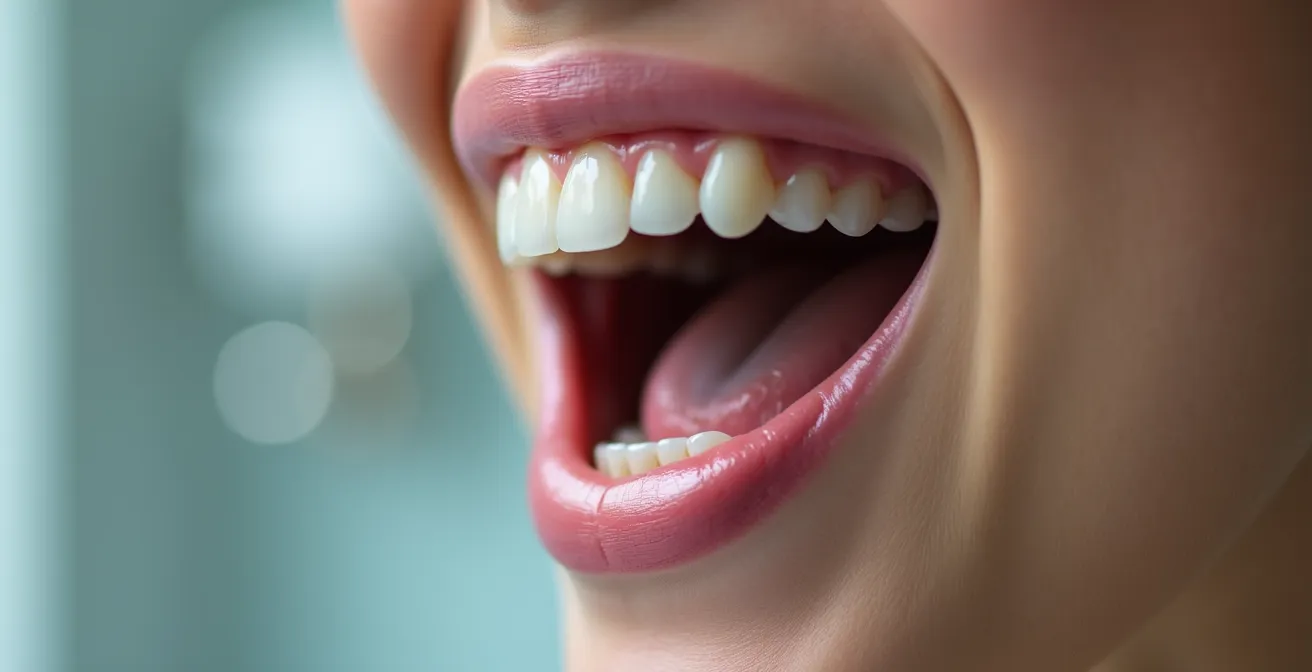
As the image above demonstrates, capturing multiple angles is non-negotiable. Your dentist will need to see the issue from the front, the left and right sides, and the biting surfaces (occlusal view) of both your upper and lower teeth. For dynamic issues like jaw clicking or pain upon movement, a short video can provide invaluable context that a static image cannot. Following these steps transforms your smartphone from a communication device into a powerful diagnostic data-gathering tool, forming the bedrock of a productive viability assessment.
Your 5-Point Photo Quality Check
- Lighting & Clarity: Are all tooth surfaces evenly lit without glare or shadows? Is the gum line clearly visible and its colour true?
- Focus & Stability: Is the image sharp and not blurry? Zoom in on the photo to check for fine details on the tooth surface.
- Completeness of Views: Have you captured all the required angles, including front, left side, right side, and the biting surfaces of both upper and lower arches?
- Obstruction-Free Viewing: Are your cheeks, lips, and tongue fully retracted so that the entire structure of the teeth is visible from the base to the tip?
- Format & Transmission: Are you prepared to submit the high-resolution files through the clinic’s secure portal, not via standard, unencrypted email?
Why Getting a Price Estimate by Email Can Be Dangerous?
In the quest for efficiency, it’s tempting to email a few photos to a clinic and ask for a price quote. This approach, however, is one of the biggest pitfalls in dental tourism. A price quote based on incomplete information is not just inaccurate; it can be dangerously misleading. A simple photo might show a missing tooth, but it cannot reveal the quality or quantity of the underlying bone. It won’t show if a sinus lift is required before an implant can be placed, or if adjacent teeth have issues that must be addressed first.
These “hidden” complexities are precisely what a proper virtual consultation aims to uncover. An emailed price is often a best-case-scenario guess that can set false expectations. Patients may budget for a certain amount, only to arrive in Montreal and discover that necessary ancillary procedures, like a bone graft, will significantly increase the final cost. This creates a high-pressure situation where the patient, having already invested in travel, feels compelled to accept the higher price.
A 2024 market analysis highlights this exact issue. While it confirms that patients can save 60-85% on dental procedures when traveling, it also notes that generic quotes frequently fail to account for these essential preparatory treatments. A responsible clinic will refuse to give a binding quote without a comprehensive virtual assessment. The goal of the initial consultation is to move beyond a simple price and develop a preliminary treatment plan. This plan provides a more realistic cost range and, more importantly, a transparent explanation of what procedures are necessary and why. It’s about shifting from a blind estimate to an informed commitment.
Is Zoom Safe for Discussing Your Medical History?
Once you move past photos and into a live video consultation, you will be discussing sensitive personal health information. For an American patient consulting with a Canadian clinic, this raises a valid question: is this secure? While you may be familiar with the U.S. Health Insurance Portability and Accountability Act (HIPAA), healthcare providers in Montreal operate under Canadian privacy laws, primarily the Personal Information Protection and Electronic Documents Act (PIPEDA). In Quebec, the recently enhanced Law 25 adds even stricter data protection rules.
So, is a standard platform like Zoom or FaceTime compliant? Not necessarily out-of-the-box. A reputable Montreal dental clinic will use a telehealth platform specifically designed for healthcare, which includes features like end-to-end encryption and protocols that align with PIPEDA. This legislation is built on a core set of principles that govern how private sector organizations handle personal information. According to Canada’s Office of the Privacy Commissioner, 10 fair information principles must be followed, covering everything from obtaining meaningful consent to ensuring data accuracy and providing secure safeguards.
This legal framework is what makes a professionally managed virtual consultation safe. The clinic must be transparent about what information they are collecting, why they are collecting it, and how it will be protected. As Victoria Toffan, CEO of Canadian firm CONNECT2D TELEDENTISTRY, states, this compliance is not optional:
Teledentistry providers must be compliant with these standards to ensure the security and protection of patient data and information.
– Victoria Toffan, CEO CONNECT2D TELEDENTISTRY, MedStack interview
Therefore, before your consultation, you should feel empowered to ask the clinic what platform they use and how they ensure PIPEDA and Law 25 compliance. This confirms you are dealing with a professional organization that takes your data security as seriously as your clinical outcome, forming a crucial part of the trust-building process in a cross-border care continuum.
How We Decide If You Are a Good Candidate Before You Fly to Montreal?
From the clinic’s perspective, the virtual consultation is a meticulous filtering process. Our primary goal is to determine, with a high degree of confidence, whether you are a good candidate for the treatment you seek. This protects you from a wasted journey and ensures our resources are focused on patients we can genuinely help. This candidate assessment relies on synthesizing all the information gathered: your high-quality photos, your detailed medical history, and the live discussion during the video call.
First, we analyze the images and videos you’ve sent. We are looking for clear indicators of the problem, but also for any red flags that might complicate treatment. For example, in the case of a dental implant, we’re assessing the space available, the health of the surrounding gums, and the condition of adjacent teeth. While we can’t see the bone, we can make an educated inference based on other visible signs. This process has been shown to be surprisingly effective for initial screening.
During the live consultation, we correlate these images with your personal account. We’ll ask you to point to specific areas, describe the type of pain or discomfort you’re feeling, and discuss your desired outcome. This conversation is just as important as the clinical data. It helps us understand your expectations and determine if they are realistic. Based on this holistic review, we can typically place a patient into one of three categories: a strong candidate likely to proceed, a borderline case requiring further in-person investigation, or a non-candidate for whom travel would not be advisable. This structured approach makes the decision to fly to Montreal an informed, collaborative one.
Who Handles Your Post-Op Complications If You Are Back Home?
The single greatest anxiety for any dental tourist is what happens if something goes wrong after they’ve returned home. This is where a proactive and well-defined cross-border care continuum separates elite clinics from the rest. Managing post-operative care remotely is not an afterthought; it must be a core part of the initial treatment plan. A responsible Montreal clinic retains full ownership of your care, using technology to bridge the geographical distance.
The process begins before you even leave Montreal. A clear protocol should be established, including 24/7 emergency contact information and a schedule of mandatory follow-up video consultations. These virtual check-ups, typically at 48 hours, one week, and one month post-procedure, allow your dentist to monitor your healing progress, answer questions, and catch any potential issues early. You will be instructed to continue taking standardized photos so the clinical team can visually track your recovery against a normal healing trajectory.
Of course, some situations may require hands-on care. Part of the pre-treatment planning involves identifying a local dentist in your home city who can act as a partner in case of an urgent issue. Your Montreal clinic should be prepared to communicate directly with this U.S.-based provider, forwarding all your treatment records and imaging to ensure continuity of care. It’s also vital for you to distinguish between normal healing and a true complication. The following table provides a general guide:
This table, based on common post-operative experiences, helps you understand what is normal versus what requires immediate contact with your Montreal care team, as outlined by guidelines for dental tourism patients.
| Symptom | Normal Healing (Days 1-7) | Contact Montreal Clinic Immediately |
|---|---|---|
| Swelling | Mild to moderate, peaks at day 3 | Severe or increasing after day 3 |
| Pain | Manageable with prescribed medication | Severe pain unresponsive to medication |
| Bleeding | Minor oozing first 24 hours | Heavy or persistent bleeding after 24 hours |
| Temperature | Slight elevation (under 100.4°F) | Fever over 100.4°F lasting >24 hours |
Why Are Americans Traveling to Montreal for Major Dental Work?
The trend of Americans seeking dental care abroad is not new, but Montreal has emerged as a uniquely attractive destination. The primary driver is, without question, cost. Major restorative work like dental implants, crowns, or full-mouth reconstructions can be prohibitively expensive in the United States. Patients often find that even after factoring in travel and accommodation, the total cost for high-quality care in Montreal is significantly lower. This isn’t about finding the cheapest option, but about accessing a higher standard of care than one might afford at home. In fact, how much you can save on dental work in Canada is a major factor driving this trend, with the U.S. dental tourism market projected to reach $3.16 billion by 2033.
However, the appeal of Montreal extends far beyond price. Canada’s dental education and clinical standards are on par with those in the U.S., and its regulatory bodies are rigorous. Patients are not sacrificing quality for savings. Furthermore, Montreal’s geographical proximity and cultural familiarity make it a far less intimidating destination for Americans than more distant locations. It’s an easy flight from most major East Coast and Midwest cities, and English is widely spoken, eliminating communication barriers.
Ultimately, the decision is about value. As prominent Montreal dentist Dr. Lenny Slepchik puts it, the focus must be holistic. It’s a combination of world-class clinical skill, advanced technology, a welcoming environment, and significant cost advantages. This blend is what makes the journey north a compelling proposition for so many.
Dental tourism isn’t only about costs; it’s all about your smile, your long-term results, respecting and listening to your wishes, and your overall oral health.
– Dr. Lenny Slepchik, Montreal General Dentistry
Where to Go for Dental Emergencies in Montreal Outside Regular Business Hours?
Even with the best planning, a dental emergency can occur during your stay in Montreal. For a visitor, the prospect of navigating a foreign healthcare system during a moment of crisis can be daunting. Fortunately, Montreal has a robust and accessible infrastructure for handling dental emergencies, providing a critical safety net for residents and dental tourists alike. You are not on your own if you experience a severe issue outside of your clinic’s regular business hours.
The city’s emergency care network is composed of two main pillars: dedicated 24/7 private dental emergency clinics and hospital-based dental departments. Major hospitals, such as the Montreal General Hospital and the Jewish General Hospital, maintain on-call dental teams trained to manage urgent cases. These facilities are equipped to handle everything from severe infections and abscesses to traumatic injuries to the teeth and jaw. They are experienced in treating international visitors and can manage the necessary logistics.
Knowing this infrastructure exists provides significant peace of mind. Your primary point of contact should always be your own Montreal-based dental clinic, as they will have an after-hours contact protocol. However, in a true, acute emergency, you can confidently proceed to one of these major hospital emergency rooms. It is wise to keep digital and physical copies of your passport, travel insurance information, and the treatment plan from your Montreal dentist readily available. This will expedite your care and ensure the emergency team has the context they need to treat you effectively and communicate with your primary provider.
Key Takeaways
- A virtual consult’s true value is not diagnosis, but as a strategic tool to assess the viability of your case before you travel.
- Submitting high-quality, multi-angle photos through a secure, PIPEDA-compliant platform is the essential first step.
- A comprehensive post-operative plan, including remote follow-ups and a partnership with a local dentist, is non-negotiable for safe dental tourism.
How to Take Crystal Clear Dental Photos with Your Smartphone?
We’ve come full circle, returning to the foundational element of the virtual assessment: the photos you take with your smartphone. Having established the technical ‘how-to’, it’s now critical to understand the strategic ‘why’. The purpose of these images is not to enable a definitive remote diagnosis—that remains the role of an in-person exam with X-rays. Rather, the goal is to determine diagnostic feasibility. Your photos help the dentist decide if the clinical situation appears manageable and if your desired outcome is realistically achievable.
This is the honest and transparent approach required in teledentistry. It’s crucial to understand the limitations. Even with perfect photos, a dentist can’t assess bone density or detect decay between teeth. A 2024 systematic review of teledentistry acknowledged this, finding a wide 48% to 98.3% sensitivity range for smartphone photography in detecting various dental issues. This variability underscores why the virtual consult is a screening tool, not a final verdict. It answers the question, “Is there a high probability of success if you make the trip?”
By providing clear images, you are not asking for a guaranteed diagnosis. You are participating in a collaborative data-gathering exercise. You are giving the clinical team the visual evidence needed to make an expert judgment on the *viability* of your case. This process filters out uncertainty, minimizes risks, and transforms your potential trip to Montreal from a speculative gamble into a well-planned strategic investment in your health. It is the most efficient and responsible first step in any dental tourism journey.
For any busy professional considering this path, the next logical step is to initiate this viability assessment. Prepare your questions, practice taking clear photos, and schedule a secure virtual consultation to get a transparent, expert opinion on your specific case.
Frequently Asked Questions About Virtual Consults and Montreal Dental Care
How does PIPEDA protect my dental information during virtual consultations?
PIPEDA requires explicit patient consent for data collection, mandates secure storage and transmission, and gives patients the right to access and correct their information. This ensures your Montreal provider handles your sensitive health data with strict confidentiality and security protocols.
What’s the difference between PIPEDA and HIPAA for American patients?
While both protect health information, PIPEDA is the Canadian federal law that applies to your Montreal healthcare provider, focusing on consent and transparency. HIPAA is the U.S. law that would apply to your U.S.-based doctors. Quebec also has its own additional data protection law (Law 25), which often provides even stricter requirements for data handling and consent.
Can Montreal dentists share my information with my US providers?
This can only be done with your explicit and documented consent. For a Montreal clinic to share your records with your home dentist for follow-up care, they must have your permission and ensure the data is transferred securely, maintaining equivalent protection levels between providers.
What documents do I need for emergency dental care in Montreal as a US citizen?
You should always have your passport, information about your travel or health insurance, and any digital or physical copies of dental records from your Montreal provider. Be aware that payment is typically required upfront for non-residents, so a credit card is essential.
How much do emergency dental services cost for tourists in Montreal?
Costs can vary, but you can expect an emergency consultation fee to range from CAD $100 to $300, plus the cost of any treatment performed. Most clinics accept major credit cards and will provide you with the necessary documentation to submit a claim to your insurance company back home.