
For anything beyond a straightforward root canal, the choice between a general dentist and an endodontist is not a preference—it’s a critical decision based on a vast technological and diagnostic gap.
- A specialist’s use of a surgical microscope dramatically increases the chance of finding hidden canals, often the source of failed treatments.
- Advanced 3D imaging (CBCT) allows an endodontist to diagnose issues like micro-fractures invisible on standard X-rays, focusing on saving the tooth rather than replacing it.
Recommendation: If you face a complex case, a retreatment, or persistent pain, you are your own best advocate. Ask for a referral to an endodontist to ensure you are receiving the highest standard of care dedicated to tooth preservation.
You’ve been told you need a root canal, or worse, you still have pain from a tooth that was treated years ago. Your general dentist, whom you trust, says they can handle it. This is a common scenario, and for many straightforward cases, it’s a perfectly reasonable path. General dentists are highly skilled practitioners who are the frontline of our oral health, managing everything from cleanings to crowns.
However, when the anatomy of your tooth is complex, when a previous treatment has failed, or when the diagnosis is unclear, the landscape changes. The conversation shifts from routine care to a specialized mission: saving a tooth that is at risk. It’s at this juncture that the role of an endodontist becomes not just beneficial, but essential. An endodontist is a dentist who has completed at least two additional years of specialized training focused exclusively on diagnosing tooth pain and performing root canal treatment.
The core issue isn’t about your dentist’s ability, but about a fundamental diagnostic and technological divide. What a specialist can see, diagnose, and treat goes far beyond the scope of general practice. This isn’t about preference; it’s about having the right tools and a depth of experience for a highly specific job. Insisting on a referral is not questioning your dentist; it’s advocating for the most advanced care available for your specific, complex problem.
This guide will walk you through the specific situations where an endodontist’s expertise is non-negotiable. We’ll explore the technology that sets them apart, from surgical microscopes to 3D imaging, and explain how these tools are used to solve problems that are otherwise untreatable. By understanding this divide, you will be empowered to make the best decision for your long-term dental health.
Summary: When to Insist on Seeing an Endodontist Instead of Your General Dentist
- Why Microscopes Make the Difference in Finding Hidden Canals?
- How to Save a Tooth That Still Hurts Years After a Root Canal?
- Why Modern Endodontic Treatment Is Often More Relaxing Than a Filling?
- Apicoectomy: What Is It and When Is It Your Last Chance to Save a Tooth?
- Why Can’t Your General Dentist Do That Calcified Molar Root Canal?
- Is a 3D Dental Scan Necessary for Routine Implant Surgery?
- Why Are Americans Traveling to Montreal for Major Dental Work?
- How to Save a Tooth That Still Hurts Years After a Root Canal?
Why Microscopes Make the Difference in Finding Hidden Canals?
The single greatest technological advantage in modern endodontics is the surgical operating microscope. While a general dentist often works with the naked eye or with dental loupes that offer minimal magnification, an endodontist performs nearly every procedure under a high-powered microscope. This isn’t just about seeing better; it’s about seeing a completely different, hidden world within your tooth.
This “diagnostic divide” is most apparent when dealing with complex molar anatomy. Many upper molars, for example, have a notorious fourth canal known as the MB2 canal. This canal is often so small and well-hidden that it’s virtually invisible without significant magnification. When a general dentist misses this canal, bacteria and infected tissue are left behind, leading to a failed root canal and persistent pain months or years later.
To understand the impact of this technology, consider the following. For an endodontist, using a microscope is standard practice, not an exception. It allows for more precise, minimally invasive procedures by illuminating and magnifying the intricate micro-anatomy of the root canal system.
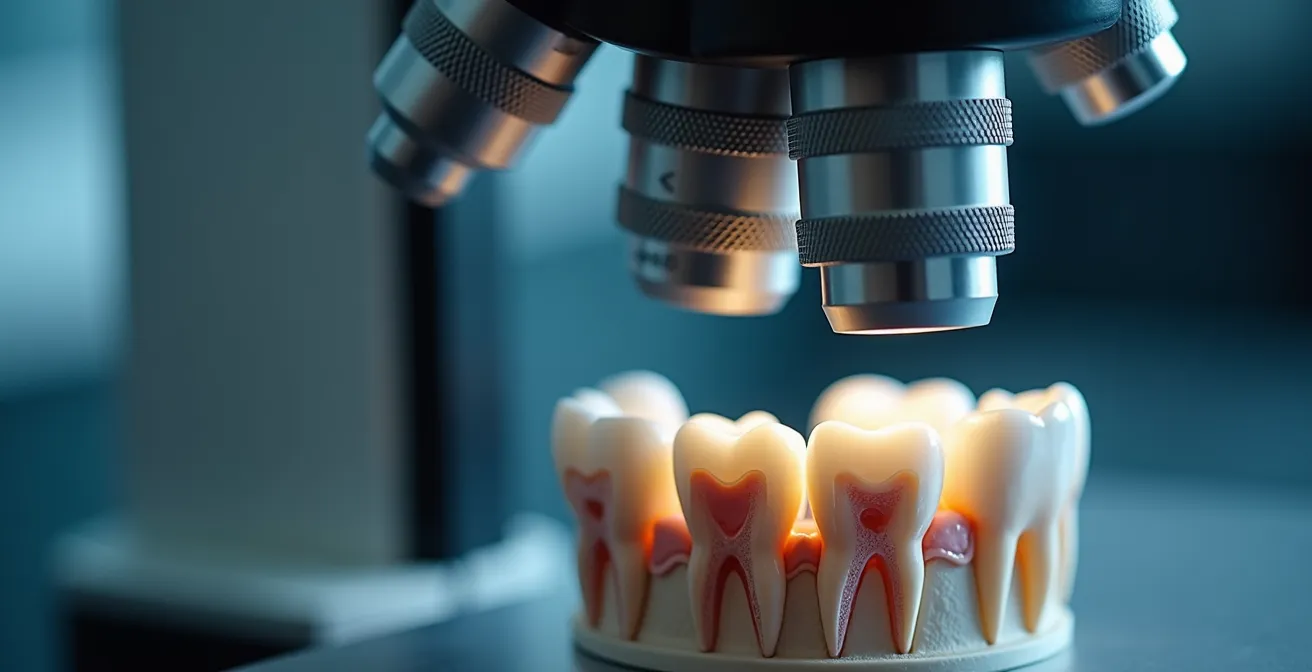
As this image suggests, the precision optics of a microscope are designed to reveal details imperceptible to the human eye. According to the American Association of Endodontists, the use of a microscope is transformative. For instance, studies show the detection rate for MB2 canals increases from 52% to 90% with microscope use. This tool also enables the specialist to identify tiny cracks and micro-fractures that could condemn the tooth, allowing for a more accurate prognosis before treatment even begins.
How to Save a Tooth That Still Hurts Years After a Root Canal?
It’s one of the most frustrating dental scenarios: you had a root canal years ago, but the tooth has started to ache again or has developed a persistent abscess. This is a classic sign of a failed root canal, and it’s a primary reason patients are referred to an endodontist. The question is, why does a root canal fail, and what can be done to save the tooth?
The most common cause of failure is an incomplete initial treatment. This often means a canal was missed—like the elusive MB2 canal mentioned earlier—or the canals were not cleaned and sealed completely to their ends. Bacteria left within this untreated space can multiply over time, leading to a new or recurring infection at the root tip. Another potential cause is a micro-fracture in the root that went undetected during the initial procedure, allowing bacteria to leak in.
A general dentist may look at a standard 2D X-ray and see nothing obviously wrong, leading them to suggest extracting the tooth and placing a costly implant. An endodontist, however, approaches this with a “salvage” mindset. They will use advanced diagnostic tools, such as a 3D CBCT scan, to get a complete view of the tooth’s root structure. This technology can reveal exactly which canal was missed or the precise location of the persistent infection.
Once the problem is identified, the solution is a procedure called endodontic retreatment. The specialist will carefully reopen the tooth, remove the old filling material, and use the microscope and specialized instruments to locate and thoroughly clean the missed canal or infected area. They then disinfect the entire system and seal it with new, biocompatible material. While root canal retreatment is more complex than an initial treatment, in the hands of a specialist, it has a very high success rate and is almost always preferable to extraction.
Why Modern Endodontic Treatment Is Often More Relaxing Than a Filling?
The term “root canal” is often associated with fear and anxiety, but this reputation is largely outdated. In fact, many patients who see an endodontist report that the experience was surprisingly comfortable—often more so than getting a simple filling at a general practice. There are specific, tangible reasons for this, rooted in the specialist’s environment and workflow.
First is the concept of procedural efficiency. As endodontist Dr. Binoy Paul notes, “an endodontist performs the same procedure multiple times a day, leading to a smooth, efficient workflow.” This repetition builds a level of mastery and speed that is impossible to achieve in a general practice where a dentist switches between fillings, cleanings, and crowns. This focused expertise means the procedure is typically completed in a single visit, is faster, and involves less time with your mouth open.
Furthermore, the endodontic clinic is designed for one purpose. The tools, the dental assistants, and the technology are all optimized for root canal therapy. This creates a calm, controlled, and predictable environment. There are fewer distractions, and the entire team functions as a highly specialized unit. This specialized atmosphere is often cited by patients as a key factor in their comfort.
Patients frequently report that modern endodontic treatment with a specialist is surprisingly comfortable. Many describe the specialized environment – designed exclusively for root canals with optimized tools, teams, and workflows – as creating a calmer, more controlled experience than the busy atmosphere of a general practice handling multiple different procedures simultaneously.
– Patient experience with specialist endodontic care, Dr. Sonia Chopra’s Blog
Finally, endodontists are experts in managing pain. They are highly skilled in profound local anesthesia techniques to ensure the tooth is completely numb before they begin. The combination of a predictable, efficient procedure and expert pain management transforms a feared treatment into a relaxed and positive experience.
Apicoectomy: What Is It and When Is It Your Last Chance to Save a Tooth?
In some cases, even a perfectly executed root canal retreatment may not resolve an infection. This can happen if the infection at the very tip of the root (the apex) is particularly persistent or if the anatomy of the root tip is inaccessible from inside the tooth. When this occurs, there is still one final option to save the tooth before considering extraction: an apicoectomy, or root-end surgery.
An apicoectomy is a microsurgical procedure performed by an endodontist or oral surgeon. Instead of accessing the infection through the crown of the tooth, the specialist makes a small incision in the gum tissue to directly access the infected root tip. Under the surgical microscope, the endodontist removes the very end of the root, cleans out the infected tissue, and places a small, biocompatible filling to seal the canal from the end. This “last resort procedure” effectively removes the source of the infection that couldn’t be reached from within.
This is a highly specialized procedure that falls squarely outside the realm of general dentistry. It requires a surgical suite, microsurgical instruments, and a deep understanding of root-end anatomy. While it may sound intimidating, it’s a routine procedure for an endodontist that is often completed in 60-90 minutes. Thanks to modern techniques, modern apicoectomies achieve success rates exceeding 90%, making it an excellent and reliable way to save a natural tooth.

The specialized, sterile environment shown here is crucial for the success of microsurgical procedures like an apicoectomy. For patients in Montreal considering this option, the process is well-defined and coordinated between the specialist and your general dentist.
Your Action Plan: The Montreal Apicoectomy Journey
- Specialist Referral & Diagnosis: Your general dentist provides a referral. The endodontist performs a CBCT scan to precisely map the infection and plan the surgery.
- Microsurgical Procedure: The apicoectomy is performed in the endodontist’s surgical suite under local anesthesia.
- Recovery & Medication: A recovery period of 3-7 days is typical, managed with prescribed anti-inflammatory and pain medications.
- Healing Follow-Up: You will have follow-up appointments with the endodontist to monitor bone healing around the treated root.
- Final Restoration Coordination: Once healing is confirmed, the endodontist coordinates with your general dentist for any necessary final restoration, such as a crown.
Why Can’t Your General Dentist Do That Calcified Molar Root Canal?
One of the most technically demanding challenges in dentistry is treating a tooth with calcified canals. Over time, due to age, trauma, or deep fillings, the pulp space inside a tooth’s roots can narrow and harden, becoming partially or fully blocked with calcified tissue. When a tooth like this becomes infected, performing a root canal is exceptionally difficult and risky.
A general dentist, working with standard instruments and limited visibility, faces an enormous challenge. Attempting to navigate a calcified canal without specialized equipment can easily lead to procedural errors, such as creating a ledge that blocks further access or, worse, perforating the side of the root. Both of these errors can render the tooth unsalvageable. This is a clear instance where the limitations of general practice are absolute.
An endodontist, on the other hand, is equipped specifically for this scenario. The difference in approach is best captured by this analogy from an endodontic specialist:
A calcified canal is like a tunnel that has collapsed. A general dentist has a map of where the tunnel should be, but an endodontist has the specialized sonic equipment and cameras to carefully re-open the path.
– Endodontic Specialist, Oral Health Group
The “specialized sonic equipment” refers to ultrasonic instruments. These tools use high-frequency vibrations to selectively and carefully chip away the calcification, reopening the path of the original canal without damaging the surrounding root structure. This is all done under the constant, high-magnification view of the surgical microscope.
Case Study: Ultrasonic Technology for Navigating Calcified Canals
Advanced endodontic practices utilize ultrasonic instruments with high-frequency vibrations to selectively remove calcification from blocked canals. This technology, rarely used for this purpose in general dentistry, allows specialists to navigate even severely calcified molars that would otherwise be considered untreatable. The combination of operating microscopes and ultrasonic tips has revolutionized the treatment of calcified cases, preventing procedural errors like perforation or ledging that could render teeth unsalvageable.
Is a 3D Dental Scan Necessary for Routine Implant Surgery?
While the title of this section mentions implant surgery, the most critical use of a 3D dental scan, or Cone Beam Computed Tomography (CBCT), in this context is for deciding whether an implant is necessary at all. The CBCT scan is a cornerstone of the “diagnostic divide” between general dentistry and endodontics, representing a philosophical difference: the focus on tooth preservation versus tooth replacement.
A standard 2D X-ray is a flat image that superimposes all the structures of your tooth and bone. It’s useful, but it has significant limitations. It cannot reveal hidden canals, the true extent of an infection in three dimensions, or the presence of a vertical root fracture. A CBCT scan, however, creates a 3D model of your tooth, allowing the endodontist to rotate it, view it in slices, and diagnose problems with absolute certainty.
In Montreal, a CBCT scan is not covered by RAMQ and can cost between $200 and $400. While this may seem like an added expense, this investment can save you thousands of dollars. It provides the definitive answer to the question: “Can this tooth be saved?” By confirming the presence of a treatable missed canal or ruling out a terminal fracture, the CBCT prevents a patient from undergoing a costly extraction and implant procedure for a tooth that could have been preserved through endodontic retreatment or apicoectomy.
The table below highlights the different goals an endodontist and an implantologist have when using the same technology. This distinction is crucial for you, the patient, to understand.
| Specialist | CBCT Purpose | Primary Goal | Key Findings |
|---|---|---|---|
| Endodontist | Find hidden canals, diagnose micro-fractures, assess infection extent | PRESERVE natural tooth | Reveals MB2 canals, vertical fractures, treatment planning for complex cases |
| Implantologist | Measure bone density, plan implant placement angle | REPLACE missing tooth | Determines bone volume, proximity to vital structures, optimal implant size |
Why Are Americans Traveling to Montreal for Major Dental Work?
A compelling testament to the quality and value of specialized dental care in Montreal is the growing trend of dental tourism, particularly from the Northeastern United States. While patients travel for various procedures, complex endodontic work is a significant driver. This phenomenon underscores two key points for a local patient: the exceptionally high standard of care available in the city and the excellent value it represents.
The primary motivator is, of course, cost. The fees for specialized dental work in the U.S. can be prohibitive. A complex procedure can be performed in Montreal by an equally qualified, and often more experienced, specialist for a fraction of the price. For example, a recent analysis shows that an endodontic retreatment that costs $4,000 USD in Boston can be performed for approximately $2,500 CAD ($1,850 USD) in Montreal. This significant cost saving, even after factoring in travel, makes the trip worthwhile.
However, this is not a story about cheap dentistry; it’s a story about high-value, world-class care. American patients are not seeking discount clinics; they are seeking top-tier specialists who happen to practice in a market with more reasonable fee structures. This influx of cross-border patients is proof of the city’s reputation for dental excellence.
Case Study: Montreal’s Endodontic Excellence Attracting Cross-Border Patients
Montreal endodontists like Dr. Pierre Pizem, with over 30 years of experience and advanced microscope-assisted techniques, demonstrate why the city has become a destination for complex dental care. The combination of specialists trained at the University of Montreal, state-of-the-art equipment like Zeiss Opmi PRO Ergo microscopes, and certification by the Royal College of Dentists of Canada ensures standards that match or exceed those in the US, while offering significant cost savings for American patients from the Northeast.
For a Montreal resident, this trend should be deeply reassuring. It confirms that the specialists you are being referred to are operating at an international standard of excellence, providing care that people are willing to cross borders to receive. You have access to this level of expertise right in your own city.
Key Takeaways
- The decision to see an endodontist is based on a real technological and diagnostic gap, not just preference.
- Specialist tools like surgical microscopes and 3D CBCT scans are essential for diagnosing and treating complex cases (missed canals, calcification, fractures) that lead to failed root canals.
- The endodontist’s primary philosophy is “tooth salvage,” using every available technique to save your natural tooth, which is almost always preferable to extraction and replacement with an implant.
How to Save a Tooth That Still Hurts Years After a Root Canal?
We’ve explored the technology, the procedures, and the philosophy that separates a general dentist from an endodontist. Now, we return to the most important question: what does this mean for you and your tooth that still hurts? It means you have options, and you have the right to advocate for a specialist’s opinion. The pain you’re feeling is a signal that something from the initial treatment was incomplete, and a specialist has the specific tools to find out what that is.
Choosing to see an endodontist is an investment in your natural dentition. While the upfront cost for a specialist is higher than for a generalist, it must be weighed against the alternative: extraction, a bone graft, a surgical implant placement, and a crown. This multi-step replacement process is significantly more expensive, more invasive, and more time-consuming than saving your natural tooth with an endodontic specialist.
Your role as the patient is to be empowered with this knowledge. When faced with a complex diagnosis, a failing root canal, or a recommendation for extraction, you have the right to ask, “Could an endodontist save this tooth?” You can and should request a referral to get a second opinion from someone whose entire career is dedicated to answering that exact question. A good general dentist will support this request, understanding that collaborating with a specialist is in your best interest.
Ultimately, saving a tooth that hurts years after a root canal is a collaborative effort. It requires your advocacy and the unparalleled expertise of an endodontist who can navigate the complex micro-anatomy of your tooth to bring it back to health. Don’t accept extraction as the only answer until you’ve explored every possibility to save what you have.
If you are experiencing persistent pain or have been told you need a complex root canal or an extraction, take the next step. Ask your general dentist for a referral to a certified endodontist for a comprehensive evaluation.
Frequently Asked Questions About 3D Dental Scans and Endodontics
Is CBCT covered by RAMQ in Quebec?
CBCT scans are not covered by RAMQ and typically cost $200-400 in Montreal, but this investment can save thousands by confirming whether a tooth can be saved through retreatment rather than requiring extraction and implant.
When does an endodontist recommend CBCT over regular X-rays?
Endodontists recommend CBCT for complex cases with unclear diagnosis, suspected MB2 canals, potential root fractures, or when deciding between saving a tooth or proceeding with extraction.
How does radiation exposure compare to traditional dental X-rays?
Modern CBCT delivers focused radiation with significantly less exposure than medical CT scans, equivalent to about 2-3 days of natural background radiation.