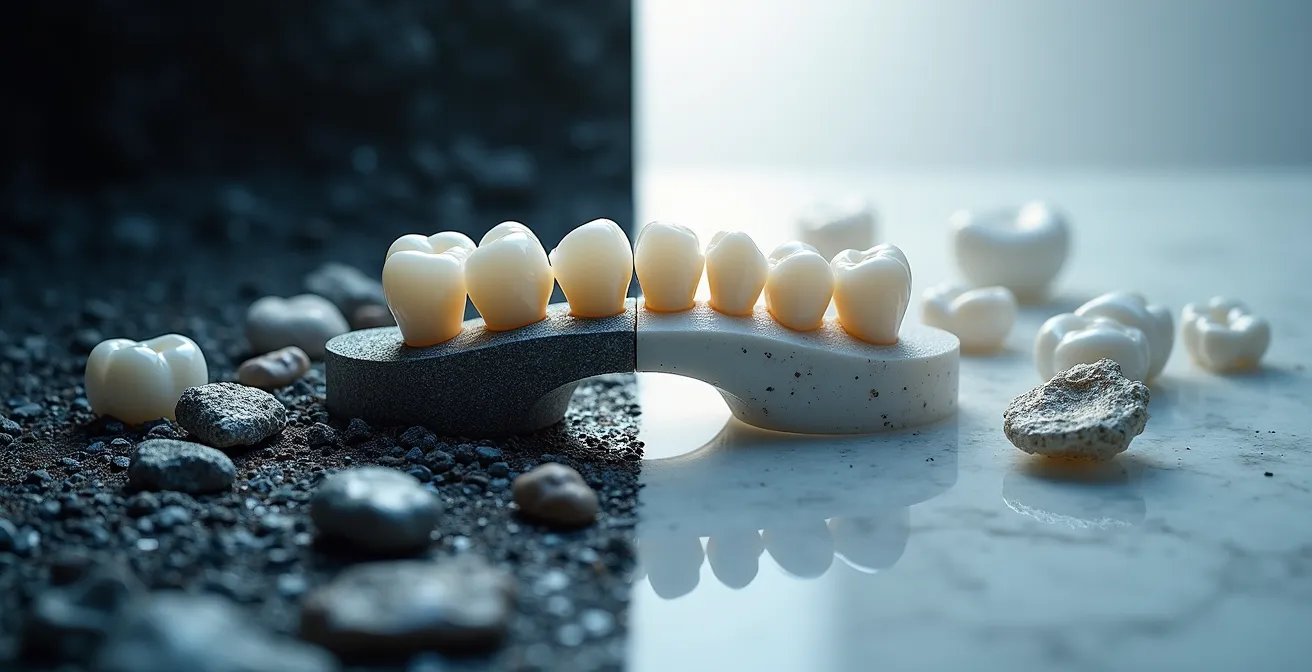
Overcoming the overwhelm of full-mouth reconstruction is possible by reframing it as a structured architectural project for your health, not an endless series of dental appointments.
- Phased planning allows for manageable financial investment and recovery periods.
- Restoring your bite is the foundational step that ensures long-term function and facial support.
- High-quality temporary restorations act as a functional and aesthetic prototype for your final smile.
Recommendation: Begin with a comprehensive diagnostic phase to create a personalized “functional blueprint” that will guide every subsequent step of your treatment.
The thought of fixing every single tooth can feel like standing at the base of a mountain with no clear path to the summit. Patients in Montreal facing a collapsed bite, terminal dentition, or extensive wear often feel a paralyzing sense of overwhelm. You hear about complex procedures, significant costs, and long timelines, which can make the first step seem impossible. The conversation often revolves around individual components like crowns, veneers, or implants, but rarely addresses the most critical question: how do you orchestrate it all?
But what if you approached this journey not as a series of disconnected treatments, but as a meticulously managed architectural project? The key isn’t just fixing teeth; it’s rebuilding a functional system. The true starting point is to adopt the mindset of a master planner. This requires a shift in perspective—from focusing on the problems to architecting the solution. It involves creating a strategic blueprint that addresses the structure, function, aesthetics, and even the psychological journey of transformation.
This guide provides that blueprint. We will deconstruct the mountain into a series of manageable, logical steps. We will explore how to phase the treatment to align with your budget and lifestyle, understand why the foundation of your bite is paramount, see what to expect during the transitional phases, and learn how to protect your final result. This is your strategic plan for rebuilding not just a smile, but a new foundation for your overall well-being.
Summary: A Strategic Guide to Full-Mouth Reconstruction
- How to Spread Full-Mouth Reconstruction Over 2 or 3 Years?
- Why Raising Your Bite Can Make Your Face Look 10 Years Younger?
- What Will You Wear While Waiting for the Final Porcelain?
- How to Handle the Psychological Shift of a New Smile?
- Why a Night Guard Is Mandatory After Full-Mouth Rehab?
- How to Restore Chewing Function When You Have Multiple Worn Down Teeth?
- Is the “Teeth in a Day” Promise Reality or Marketing Hype?
- How to Spread Full-Mouth Reconstruction Over 2 or 3 Years?
How to Spread Full-Mouth Reconstruction Over 2 or 3 Years?
The single greatest barrier for many patients considering a full-mouth reconstruction is the perceived monolithic cost and time commitment. The solution lies in strategic phasing. Approaching your treatment as a multi-year project transforms an overwhelming expense into a series of planned, manageable investments. This is the cornerstone of effective “treatment architecture,” giving you control over the financial and logistical aspects of your care.
Phasing isn’t about cutting corners; it’s about intelligent sequencing. The process is broken down into logical stages, each with its own objective, timeline, and budget. This allows for healing and adaptation between major steps and can be particularly advantageous for maximizing dental insurance benefits, as you may utilize multiple benefit years to cover different stages of the treatment. This method contrasts sharply with a consolidated approach where everything is done at once, which requires a significant upfront financial outlay and a concentrated, intense recovery period.
This table illustrates the strategic advantages of breaking down the project, making it a more practical and less daunting endeavor for patients in Montreal and beyond.
| Aspect | Phased Treatment | Consolidated Approach |
|---|---|---|
| Financial Impact | Divided into affordable, practical segments | Full payment upfront |
| Recovery Time | Distributed over years | Concentrated recovery period |
| Insurance Coverage | May utilize multiple benefit years | Single benefit period |
| Flexibility | Can adjust plan based on response | Fixed treatment schedule |
Ultimately, a phased approach provides the flexibility to ensure every detail is attended to, allowing you to proceed with confidence at a pace that works for you. It turns the financial mountain into a series of manageable hills.
Why Raising Your Bite Can Make Your Face Look 10 Years Younger?
Before considering the aesthetics of individual teeth, a master planner must first re-establish the architectural foundation of the face: the vertical dimension of occlusion (VDO). Years of grinding, wear, or tooth loss can cause the bite to “collapse,” leading to a decrease in the distance between the nose and chin. This seemingly small change has a dramatic impact on facial aesthetics, contributing to a prematurely aged appearance. A shortened lower face can cause cheeks to sink, jowls to form, and deep wrinkles to appear around the mouth.
Restoring the VDO is like performing a non-surgical facelift. By carefully rebuilding the height of the teeth with crowns or other restorations, we re-establish the natural proportions of the lower third of the face. This provides crucial support for the lips, cheeks, and surrounding soft tissues. Studies show that even a 3-5mm increase in vertical dimension can dramatically reduce the appearance of wrinkles, define the jawline, and create a more youthful, balanced facial profile. This foundational step is the essence of a functional blueprint; it ensures the entire structure is sound before the final details are added.

As you can see, this isn’t merely about teeth; it’s about rebuilding the underlying framework that supports your entire facial structure. The result is a smile that not only functions correctly but also restores a natural, harmonious aesthetic to the whole face. This is where true facial rejuvenation begins, creating a result that is both beautiful and biomechanically stable for the long term.
What Will You Wear While Waiting for the Final Porcelain?
A common anxiety in a multi-year reconstruction plan is the “in-between” phase. Will you be left with gaps or unsightly teeth while waiting for the final restorations? The answer is a definitive no. This transitional period is a critical part of the architectural process, involving the use of high-quality provisional (temporary) restorations. These are not just placeholders; they are a functional and aesthetic prototype of your new smile.
Crafted by skilled technicians in specialized Montreal dental labs, these provisionals serve several vital purposes. First, they allow you to “test drive” the new bite, shape, and position of your teeth. Any necessary adjustments to your functional blueprint can be made at this stage, ensuring the final porcelain restorations are perfect. Second, they protect the underlying prepared teeth. Most importantly, they provide a beautiful, confident smile, allowing you to eat, speak, and socialize normally throughout the entire treatment process. You never have to “hide” your smile.
Living with provisionals requires some care, but it is straightforward. A gradual reintroduction to harder foods is recommended, and meticulous hygiene is essential to ensure the underlying tissues remain healthy. Following these simple guidelines ensures a smooth journey to your final, permanent smile.
Living with Provisional Restorations: Practical Guidelines
- Start with soft foods like rice, yogurt, and porridge in the first few days, then gradually introduce harder foods as healing progresses.
- Clean provisional teeth with a soft toothbrush and antimicrobial mouthwash for the first week to protect healing gums.
- Use interdental brushes or a water flosser to carefully remove any food debris from between the provisional teeth.
- Rest well during the initial recovery days, as proper healing prevents complications and ensures the best long-term outcome.
- Avoid extremely hard or sticky foods (e.g., hard nuts, taffy) to prevent dislodging or damaging the temporaries.
This prototyping phase is an indispensable part of a well-managed reconstruction, ensuring both comfort and a predictable, successful final outcome.
How to Handle the Psychological Shift of a New Smile?
The transformation of a full-mouth reconstruction is more than just a physical change; it’s a profound psychological event. For years, you may have hidden your smile, avoided certain social situations, or felt self-conscious about your appearance. Reclaiming a healthy, beautiful smile can be an incredibly emotional and liberating experience, but it also requires a period of adjustment. This “psychological onboarding” is a planned and supported part of your treatment journey.
Suddenly seeing a new person in the mirror can be startling. It takes time for your brain to recalibrate its self-image to match the new reflection. This is a positive shift, but a shift nonetheless. A key part of the process at leading Montreal clinics is building a trusting relationship where these concerns can be openly discussed. Your treatment planner’s role is not just to manage the clinical steps but also to guide you through this personal transformation, ensuring the final result aligns with your goals and expectations.
This journey is about rediscovering confidence. As one team of experts notes, the impact goes far beyond the physical teeth. As the New York Smile Institute Team states in their “Full Mouth Restoration Patient Outcomes”:
Patients frequently report improved self-esteem, greater confidence, and a renewed sense of well-being after their smile transformation. Rebuilding a healthy, attractive smile often has a profound psychological impact.
– New York Smile Institute Team, Full Mouth Restoration Patient Outcomes
Embracing this change is the final step in the architectural project—learning to live confidently within the beautiful new structure you have built. Allowing yourself the grace to adapt is as important as any clinical procedure.
Why a Night Guard Is Mandatory After Full-Mouth Rehab?
After completing a full-mouth reconstruction, you have made a significant investment in your health, function, and appearance. Protecting that investment is not optional; it is a mandatory part of the long-term success plan. The single most important tool for this protection is a custom-fabricated night guard. Think of it as the essential “durability engineering” that ensures your new dental architecture withstands the test of time.
The forces of nighttime grinding or clenching (bruxism) are immense and can be destructive to natural teeth and porcelain restorations alike. Even if you are not aware of grinding, most people experience some level of nocturnal parafunction. A night guard acts as a protective cushion, absorbing and distributing these powerful forces away from your new crowns, veneers, and implants. It prevents chipping, fractures, and excessive wear on the very restorations you have just invested in. Considering the $30,000-$90,000 average investment for full-mouth reconstruction in Canada, a night guard is the most cost-effective insurance policy you can have.
Many top Montreal clinics, including those like Dr. Mirmooji’s, make night guard use a condition of their warranty on ceramic work. It is a non-negotiable component of post-treatment care because it is clinically proven to be the best defense against the primary cause of late-stage restoration failure. Wearing it diligently every night is a simple habit that ensures your beautifully restored smile remains healthy, functional, and intact for decades to come.
How to Restore Chewing Function When You Have Multiple Worn Down Teeth?
The ultimate goal of any full-mouth reconstruction is not just a beautiful smile, but the restoration of comfortable, efficient chewing function. When multiple teeth are worn down, the entire system is compromised. The solution lies in a two-part approach: rebuilding with the right materials and systematically re-adapting to their use. The choice of materials like zirconia and e-max porcelain is critical. These modern ceramics offer a combination of immense strength to withstand chewing forces and aesthetics that mimic natural tooth enamel.
Once the new restorations are in place, your mouth needs time to relearn how to chew effectively. The process is a gradual reintroduction to different food textures, allowing the jaw muscles, joints, and newly integrated implants to adapt. This structured approach prevents overloading the new system and builds confidence with every meal. It is a journey from soft, easy-to-manage foods back to a full, unrestricted diet.
The final goal is to return to a normal, enjoyable diet without a second thought. For a Montrealer, that might mean confidently biting into a St-Viateur bagel or enjoying a classic smoked meat sandwich. This timeline provides a tangible, hopeful path from a compromised state to complete functional freedom.
Your Action Plan: Auditing Your Current Chewing Capacity
- Identify Limitations: Make a list of all the foods you currently avoid or find difficult to eat. Are they hard, chewy, or tough?
- Pinpoint Discomfort: Note where you feel discomfort when chewing. Is it a specific tooth, a joint, or general muscle fatigue?
- Assess Efficiency: Do you find yourself chewing exclusively on one side of your mouth? How long does it take you to eat a normal meal?
- Document Changes: Have you noticed any changes in your digestion that might be related to not chewing your food thoroughly?
- Define Your Goal: List 3-5 foods you would love to be able to eat again without pain or difficulty. This becomes a key objective for your treatment plan.
By following a progressive plan, patients consistently report being able to eat everything they once enjoyed, confirming the successful restoration of their core chewing function.
Is the “Teeth in a Day” Promise Reality or Marketing Hype?
The “Teeth in a Day” concept, often associated with All-on-4 treatments, is one of the most heavily marketed ideas in modern dentistry. It promises an immediate, full-arch set of teeth on the same day as implant surgery. From a treatment planner’s perspective, it’s crucial to separate the marketing promise from the clinical reality. While the procedure is a powerful option for the right candidate, it is not a universal magic bullet.
“Teeth in a Day” is a real procedure, but the teeth you receive on day one are a temporary, fixed prosthesis made of a high-quality acrylic. They look and feel great, allowing you to leave the surgery with a full smile. However, this is not the final product. This initial set is designed for the 3-6 month healing period while the titanium implants fuse with your jawbone (a process called osseointegration). Once healing is complete and the implants are confirmed to be stable, a new, stronger, and more detailed permanent prosthesis is fabricated from more durable materials like zirconia or porcelain.
The key is understanding that “Teeth in a Day” is a protocol for immediate loading, not an instant final result. It carries a higher risk than the traditional phased approach if bone quality is poor or if post-operative instructions are not followed. Therefore, strict patient selection is paramount to its success. It represents a potential “fast-track” construction method, but one that requires a very solid foundation.
| Factor | Immediate Loading (Teeth in a Day) | Traditional Phased Approach |
|---|---|---|
| Initial Result | Temporary dental prosthesis placed immediately | Healing period before prosthesis |
| Final Restoration | New permanent prosthesis after implants fuse to bone | Permanent prosthesis after confirmed integration |
| Risk Level | Higher risk if poor bone quality | Lower risk with healing verification |
| Patient Selection | Strict candidacy requirements | Broader patient eligibility |
This approach can be life-changing for eligible patients, but a thorough assessment by your Montreal specialist is essential to determine if it is the right strategic choice for your specific clinical situation.
Key Takeaways
- Phasing Is Control: Spreading treatment over time makes it financially and logistically manageable.
- Bite Is Foundation: Restoring the vertical dimension is the architectural first step for function and facial aesthetics.
- Provisionals Are Prototypes: High-quality temporaries allow you to test drive your new smile and ensure a predictable final result.
- Protection Is Mandatory: A night guard is non-negotiable insurance to protect your long-term investment.
How to Spread Full-Mouth Reconstruction Over 2 or 3 Years?
Now that we’ve established the strategic and financial benefits of phasing, let’s look at a concrete clinical and logistical blueprint. How does a 2- or 3-year plan actually unfold? A well-structured reconstruction follows a logical sequence, ensuring each step builds upon a solid foundation. This is not an arbitrary timeline; it’s a clinical pathway designed for optimal healing, integration, and predictability.
The entire project is typically divided into three primary phases, each lasting approximately one year. This timeline can be adjusted based on individual healing responses and specific clinical needs, but it provides a clear and reliable roadmap for the journey ahead. The goal is to ensure that by the end of the process, every detail has been meticulously attended to, and the patient fully understands and is comfortable with every stage of their transformation.
This phased clinical timeline demonstrates how the architectural project is built from the ground up, moving from foundational stability to structural reconstruction and, finally, to aesthetic perfection.
A 3-Year Phased Treatment Timeline
- Year 1: The Diagnostic and Foundational Phase. This year is dedicated to creating the blueprint. It involves a comprehensive examination, 3D imaging, and addressing any underlying health issues. Foundational treatments such as periodontal (gum) therapy or necessary extractions are completed to create a healthy base for reconstruction.
- Year 2: The Structural Reconstruction Phase. With the foundation stable, this phase focuses on rebuilding the core structure. This typically involves the placement of dental implants. A critical healing period follows, allowing the implants to fully integrate with the bone, creating a solid anchor for the final teeth.
- Year 3: The Final Aesthetic Phase. This is the year where the final vision comes to life. Once the implants are fully integrated, the master-crafted final porcelain crowns, bridges, or veneers are designed and permanently placed. This phase focuses on perfecting the bite, function, and final aesthetic details of your new smile.
This structured, multi-year approach demystifies the process, providing a clear, step-by-step path to a completely restored and functional smile.
With a clear blueprint in hand, the next logical step is to schedule a comprehensive diagnostic consultation. This initial assessment is where your personalized architectural plan will be created, turning the overwhelming mountain into a clear and achievable path forward.
Frequently Asked Questions about Full-Mouth Reconstruction
What exactly happens on surgery day?
Surgery day is preceded by a comprehensive assessment which includes a review of your medical history, intraoral scans, dental impressions, a bone density check, and 3D X-rays. This data is used to create a detailed map of your bone structure, allowing for precise planning of the procedure.
Is the prosthesis truly permanent on day one?
No. For “Teeth in a Day” procedures, patients receive a high-quality temporary prosthesis at the time of implant placement. A new, stronger, permanent prosthesis is custom-made after the implants have fully fused to the bone, which typically takes several months.
What are the long-term success rates?
The long-term success of full-mouth reconstruction is very high but depends heavily on factors like the patient’s original bone quality, strict compliance with post-operative care, and adherence to proper maintenance protocols established by your Montreal specialist, including regular check-ups and night guard use.