
The city-wide shift from silver to white fillings isn’t just about aesthetics or mercury; it’s a fundamental change in dental philosophy toward preserving your natural tooth for a lifetime.
- Modern composite materials allow for minimally invasive techniques, meaning less drilling and more of your healthy tooth structure is saved.
- Unlike metal fillings that act as a wedge, composites bond with the tooth, reinforcing its structure and reducing the risk of future fractures.
Recommendation: Ask your Montreal dentist not just about the material, but about their approach to “biomimetic” and “minimally invasive” dentistry for your long-term health.
For decades, the glint of a silver amalgam filling was a common sight. If you have one, you might be wondering if it’s time for a change, or perhaps your dentist has recommended a white composite resin for a new cavity. The conversation often revolves around two familiar points: aesthetics and the presence of mercury in amalgam. While it’s true that tooth-coloured fillings are visually superior and the debate around mercury continues, these points only scratch the surface of a much deeper transformation happening in dental practices across Montreal.
This isn’t merely a trend or a simple material swap. The move towards composite resins represents a profound shift in the very philosophy of dental care. We’re moving away from a mechanical model of “drilling and filling” towards a more biological and conservative approach known as biomimetic dentistry. The goal is no longer just to patch a hole, but to replicate the natural form and function of the tooth, preserving its structural integrity for years to come. This modern standard of care prioritizes saving every possible micron of your healthy tooth structure.
This guide will walk you through the practical and philosophical reasons behind this evolution in dental standards. We’ll explore how modern materials create invisible restorations, why they require less drilling, and how they truly compare in longevity. We’ll also tackle practical concerns specific to Montrealers, from post-procedure sensitivity during our cold winters to the realities of Quebec’s dental insurance landscape.
To help you navigate this important topic, this article breaks down the key questions patients have about the transition from amalgam to composite fillings. Here is a look at what we will cover.
Summary: The Shift to Modern Composite Restorations
- How to Make Your Front Tooth Filling Completely Invisible in Natural Light?
- Why Do Composite Fillings Require Less Drilling Than Metal Ones?
- Composite vs. Amalgam: Which Material Actually Lasts Longer for Molars?
- Why Does Your Tooth Feel Sensitive to Cold Days After a White Filling?
- Are Composite Fillings Fully Covered by Quebec Dental Insurance Plans?
- Can You Really Get a Permanent Crown in 2 Hours?
- Can You Heal a Cavity at Home Before It Needs a Filling?
- Are Composite Fillings Fully Covered by Quebec Dental Insurance Plans?
How to Make Your Front Tooth Filling Completely Invisible in Natural Light?
The most immediately obvious benefit of composite resin is its aesthetic superiority, a factor driving a global market expected to reach USD 1.9 billion by 2033. For front teeth, this is non-negotiable. Unlike the stark, metallic appearance of amalgam, composite fillings are designed to be indistinguishable from natural enamel. This isn’t achieved by chance; it’s a result of advanced material science and a high degree of clinical artistry. Modern dentists in Montreal don’t just use one shade of white. They use a multi-layering technique, applying different shades and opacities of composite to mimic the natural translucency and depth of a real tooth.
A natural tooth isn’t a single, flat colour. The main body (dentin) is more opaque and yellowish, while the outer layer (enamel) is more translucent, especially at the biting edge. To create a truly invisible filling, your dentist will artistically rebuild these layers. A more opaque layer is placed deeper inside the tooth, followed by more translucent layers towards the surface. This meticulous process allows the filling to catch and reflect light in exactly the same way as the surrounding tooth structure, making the restoration disappear in any lighting condition, from indoor office lighting to bright, natural sunlight.
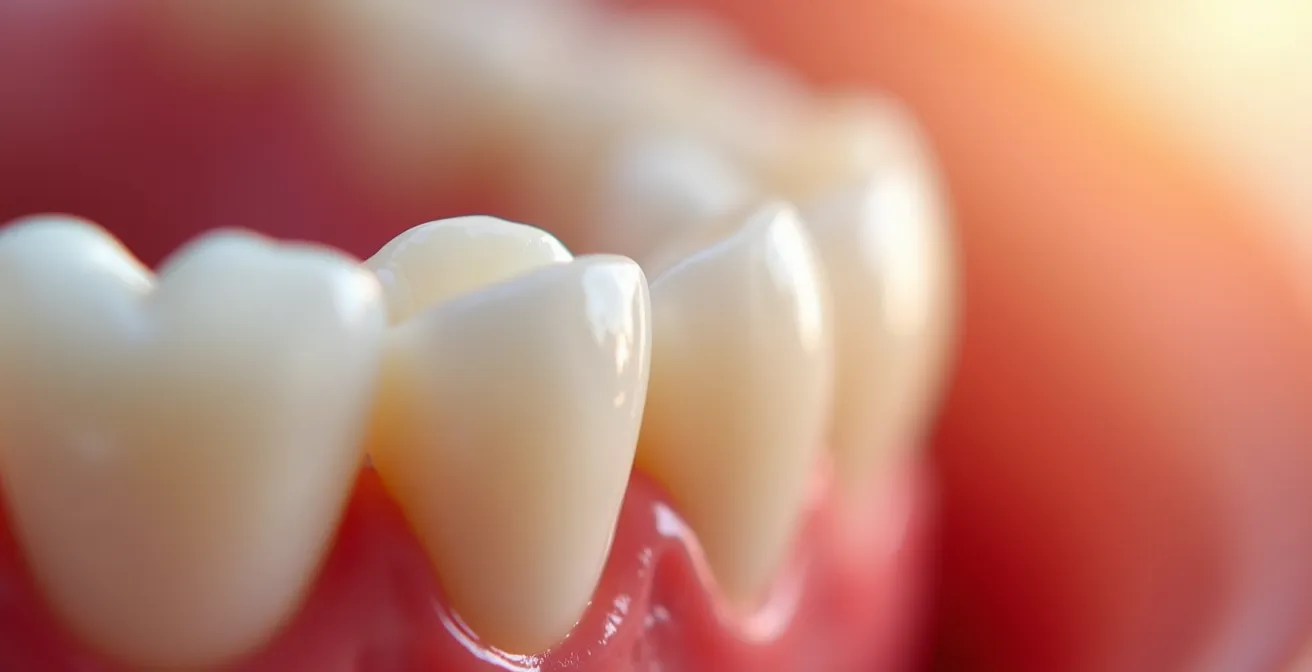
As you can see, the goal of modern cosmetic dentistry is not just to fill a space but to restore the tooth to its original, seamless beauty. Because the composite material is so versatile, it can be closely matched to the precise colour of your existing teeth, making it the ideal choice for any visible areas of the mouth. This is the essence of biomimetic restoration: mimicking nature so perfectly that the repair becomes invisible.
Why Do Composite Fillings Require Less Drilling Than Metal Ones?
The core difference between amalgam and composite fillings lies in how they are secured to the tooth. This difference is the very reason composite restorations are central to the philosophy of minimally invasive dentistry. An amalgam filling is a metal alloy that is essentially packed and wedged into a prepared cavity. For it to stay in place, the dentist must create a specific shape with undercuts, which often requires the removal of healthy, unaffected tooth structure just to ensure mechanical retention.
In addition, because of the way amalgam fillings are placed, some healthy tooth structure must be removed during the treatment. With composite fillings, on the other hand, dentists are able to remove very little of the tooth. This allows the tooth to retain more of its natural structure and strength.
– Wilkinson Dental, Amalgam vs. Composite Fillings
Composite resin, however, works through a completely different mechanism: adhesive technology. The material is chemically bonded directly to the tooth’s enamel and dentin. This means the dentist only needs to remove the decayed or damaged portion of the tooth. There is no need to drill away extra healthy structure to create a mechanical lock. By preserving more of the natural tooth, its inherent strength and integrity are maintained, reducing the risk of fractures down the line. This conservative approach is not just a technique; it’s a commitment to the long-term health of your tooth.
Your Action Plan for a Minimally Invasive Filling
- Identify the Issue: Work with your dentist to pinpoint all areas of decay or aesthetic concern using modern diagnostic tools like digital X-rays and intraoral cameras.
- Assess the Canvas: Your dentist will inventory the existing healthy tooth structure to determine how much can and should be preserved during the procedure.
- Align with Philosophy: Discuss treatment options (e.g., composite vs. other materials) and how they align with the goal of minimal intervention and long-term preservation.
- Evaluate Long-Term Strength: Analyze which approach will best reinforce the tooth’s natural structure, considering the forces of biting and chewing.
- Define the Action Plan: Confirm the steps for the most conservative and durable restoration, ensuring you understand the “why” behind the chosen procedure.
Composite vs. Amalgam: Which Material Actually Lasts Longer for Molars?
The question of longevity is one of the most debated topics when comparing amalgam and composite. Historically, amalgam has been known for its durability, especially on molars that endure heavy chewing forces. However, the definition of “lasting longer” is more nuanced than a simple number of years. It’s crucial to consider not just the lifespan of the filling itself, but its long-term effect on the tooth’s structural integrity.
A comprehensive analysis by CADTH, a Canadian health technology agency, confirms that amalgam restorations have a longer life and cost less initially. However, the way these fillings fail is a critical distinction. Amalgam, being a metal, expands and contracts with temperature changes at a different rate than the tooth. This can create stress over time, leading to cracks and, ultimately, a catastrophic tooth fracture that may require a crown or even extraction.
| Material | Average Lifespan | Failure Mode | Cost Analysis |
|---|---|---|---|
| Amalgam | 10-15 years | Tooth fracture (catastrophic) | Lower initial cost, may require crown later |
| Composite Resin | 5-10 years | Chipping/wear (repairable) | Higher initial cost, often repairable |
| Bulk-Fill Composites | Approaching amalgam longevity | Similar to standard composite | Premium pricing |
Composite fillings, on the other hand, tend to fail by chipping or wearing down at the surface. While their average lifespan may be shorter, these failures are often easily repairable by simply adding new composite to the worn area, without having to replace the entire filling. This repairability, combined with the material’s ability to reinforce the tooth, presents a different kind of long-term value. With advancements in materials like bulk-fill composites, the longevity gap is closing rapidly, offering a solution that is both durable and preserves the tooth’s structure.
Why Does Your Tooth Feel Sensitive to Cold Days After a White Filling?
It’s a common scenario for Montrealers: you get a new white filling, and a few days later, a sip of iced coffee or a gust of frigid winter air sends a sharp, brief pain through your tooth. This post-operative sensitivity is one of the most frequent concerns with composite fillings. While alarming, it’s usually temporary and is a known side effect of the adhesive process itself. The primary cause is a phenomenon called polymerization shrinkage. As the composite material is hardened layer by layer with a special UV light, it shrinks on a microscopic level.
This tiny amount of shrinkage can create a minuscule gap between the filling and the tooth wall, or it can place stress on the tooth’s nerve (the pulp). This can leave the microscopic tubules within the tooth’s dentin layer exposed, making them sensitive to temperature changes. Your dentist uses specialized techniques and bonding agents to minimize this effect, but a mild, transient sensitivity to cold for a few days to a couple of weeks is considered normal. In contrast, amalgam fillings can cause more long-term issues, as they constantly expand and contract with temperature, potentially leading to cracks over time.

The key is to monitor the sensitivity. If it’s severe, lasts longer than a few weeks, or if the tooth hurts when you bite down, you should contact your dentist immediately. This could indicate that the filling is slightly too high and needs a simple adjustment. In most cases, however, the sensitivity will gradually fade as the tooth’s pulp calms down and adapts to the new restoration.
Are Composite Fillings Fully Covered by Quebec Dental Insurance Plans?
This is a critical question for any patient in Quebec. The financial aspect of dental care is a significant consideration, especially in a system where public coverage is limited for adults. In Canada, total dental spending reached $13.6 billion, with the private sector accounting for $12.7 billion of that. This highlights how heavily most Canadians, including Montrealers, rely on private insurance plans.
First, let’s address the public plan. The Régie de l’assurance maladie du Québec (RAMQ) provides dental coverage primarily for children under 10 and recipients of social assistance. For most other adults, RAMQ coverage for fillings is virtually non-existent. This means the vast majority of patients must turn to their private, employer-sponsored, or individually purchased dental insurance plans.
Here’s where it gets complicated. While most private plans cover fillings, the extent of that coverage for composites varies widely. Given that a composite filling can cost between $200 and $400, compared to $150 to $250 for an amalgam filling, the details of your plan matter. Some plans may cover composites at a high percentage (e.g., 80-90%), while others might cover them at a lower rate than amalgam or apply a specific clause we’ll discuss later. It is essential to check your plan’s details regarding annual maximums, deductibles, and co-payments.
Can You Really Get a Permanent Crown in 2 Hours?
While this article focuses on fillings, the same philosophy of advanced, efficient care extends to more extensive restorations like crowns. The days of multiple appointments, messy impressions, and temporary crowns are quickly becoming a thing of the past for many Montreal dental clinics. Thanks to CAD/CAM technology, most famously known by the brand name CEREC (Chairside Economical Restoration of Esthetic Ceramics), it is now entirely possible to get a permanent, custom-made ceramic crown in a single visit.
This technology revolutionizes the patient experience. Instead of a physical impression, your dentist uses a digital scanner to create a precise 3D model of your tooth. This model is then sent to an in-office milling machine that carves your permanent crown from a solid block of high-quality ceramic in about 15-20 minutes. Your dentist can then custom-stain and glaze it to perfectly match your other teeth before permanently cementing it in place. The entire process, from preparation to final placement, can often be completed in about two hours.
The benefits are clear: it saves you time, eliminates the discomfort of a temporary crown, and provides a highly accurate and durable final restoration. As one Montreal clinic notes, with this technology, “patients have the option to walk into their dental appointment and leave with a new smile on the same day.” The process is a seamless integration of digital design and precision manufacturing, right in the dental office.
- Digital Scanning: A 3D camera takes a precise digital impression of the prepared tooth, eliminating the need for messy putty.
- CAD/CAM Design: Your dentist designs the custom crown on a computer, ensuring a perfect fit and bite.
- In-Office Milling: The design is sent to a milling unit that carves the crown from a block of tooth-coloured ceramic.
- Custom Finishing: The crown is stained and glazed to match the natural appearance of your other teeth.
- Final Cementation: The permanent crown is bonded to your tooth, completing the restoration in a single visit.
Can You Heal a Cavity at Home Before It Needs a Filling?
With dental caries affecting an estimated 2.3 billion people worldwide, prevention is the cornerstone of modern dentistry. This leads to a common and hopeful question: is it possible to reverse a cavity before a filling becomes necessary? The answer is a qualified “yes,” but it depends entirely on the stage of the cavity.
A cavity doesn’t appear overnight. It begins with a process called demineralization, where acids produced by bacteria start to leach minerals from the tooth’s enamel. The very first sign of this is often a “white spot lesion”—a chalky, white area on the tooth. At this initial stage, the process is reversible. This is where at-home care and preventive treatments are most powerful. The tooth can be “healed” through a process called remineralization.
This involves several key actions:
- Excellent Oral Hygiene: Meticulous brushing and flossing to remove the bacterial plaque that produces acid.
- Fluoride Application: Using fluoride toothpaste, rinses, or receiving professional fluoride treatments from your dentist. Fluoride helps to attract minerals like calcium and phosphate back into the enamel, rebuilding and strengthening it.
- Dietary Changes: Reducing the frequency of sugar and acid intake to give your teeth a chance to recover between meals.
However, once the demineralization process breaks through the enamel surface and creates a physical hole or cavity, it is no longer reversible at home. At that point, the damaged structure is lost, and a filling is required to remove the decay, seal the tooth, and restore its function. The key is to catch it early.
Key Takeaways
- The switch to composite fillings is driven by a modern dental philosophy of minimal invasion and long-term tooth preservation, not just aesthetics.
- Composite fillings bond to the tooth, reinforcing its natural structure, while amalgam acts as a wedge that can increase fracture risk over time.
- While amalgam may last longer, composite failures are often repairable, representing a different kind of long-term value that prioritizes saving the tooth.
Are Composite Fillings Fully Covered by Quebec Dental Insurance Plans?
Continuing our discussion on insurance, understanding the fine print of your private plan in Quebec is essential. Even if your plan covers composite fillings, there is a common clause that every patient should be aware of: the “Least Expensive Alternative Treatment” (LEAT) clause. This is a frequent feature in many Canadian dental plans.
The LEAT clause means that if there are multiple valid treatment options for a dental issue, the insurance company will only reimburse for the least expensive one. In the context of fillings for a back tooth, amalgam is almost always the cheaper option. Therefore, under a plan with a LEAT clause, the insurance will cover the composite filling but only up to the equivalent cost of an amalgam filling. The patient is then responsible for paying the difference out-of-pocket. For example, if an amalgam costs $200 and a composite costs $350, your insurance might reimburse 80% of the $200 amalgam fee, leaving you to cover the remaining 20% plus the full $150 difference.
This is why it’s crucial to request a pre-determination of benefits from your dentist’s office before proceeding with treatment. They will submit the proposed treatment plan to your insurance company, which will respond with a detailed breakdown of what they will cover. This eliminates surprises and allows you to make a fully informed financial decision that balances the best clinical option with your budget. The modern dental practice is a partner in navigating this, prioritizing both your oral health and your financial clarity.
The best first step is to schedule a consultation with your dentist to discuss your specific oral health, review your old fillings, and get a clear, personalized plan that aligns with both modern dental standards and your financial situation.
Frequently Asked Questions About Composite Fillings
Why does my tooth hurt after a composite filling?
Mild, temporary sensitivity to cold is common after a composite filling. This is due to “polymerization shrinkage,” where the material shrinks microscopically as it hardens, which can irritate the tooth’s nerve. This usually subsides within a few days to a couple of weeks.
What causes polymerization shrinkage?
The composite material shrinks microscopically as it hardens under the UV light used by your dentist. This is a natural property of the material. Dentists use special techniques, like placing the filling in small layers, to minimize this shrinkage and reduce post-operative sensitivity.
When should I contact my dentist about sensitivity?
You should contact your dentist if you experience any persistent sensitivity that doesn’t improve after two weeks, if the pain is severe, or if you feel pain when you bite down. This could mean a simple adjustment to your bite is needed, which can provide immediate relief.