Attempting to remove tartar at home with a metal tool is not a risk; it is a guarantee of permanent damage to your teeth.
- Dental tartar has a mineral composition similar to concrete and forms a chemical bond with your tooth that cannot be safely broken with manual force.
- Scraping with an uncalibrated tool creates microscopic scratches on your enamel, making it a perfect breeding ground for more bacteria and future staining.
Recommendation: Abandon any consideration of DIY tartar removal. The procedure is an act of self-injury. Your only safe and effective option is a professional cleaning with a licensed dental hygienist.
The temptation is understandable. You see a small metal pick on Amazon, promising professional dental results for a fraction of the cost of a visit to the hygienist. For the DIY enthusiast in Montreal looking to save money, it seems like a logical, cost-effective solution to a persistent problem. You believe that with a steady hand and a bit of caution, you can handle it yourself. This belief is dangerously wrong.
As a safety officer in the dental wellness space, my duty is to be unequivocally clear: using one of these tools on your own teeth is not a “hack.” It is an act of self-injury. The common advice to “be careful” is negligent because it fails to address the fundamental material science at play. You are not chipping away at a simple deposit; you are attempting to break a mineralogical bond on a delicate, living surface. This is an uncontrolled procedure with a 100% chance of causing irreversible damage.
This article is not a list of suggestions. It is a safety briefing. We will dismantle the false economy of DIY tartar removal by examining the concrete-like nature of calculus, the permanent damage you will inflict on your enamel, the real costs of “saving” money on a cleaning, and why the “pain” of a professional cleaning is a manageable process, unlike the trauma you will inflict at home. Your oral health is not a weekend project.
This guide will provide a critical examination of the risks and realities of tartar management. We will cover the essential information you need to make a safe and informed decision for your health.
Summary: A Stern Look at At-Home Tartar Removal
- Why Is Tartar Like Concrete on Your Tooth Root?
- How You Can Permanently Scratch Enamel and Attract More Bacteria?
- Numbing Gel or Freeze: How to Get Through a Deep Cleaning Pain-Free?
- Why Do Your Gums Bleed During a Cleaning If the Hygienist Is Gentle?
- Why Do Some People Build Tartar in 3 Months While Others Take 12?
- Why Skipping Your $200 Hygiene Appointment Costs You $2,000 Later?
- When Should You Insist on Seeing an Endodontist Instead of a General Dentist?
- How You Can Permanently Scratch Enamel and Attract More Bacteria?
Why Is Tartar Like Concrete on Your Tooth Root?
You must first understand what you are attempting to remove. Tartar, or dental calculus, is not simply old, hardened plaque. It is a biocompatible mineral structure that has undergone a process of calcification. Think of it less like grime and more like a barnacle chemically fused to the hull of a ship. The plaque biofilm on your teeth absorbs minerals from your saliva, primarily calcium phosphate. This process transforms the soft, sticky film into a rock-hard deposit.
The mineral composition of this deposit is alarmingly similar to construction materials. An analysis shows that tartar is a complex of calcium phosphate, calcium carbonate, and magnesium phosphate. These are the very same minerals that give concrete and bone their strength and rigidity. When you take a metal pick to this substance, you are not flaking off a deposit; you are attempting to chisel a mineral that has bonded directly to the surface of your tooth root and enamel.
A professional hygienist does not use brute force. They use specialized tools, such as ultrasonic scalers, which vibrate at tens of thousands of times per second. These vibrations are precisely tuned to disrupt the chemical bond of the calculus without damaging the underlying enamel. Your hand, holding a static piece of metal, cannot replicate this. You are applying uncontrolled, blunt force to a microscopic problem, which is a recipe for catastrophic failure. The notion that tartar can simply “break off” on its own is a dangerous myth; its bond is too strong.
How You Can Permanently Scratch Enamel and Attract More Bacteria?
Your tooth enamel is the hardest substance in the human body, but it is not invincible. More importantly, it is not self-repairing. Once it is scratched, pitted, or gouged, the damage is permanent. Using a metal dental pick from Amazon is an uncontrolled abrasion experiment on your own teeth. You lack the training, the visibility, the stable fulcrum, and the properly angled instruments to perform this task safely. The result is inevitable: micro-scratches across the entire surface you touch.
This paragraph introduces a concept complex. To best understand it, it is useful to visualize its components. The illustration below breaks down this process.
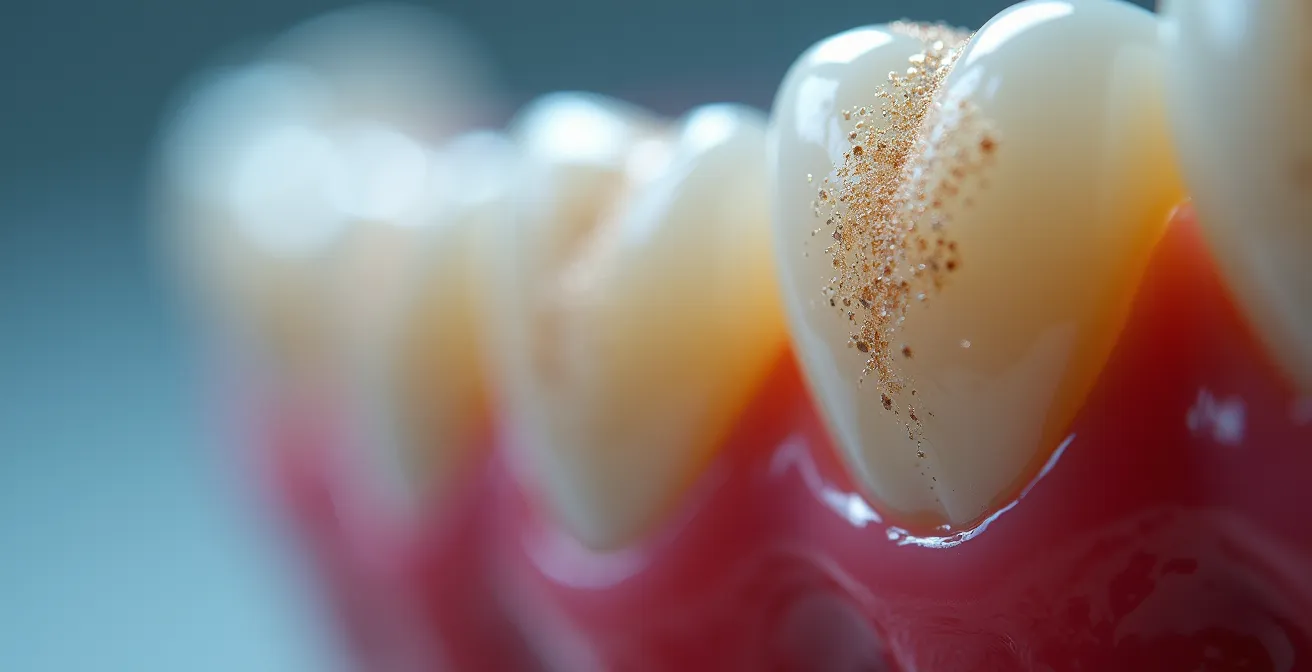
As this microscopic view demonstrates, a smooth enamel surface is your best defense against plaque. It is difficult for bacteria to adhere to a polished, glass-like surface. However, the moment you create scratches and grooves with a DIY tool, you have created a bacterial haven. These new surface imperfections are perfect colonization sites for new plaque to form, which will then mineralize into tartar even faster than before. You are creating the very problem you are trying to solve.
The consequences are not just aesthetic. This damage directly leads to increased sensitivity, as the micro-scratches can expose the underlying dentin. In fact, reports from dental institutions show that DIY methods can increase tooth sensitivity by 60-80%. You are trading a temporary cosmetic issue for permanent structural damage and chronic discomfort. This is an unacceptable risk.
Numbing Gel or Freeze: How to Get Through a Deep Cleaning Pain-Free?
A common deterrent to professional cleanings, especially deep cleanings (scaling and root planing), is the fear of pain. This is a valid concern, but one that modern dentistry in a city like Montreal is fully equipped to handle. Unlike the sharp, uncontrolled pain you can inflict on yourself at home, a professional procedure is managed. You do not have to endure discomfort. You have options, and you must advocate for them.
A professional hygienist is trained to manage your comfort. The process is systematic and designed to be as painless as possible, which stands in stark contrast to the unpredictable jabbing of a home tool. The range of options available ensures that even the most sensitive or anxious patient can undergo a deep cleaning without distress.
Action Plan: Understanding Professional Pain Management Options
- Topical Anesthetic Application: The first step is always a powerful numbing gel applied directly to the gums. This desensitizes the surface before any instruments are used.
- Computer-Assisted Anesthesia: If local anesthetic (“freezing”) is needed, many Montreal practices use systems like ‘The Wand’. This delivers the anesthetic at a slow, controlled rate, making the injection itself virtually painless.
- Advanced GBT Technology: The Guided Biofilm Therapy (GBT) system uses a warm-water spray with a fine powder to gently blast away biofilm, significantly reducing the need for traditional scraping on less tenacious deposits.
- Modern Piezon Technology: For heavy calculus, advanced ultrasonic scalers use piezoelectric technology. This breaks the tartar free with high-frequency vibrations and minimal pressure, not with painful scraping force.
- Sedation Options: For patients with high anxiety, nitrous oxide (“laughing gas”) is a safe and effective option widely available in Montreal clinics to ensure a stress-free experience.
The key takeaway is control. In a professional setting, pain is a variable that is actively managed. At home, with a sharp pick, pain is an uncontrolled certainty and a signal of tissue damage. Do not mistake the two.
Why Do Your Gums Bleed During a Cleaning If the Hygienist Is Gentle?
This is a critical point of misunderstanding. Many patients believe that if their gums bleed during a cleaning, the hygienist is being too rough. This is fundamentally incorrect. In almost all cases, the bleeding is not a sign of injury from the cleaning; it is a symptom of pre-existing inflammation being addressed. Healthy gum tissue does not bleed from gentle touch.
Your gums, or gingiva, become inflamed when plaque and tartar accumulate at and below the gumline. This condition is called gingivitis. The tissue becomes swollen, red, and engorged with blood as your body’s immune system tries to fight off the bacterial invasion. This tissue is extremely fragile. The slightest touch—whether from a toothbrush, floss, or a hygienist’s instrument—will cause it to bleed.
The bleeding you see during a cleaning is the release of this built-up fluid and a sign that the source of the inflammation—the tartar and plaque—is being removed. It is a necessary part of the healing process. As the hygienist gently and methodically debrides the tooth surface, the irritant is gone, and your body can finally begin to heal. Within days of a proper cleaning, the inflammation will subside, and the bleeding will stop. If you avoid cleaning because it causes bleeding, the underlying infection will only worsen, progressing to periodontitis and bone loss.
Consider the bleeding a diagnostic sign of a problem being solved, not created. A professional knows the difference between the bleeding of inflamed tissue and iatrogenic injury. You, with a DIY pick, do not. Any bleeding you cause is a sign of a fresh wound you have just inflicted on healthy or already-compromised tissue.
Why Do Some People Build Tartar in 3 Months While Others Take 12?
The rate of tartar buildup is not a moral failing or a simple matter of brushing technique. It is a complex issue dictated by individual biochemistry, genetics, and anatomy. Understanding your personal risk profile is essential for proper maintenance. It explains why a “one-size-fits-all” approach to hygiene is ineffective and why your friend might only need a cleaning once a year, while you require one every three to four months. The prevalence of related issues is vast, with a Canadian Academy of Periodontology survey indicating that up to 47% of North American adults experience some form of periodontal disease.
Several key factors determine your individual rate of calculus formation. Your saliva’s pH and mineral content are primary drivers. If you have a high concentration of calcium and phosphate in your saliva, you will mineralize plaque into tartar much faster. An acidic oral environment, often influenced by diet and genetics, also contributes. The following table outlines the profiles for high and low-risk individuals.
| Factor | High Risk Profile | Low Risk Profile |
|---|---|---|
| Salivary pH | Acidic (below 6.5) | Neutral/Alkaline (7.0-7.5) |
| Mineral Composition | High calcium/phosphate in saliva | Balanced mineral levels |
| Medications | Dry mouth from medications reduces saliva that helps wash away particles | Normal saliva production |
| Teeth Alignment | Crowded/misaligned teeth | Properly aligned teeth |
| Diet (Montreal specific) | High acidic coffee, sugary Tim Hortons drinks, craft beers | Balanced diet, water consumption |
Anatomical factors like crowded or misaligned teeth create “plaque traps” that are impossible to clean effectively at home, accelerating tartar formation in those areas. This is not something you can overcome with a better brushing angle; it is a structural reality. A hygienist can identify these individual factors and create a personalized recall schedule that keeps tartar under control before it becomes a major problem.
Why Skipping Your $200 Hygiene Appointment Costs You $2,000 Later?
The decision to use a DIY pick is almost always rooted in a desire to save money. This is a classic example of false economy. The perceived saving on a routine hygiene appointment is insignificant compared to the guaranteed future cost of repairing the damage you will cause or treating the disease you will allow to progress. The cost of prevention is, and always will be, exponentially lower than the cost of treatment.
In Canada, a routine professional cleaning is a predictable and relatively low expense. However, once tartar is left to accumulate below the gumline, it triggers a cascade of destructive events. The initial gingivitis progresses to periodontitis, a chronic infection that destroys the gum tissue and the underlying bone that supports your teeth. This is not a cosmetic issue; it is a degenerative disease that requires extensive and costly intervention.
Let’s examine the financial escalation. According to a detailed cost analysis of periodontal treatments in Canada, the numbers are stark. A full-mouth deep cleaning (scaling and root planing) to address the initial stage of disease can cost between CAD $760 and $1,600. If the disease progresses further due to neglect, you enter the realm of periodontal surgery. A gum graft to repair recession on a single tooth can cost CAD $800-$1,600. Flap surgery, required to clean the roots of multiple teeth, can easily reach CAD $1,200-$3,500. Advanced laser treatments like LANAP can cost upwards of CAD $14,000 for a full mouth. That initial $200 appointment fee now seems trivial.
When Should You Insist on Seeing an Endodontist Instead of a General Dentist?
Part of a robust safety protocol is knowing the limits of your care provider and when to escalate to a specialist. While your general dentist is highly skilled in a wide range of procedures, certain complex situations demand the focused expertise of an endodontist. An endodontist is a dentist who has completed additional years of specialized training focused exclusively on diagnosing tooth pain and performing root canal treatments and other procedures relating to the interior of the tooth (the pulp).
You must not hesitate to ask for a referral if you encounter specific red flags. A general dentist can handle most routine root canals, but you should insist on a referral to an endodontist in the following scenarios:
- Complex Diagnosis: If you have persistent, severe pain that is difficult to pinpoint, or pain that radiates to other areas, an endodontist has advanced diagnostic tools, such as cone-beam computed tomography (CBCT), to get a 3D view and identify the source.
- Complex Anatomy: If an X-ray reveals that the tooth in question has curved, narrow, or extra canals, the success rate is significantly higher with a specialist who works with high-magnification microscopes and specialized flexible instruments daily.
- Retreatment of a Previous Root Canal: If a previously treated tooth becomes re-infected, the procedure to redo the root canal is far more complex and should always be handled by an endodontist.
- Traumatic Injury: A cracked or dislodged tooth requires immediate and specialized assessment that falls squarely within an endodontist’s purview.
Insisting on a referral is not an insult to your general dentist; it is an act of responsible self-care. It is about ensuring the right professional with the right tools is handling a complex, high-stakes procedure. Your dentist’s goal is the same as yours: the best possible long-term outcome for your tooth. Recognizing when a specialist is needed is a sign of a good practitioner.
Key Takeaways
- DIY tartar removal with a metal pick is not a ‘risk’, it is guaranteed self-injury that causes permanent enamel damage.
- Tartar is a mineral deposit chemically bonded to your teeth, similar to concrete, and cannot be safely removed with manual force.
- The bleeding that occurs during a professional cleaning is a sign of healing pre-existing inflammation, not a sign of injury.
- Skipping a ~$200 professional cleaning leads to diseases that can cost thousands of dollars in surgical intervention to correct.
How You Can Permanently Scratch Enamel and Attract More Bacteria?
We previously established that using a DIY tool will inevitably scratch your enamel. It is now imperative to understand the long-term pathological consequences of that damage. The smooth, inorganic surface of healthy enamel is a relatively poor substrate for bacterial adhesion. But the moment you create a landscape of microscopic grooves and fissures, you have fundamentally altered the tooth’s ecosystem in favor of disease.
These new scratches become protected colonization sites for oral bacteria, particularly the strains responsible for cavities (Streptococcus mutans) and gum disease (Porphyromonas gingivalis). These bacteria can now anchor themselves deep within the grooves, shielded from the bristles of your toothbrush and the flow of saliva. Here, they can metabolize sugars and produce acid without interruption, directly eroding the already-weakened enamel.
This creates a vicious, compounding cycle of failure. The scratches you made to “clean” your teeth now act as plaque traps, leading to faster plaque accumulation. This new plaque quickly mineralizes in these protected grooves, forming new, more tenacious tartar. Your attempt to remove tartar has created the ideal conditions for more tartar to form, more rapidly, and in a way that is even harder to remove. You have not solved a problem; you have created a permanent, self-perpetuating one.
Ultimately, this leads to an increased risk of cavities and a chronic state of gingival inflammation as your body constantly tries to fight the bacterial colonies now living in the damaged enamel. This is the pathway to periodontitis and bone loss. The initial act of scratching is the first step on the road to major restorative work, like crowns, or even tooth loss.
The only logical and safe course of action is to discard any DIY tools and schedule an appointment with a licensed dental hygienist. They possess the training, tools, and expertise to remove calculus safely and effectively, preserving the integrity of your enamel and securing your long-term oral health.