You think brushing and flossing is about cleaning a surface, but it’s not. The disgusting truth is you’re in a constant war with biofilm, a smart, fortress-like bacterial sludge that rebuilds itself within hours. This article reveals its survival tactics and explains why only forceful, mechanical disruption—not rinsing—can ever win the battle for a truly clean mouth.
It’s a frustratingly familiar feeling. You leave the dental hygienist’s office in Montreal, your teeth feeling glassy, smooth, and perfectly clean. You run your tongue over them, enjoying that rare sensation of absolute purity. Yet, by the next morning, or even by the end of the day, that fuzzy, grimy film is already staging its comeback. You brush, you floss, you rinse, but it feels like a losing battle. You’re not imagining it, and it’s not because you’re doing it wrong. It’s because you’ve been taught to think about oral hygiene as simple cleaning, like wiping a countertop.
The reality is far more biological and, frankly, a bit gross. Your mouth is not a kitchen counter; it’s a thriving, complex ecosystem. The enemy isn’t just “bacteria”; it’s a highly organized, intelligent, and resilient structure called biofilm. This microscopic sludge doesn’t just sit on your teeth; it builds fortresses, communicates, and actively resists your attempts to evict it. The conventional advice to “brush and floss” is correct, but it fails to explain the vicious cycle you’re trapped in because it ignores the true nature of your opponent.
But what if you could understand the enemy’s strategy? Instead of just fighting a battle, what if you could wage a smarter war? This article will take you into the microscopic warzone of your mouth. We will dissect the shocking biology of biofilm, revealing how it forms so fast, why it’s so stubborn, and what you must do to truly disrupt its relentless cycle. It’s time to stop just “cleaning” and start dismantling.
To navigate this microscopic battlefield, we will explore the core mechanisms of biofilm, from its defensive structures to the financial cost of letting it win. This guide will arm you with the knowledge to finally gain the upper hand.
Summary: Why Plaque Is More Than Just a Film on Your Teeth
- How Bacteria Build Fortresses to Protect Themselves from Toothpaste?
- Why You Cannot Rinse Away Biofilm Without Scrubbing It First?
- How Fast Do Bacteria Turn Sugar into Acid After You Eat?
- Why Your Mouth Tastes Bad in the Morning (The Biofilm Party)?
- Why We Can’t Just Take a Pill to Kill All Cavity Bacteria?
- Why Skipping Your $200 Hygiene Appointment Costs You $2,000 Later?
- Mouthwash for Bad Breath vs. Gingivitis: Are You Using the Wrong One?
- The Unavoidable Truth: Why Scrubbing Is Your Only Weapon Against Biofilm
How Bacteria Build Fortresses to Protect Themselves from Toothpaste?
That fuzzy feeling on your teeth isn’t just a random collection of germs; it’s a meticulously constructed bacterial metropolis. When the first pioneering bacteria attach to your tooth surface, they don’t just multiply. They immediately begin to secrete a slimy, sticky substance called an extracellular polymeric substance (EPS). This isn’t just waste; it’s a sophisticated building material. This EPS matrix acts as a superglue, anchoring the colony to your enamel and forming a protective dome over them.
Think of it as a microscopic fortress. This slimy shield is what makes biofilm so resilient. It protects the bacteria inside from your saliva’s natural cleaning agents, your toothpaste’s fluoride, and even potent antimicrobial mouthwashes. In fact, research shows that bacteria in biofilms are up to 1,000 times more resistant to antimicrobials than free-floating bacteria. This is why you can’t just rinse plaque away. The fortress walls are too strong, deflecting chemical attacks and keeping the inner sanctum safe.
Inside this fortress, the bacteria thrive. The matrix contains water channels that act like a primitive circulatory system, bringing in nutrients (like the sugar from your afternoon snack) and removing waste. This organization is why plaque feels so substantial and grows so quickly. It’s not just a film; it’s a living, breathing, and alarmingly well-defended city of microbes on every tooth.
Case Study: Advanced Biofilm Removal in Montreal
To combat these fortresses, technology has evolved. At Montreal’s Dr. Slepchik clinic, they utilize Guided Biofilm Therapy (GBT). This advanced system first uses a dye to make the invisible biofilm visible. Then, instead of traditional scraping, it employs a high-tech airflow device with a specially formulated powder to literally blast the biofilm fortress off the tooth surface, demonstrating the need for powerful mechanical force to overcome biofilm’s defenses.
Why You Cannot Rinse Away Biofilm Without Scrubbing It First?
Imagine trying to clean a plate covered in dried, sticky syrup simply by holding it under a running tap. It wouldn’t work. You intuitively know you need a sponge and some elbow grease to break it up. Oral biofilm is exactly like that, but on a microscopic scale. The EPS matrix that bacteria build is incredibly adhesive, acting like a powerful bio-glue. It physically bonds the plaque to your teeth, making it immune to a simple swish of water or mouthwash.
This is where the concept of mechanical disruption becomes critical. Brushing and flossing are not just about “wiping” bacteria away; they are about physically tearing down the biofilm fortress. The bristles of your toothbrush and the friction of the floss are the tools you use to break apart the slimy EPS matrix and dislodge the bacterial colonies. Without this forceful, physical scrubbing, the biofilm remains intact, and any antimicrobial rinse you use will simply flow over the surface of the protective slime, unable to penetrate and kill the bacteria hiding within.
This paragraph introduces the complex challenge of reaching all dental surfaces. To fully grasp this, the following illustration of a professional cleaning in a Montreal setting provides a clear visual context.
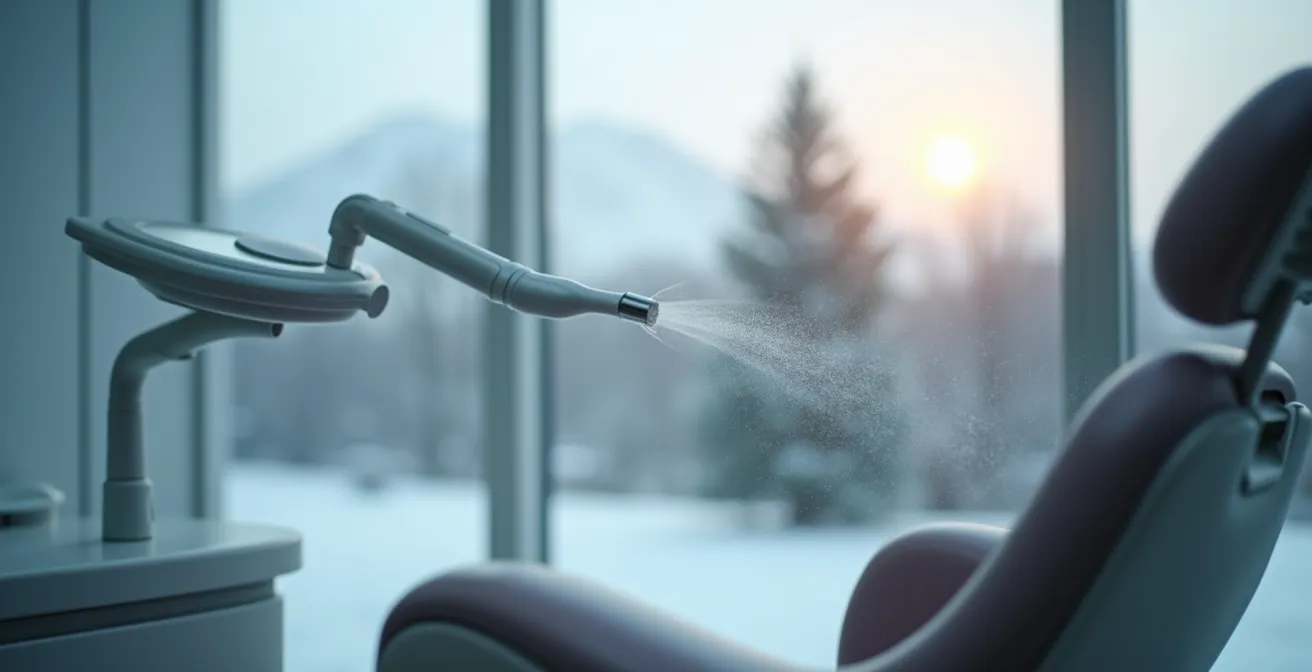
Even with diligent brushing, you’re fighting an uphill battle. Studies show that brushing alone only reaches approximately 60% of tooth area, leaving the spaces between teeth and along the gumline as safe havens for biofilm to mature. This is where professional cleanings, with tools like the ultrasonic scaler shown, become essential for total mechanical disruption.
Your Daily Biofilm Disruption Plan
- Brush Correctly, Twice Daily: Use a fluoride toothpaste and focus on the gumline where biofilm accumulates. This is your primary mechanical attack.
- Floss or Use Interdental Cleaners Daily: This is non-negotiable. It is the only way to mechanically disrupt the biofilm fortresses built between your teeth, where your brush can’t reach.
- Use an Antimicrobial Rinse (After Brushing): Use a rinse after you’ve broken up the biofilm. This allows the liquid to access and kill the now-exposed and weakened bacteria.
- Limit Sugary/Sticky Fuel: Reduce the frequency of sugary snacks. Every time you eat sugar, you’re providing construction materials and fuel to the enemy.
- Schedule Professional Cleanings: Visit your hygienist regularly in Montreal to have the hardened, mature biofilm (calculus) professionally and mechanically removed.
How Fast Do Bacteria Turn Sugar into Acid After You Eat?
The bacteria in your mouth, particularly Streptococcus mutans, are incredibly efficient sugar-to-acid factories. The process is terrifyingly fast. From the moment you take a bite of a sugary croissant or a sip of a soft drink, these bacteria get to work. They don’t just “eat” the sugar; they metabolize it through a process called glycolysis. The immediate byproduct of this feast is lactic acid. This entire conversion from sugar to acid can begin within seconds, and the pH in your mouth can plummet from a healthy neutral (around 7.0) to a dangerously acidic level (below 5.5) in as little as 5 to 10 minutes.
This is what’s known as an “acid attack.” At a pH of 5.5, your tooth enamel—the hardest substance in your body—begins to demineralize, or dissolve. The calcium and phosphate crystals that make up your enamel are literally leached out by the acid. Each sip of soda, each cookie, each sweetened coffee triggers another one of these 20-30 minute acid attacks. If you’re sipping or snacking frequently throughout the day, your teeth are living in a near-constant acid bath, never getting the chance to remineralize and repair themselves with the help of your saliva.
It’s not the amount of sugar you consume in one sitting that’s most damaging; it’s the frequency. The biofilm on your teeth acts as a reservoir, holding the sugar against the tooth surface and concentrating the acid right where it does the most harm. After a thorough cleaning, it takes only about 24 hours for this entire organized, acid-producing ecosystem to re-establish itself on your teeth, ready for the next sugar delivery.
Scientific Proof: Water Flossing vs. Rinsing
The need for mechanical removal of this sugary fuel is clear. A 2023 study published in Dentistry Journal tested a water flosser’s ability to remove sucrose (table sugar) from a biofilm model. The results were stark: after applying sugar, rinsing with a syringe left 1.75 mg/mL of sugar behind. In contrast, the mechanical action of the water flosser resulted in complete sucrose removal (0 mg/mL) and a nearly 30-fold reduction in bacterial concentration. This highlights how physical force is superior for removing the fuel that powers the acid factories.
Why Your Mouth Tastes Bad in the Morning (The Biofilm Party)?
That stale, foul taste in your mouth when you wake up—often called “morning breath”—is the direct result of the biofilm’s overnight activities. While you sleep, your saliva production drops significantly. Saliva is your mouth’s natural rinsing agent and buffer, helping to wash away food debris and neutralize acids. When its flow decreases, the oral environment becomes stagnant, creating the perfect conditions for a full-blown biofilm party.
With the lights out and the saliva flow down, the hundreds of bacterial species in your mouth go into overdrive. Anaerobic bacteria (those that thrive in low-oxygen environments) are particularly active. They feast on the leftover food particles, dead cells, and proteins trapped in the biofilm. As they digest this material, they release a cocktail of smelly waste products known as Volatile Sulfur Compounds (VSCs). These are the same compounds that give rotten eggs their characteristic stench, and they are the primary culprits behind morning breath. Essentially, your mouth tastes bad because you’re waking up to the accumulated waste of a massive, overnight bacterial banquet.
The fuzzy feeling on your teeth is the thickened biofilm itself, now engorged with bacteria and their byproducts. It’s a tangible sign that the microscopic warzone was left unguarded all night. This reinforces a crucial point made by oral health experts:
Biofilm can’t be eliminated, but it can be reduced and controlled.
– Anne O. Rice, RDH, CDP, FAAOSH, RDH Magazine
This is why brushing first thing in the morning is so important. It’s not just about fresh breath; it’s about mechanically dismantling the entire party structure that was built while you slept, clearing out the waste, and resetting the battlefield for the day.
Why We Can’t Just Take a Pill to Kill All Cavity Bacteria?
It’s a tempting thought: if bacteria cause cavities, why can’t we just develop an antibiotic pill to wipe them all out? The answer lies in the incredible complexity of your oral microbiome. Your mouth isn’t home to just one or two “bad” bacteria; molecular techniques have identified approximately 1,000 different bacterial species that can inhabit dental biofilm. More importantly, this collection of microbes is not an infection; it’s an ecosystem. And in a healthy state, it’s a balanced one.
Using a broad-spectrum antibiotic to kill cavity-causing bacteria like Streptococcus mutans would be like firebombing Montreal’s Mount Royal park to get rid of a few pesky squirrels. You’d certainly kill the squirrels, but you’d also wipe out the beneficial insects, the songbirds, the native plants, and the delicate balance that allows the park to thrive. In your mouth, many “good” bacteria play a protective role. They outcompete harmful species for resources, produce substances that inhibit pathogens, and even help with the initial stages of digestion. Carpet-bombing this ecosystem would likely lead to unintended and disastrous consequences, such as an overgrowth of even more harmful microbes, like the fungus that causes thrush (Candida albicans).
This concept is visualized in the metaphor below, comparing the oral microbiome to the balanced ecosystem of Montreal’s iconic Mount Royal.

As the image suggests, a healthy oral microbiome, like a park, is about balance and diversity, not sterility. The goal of oral hygiene isn’t to create a sterile environment, which is both impossible and undesirable. The goal is to control the ecosystem. It’s about mechanically disrupting the biofilm to prevent the harmful, acid-producing bacteria from gaining the upper hand and forming the dominant, destructive colonies that lead to cavities and gum disease. It’s a continuous act of gardening, not warfare with scorched-earth tactics.
Why Skipping Your $200 Hygiene Appointment Costs You $2,000 Later?
It can be tempting to postpone a routine hygiene appointment. In Montreal, a cleaning and check-up might seem like a discretionary expense of a couple of hundred dollars. However, viewing this as a “cost” is a financial mistake. It’s an investment, and skipping it almost guarantees much larger, more painful expenses down the road. The math is simple: prevention is exponentially cheaper than restoration.
When biofilm is not regularly and professionally disrupted, it absorbs minerals from your saliva and hardens into calculus, or tartar. This is the biofilm fortress, upgraded to solid concrete. You cannot remove calculus at home with a toothbrush or floss. As it builds up, it irritates your gums, causing inflammation (gingivitis). Left unchecked, this inflammation deepens, destroying the bone that supports your teeth (periodontitis). Now, you’ve moved from a problem requiring a $200 cleaning to one requiring deep scaling and root planing, which can cost over $1,000. If a tooth is lost, a dental implant to replace it can easily cost $4,000-$5,000. That initial $200 looks pretty good in hindsight. Similarly, an unchecked cavity that could have been a $300 filling becomes a $2,000 root canal and crown.
In Canada, these costs are escalating. With Canadian dental costs are rising by 5-10% annually due to inflation and overhead, the financial penalty for delay is only getting worse. Understanding your coverage is key, as many services are not fully covered, even with new federal plans.
The table below, based on information from the Ordre des dentistes du Québec (ODQ), shows that even basic public coverage for children doesn’t cover preventive cleanings, and private plans have limits. This data, sourced from a comprehensive fee guide from the ODQ, underscores the personal financial responsibility for preventive care.
| Coverage Type | What’s Covered | What’s Not Covered |
|---|---|---|
| RAMQ (Children under 10) | Examinations, fillings, extractions, root canals | Cleaning, plaque removal, fluoride, orthodontics |
| Private Insurance | Partial coverage with annual maximum | Portion of costs, deductibles apply |
| Canadian Dental Care Plan | Preventive services, scaling, fluoride (from 2024) | Services before coverage start date |
Mouthwash for Bad Breath vs. Gingivitis: Are You Using the Wrong One?
The mouthwash aisle is confusing. Some bottles promise icy-fresh breath, while others talk about fighting plaque and gingivitis. They are not the same thing, and using the wrong one is like using an air freshener to put out a fire. The key difference lies in their ingredients and their purpose: cosmetic versus therapeutic.
A cosmetic mouthwash is essentially a breath mint in liquid form. Its primary job is to temporarily mask bad breath (halitosis). It typically contains flavoring agents like mint and a high concentration of alcohol, which provides that initial sharp, “clean” feeling. However, it does little to nothing to address the root cause of bad breath: the VSC-producing bacteria in your biofilm. In fact, the high alcohol content can dry out your mouth, which can ironically make bad breath worse in the long run by reducing saliva flow.
A therapeutic mouthwash, on the other hand, is formulated to have a biological effect. These rinses contain active ingredients designed to kill bacteria and control gingivitis, the earliest stage of gum disease. Common ingredients include:
- Cetylpyridinium Chloride (CPC): Kills bacteria and inhibits plaque growth.
- Essential Oils (e.g., eucalyptol, menthol, thymol): Penetrate the biofilm to kill bacteria.
- Chlorhexidine Gluconate (prescription-only in Canada): A powerful antiseptic used for short-term treatment of severe gingivitis.
If you are fighting the red, swollen gums of gingivitis, you need a therapeutic rinse. If you only use a cosmetic one, you are doing nothing to stop the disease process. Plaque left undisturbed will eventually harden into calculus, a process that can take, on average, just 12 days. Once calculus forms, the problem escalates, and no mouthwash can remove it.
Key Takeaways
- Plaque is not just germs; it’s a “biofilm,” a smart, organized bacterial fortress that actively resists cleaning.
- You cannot rinse biofilm away. It must be physically destroyed through “mechanical disruption” like brushing and flossing.
- Bacteria convert sugar to tooth-dissolving acid in minutes, making snack frequency more damaging than quantity.
The Unavoidable Truth: Why Scrubbing Is Your Only Weapon Against Biofilm
We’ve journeyed into the microscopic warzone of your mouth, and the central truth has become undeniable. Your battle for oral health is not a chemical one; it is a physical one. We’ve seen how bacteria build impregnable fortresses, how they party in your mouth overnight, and how they operate as ruthlessly efficient acid factories. All these problems point to a single, unifying solution: the absolute necessity of mechanical disruption.
Hoping a mouthwash, a special diet, or even a futuristic pill will solve the problem is a fundamental misunderstanding of the enemy. Biofilm is a physical structure, a sticky, resilient sludge tenaciously glued to your teeth. The only effective strategy is to physically tear it down, day after day. Brushing is your artillery, breaking down the main walls. Flossing is your special forces, attacking the enemy strongholds between the teeth where the greatest damage is often planned. Your professional hygiene appointment is the periodic airstrike, obliterating the hardened calculus that your daily ground troops can’t handle.
Accepting this physical reality is liberating. It ends the frustrating search for a “magic bullet” and empowers you with a clear, effective strategy. The fuzzy feeling returns not because you are failing, but because the enemy is relentless, disciplined, and rebuilding its fortress every single hour. Your job is to be just as relentless and disciplined in tearing it down.
Your next step is to put this knowledge into action. Take the daily disruption plan seriously and schedule your next professional cleaning in Montreal not as a chore, but as a crucial strategic maneuver in your personal war against biofilm.
Frequently Asked Questions About Plaque and Biofilm
Do antimicrobial rinses remove plaque biofilm?
No, antimicrobial rinses do not remove existing plaque biofilm. They can kill bacteria and inhibit new growth for up to 12 hours, but the slimy biofilm matrix is extremely difficult to disrupt without the mechanical action of a toothbrush and floss.
Why doesn’t mouthwash alone prevent plaque?
Using mouthwash without brushing is like applying antibacterial ointment to a dirty wound without cleaning it first. It’s ineffective. Brushing and flossing physically disrupt and remove the bulk of the plaque; the rinse then kills the remaining disorganized bacteria and helps create an environment less favorable for new growth.
Can diet prevent plaque formation?
No, you cannot completely prevent plaque formation through diet. It is a naturally occurring process that happens regardless of what you eat or drink. Biofilm must be mechanically removed through regular brushing, flossing, and even the abrasive action of chewing certain foods.